Showing posts with label politics. Show all posts

Saturday, January 24, 2015

Thomas Struth: Striving for the big picture

Review by Tim Connor


As a photography student at Kunstakademie Düsseldorf in the 1970s, Thomas Struth learned to create big, highly detailed pictures with his classmates – now photographic luminaries -- Andreas Gursky, Thomas Ruff and Candida Hofer. At the time their teachers, the legendary husband-wife team, Bernd and Hilla Becher, taught a technically rigorous system to “objectively” document disappearing German architecture. According to the Becher system, subjects must be captured serially with a large-format camera using black-and-white film under a cloudless sky. All subjects must be shot from uniform distances and heights, printed with medium contrast at a prescribed size and shown together to facilitate comparison.

In his current show at the Met we see Struth’s homage to this exacting style -- a wall-sized grid of black-and-white prints showing well-known New York City intersections in 1978. Older New Yorkers may treasure or rue these pictures as memories, but the more salient point is that, soon enough, nobody will be alive to remember them. Still, there is much to admire in the way the pictures treat, not only the streets and buildings , but everything -- every parked car, overloaded trash can and  random walking-through-the-shot human -- with exactly the same crisp, non-judgmental clarity.

CrosbyStSoho1978_struth
"Crosby Street, Soho, 1978," Thomas Struth, All rights reserved
This is Struth’s first major project.  Afterward, his career moves on fast. Without abandoning the discipline and technique he has acquired from the Bechers, he begins to take on large ideas and issues. It is his willingness to do so that animates this show.

In the 80s Struth continues to shoot architecture and landscapes.  Like his schoolmate Gursky, he takes up color and begins to use photoshop to assemble from multiple viewpoints single images of large locations and structures. But, unlike Gursky, who over the years steadily creates more and more gigantic prints of larger and larger events, (the Chicago Board of Trade, the Olympics)  Struth’s big pictures seem uninterested in spectacle. Gursky wins worldwide acclaim by moving farther and farther away from what he photographs. Struth moves closer. His pictures, though still large and complex, become more and more about the people present or implied within the frame.  They radiate emotion that can be felt by anyone.

These qualities are best seen in the pictures the Met has collected from Struth’s three ongoing series – roughly titled, “Museum,” “Paradise” and “Technology.”

Struth’s “Museum” series comes from a simple idea. He photographs people looking at art and history in museums all over the world. Strictly realistic, rendered in sumptuous colors, these large, calm compositions at times resemble the Old Master paintings that appear in many of the prints. Yet the unrehearsed modern tourist crowds are always there too. Some museum-goers are reverent. Some are playing with their iphones and thinking about their lunch. They bring a  here-and-now immediacy to pictures meant to last. 

MuseumStruth
"Art Institute of Chicago,1990," Thomas Struth, All rights reserved
struthbigMuseum
"Museo Del Prado 7, 2005," Thomas Struth, All rights reserved

The balance between large ideas – the present and the past, the material and the spiritual, for example – makes me wonder if Struth is aiming for the cusp between them? Or do his museum pictures – like many of the old religion-based paintings depicted within them –incline toward moral lessons? If so, the messages are hard to recognize, extremely subtle. Yet the question continues to rise.

Asked about the Museum series, Struth said “… the ineffable spills into the ordinary and the spiritual aspirations of our ancestors intersect with the needs of the present.” It’s clear that with these works Struth is gesturing toward something beyond their quotidian content. In fact – like every artist -- he is imbuing lifeless materials with human energy. Where does that energy come from?

We get to decide for ourselves.

One thing I think we know.  In the Museum series the goal of this energy is no longer the same as it is in the old paintings. Unlike the paintings, the energy of the photographs is not directed at individual salvation.  We might think of its heaven as salvation for all.

familyofartistsretouchersTStruth
"Art Restorers at San Lorenzo Maggiore, Naples, Italy, 1988," Thomas Struth


I think this becomes clear in Struth’s Paradise series. Photographed at ground level in various rainforests in Japan, Australia and South America, all the images in the series are called “paradise” and numbered.  Only one, “Paradise 13, Yakushima, Japan 1999,” is included in the show.  Yet, from this picture and others I have seen elsewhere, “paradise” seems a very odd title for Struth to have chosen.
“Paradise 13,” for example, is shot deep inside a low, wet, dark forest strewn with fallen trees and moss-covered boulders. It is certainly no Eden. Struth is well-known as an ardent environmentalist, and it’s hard to imagine him resorting to cheap irony. Some of the other forest “interiors” in this series are tangles of dazzling green, flooded with transforming light. They are beautiful to look at and, as we know, vital to the health of our planet.
 But – come to think of it – real rainforests are always unrestrained riots of hungry competitive life. They are always difficult for humans. Struth is making a difficult point. Our human instinct is to transform them to meet our needs. But the Earth too needs salvation.

Paradise17-TStruth
"Paradise 13," Thomas Struth

thomas-struth-growth-09-690x568
 "Paradise 9," Thomas Struth, All rights reserved

With the “Technology” series, Struth asks: Does the human genius for technology threaten our species? Does technology also offer hope? These too are ultimately spiritual questions.

 Struth’s “Hot Rolling Mill, Thysen Krupp Steel, Duisburg, 2010,” takes us into the silent interior of a gigantic industrial machine. By choosing an old German steel mill and associating it with the name Krupp, Struth is deliberately evoking Hitler’s Third Reich and the murderous weapons with which Germany came close to conquering the world. And the picture itself -- a vast brutal wall of machinery in semi-darkness, grime-encrusted, its khaki greens punctuated with the faded, reds and oranges of catwalks and cables -- is indeed terrifying. Even worse, a thick chain is bolted to the steel-plate floor in the only area lit by a window. It took bravery to make this picture. Struth knows exactly what he is alluding to. 
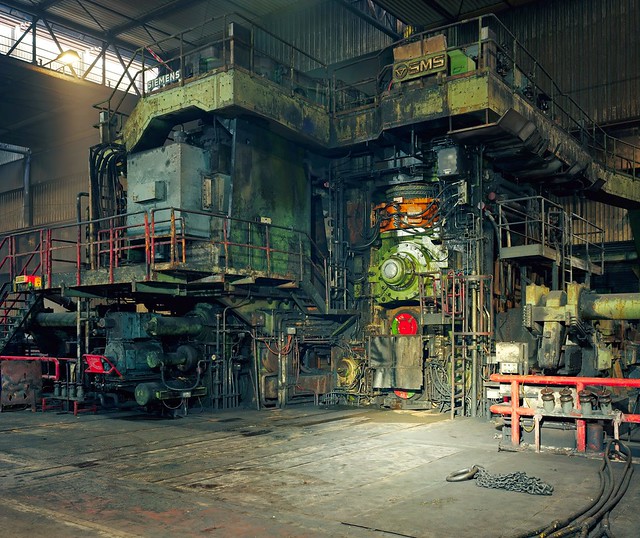
5. Hot Rolling Mill,ThyssenKrupp Steel, Duisburg_Thomas Struth
"Hot Rolling Mill, Thysen Krupp Steel, Duisburg, 2010," Thomas Struth

If “Hot Rolling Mill” balances past and present, the most astonishing picture in the Technology series presents itself literally as a fulcrum between present and future.   Called “Figure 2, Charite, 2013,” the picture shows a woman strapped to a medical gurney suspended in mid air. Looping in from piled machines and monitors are dozens of wires, tubes and cables, all of which attach to her body. At first, we recoil from the image. It seems to be a Frankenstein-like experiment or perhaps some hideous torture. Then we notice that the room is spotless, the light is clear and the woman is young and blonde with beautiful skin.  We are confused. What are we looking at?
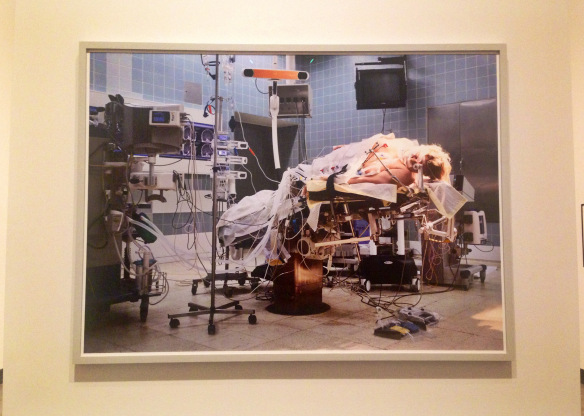
Figure2,Charite, 2013
"Figure 2, Charite, 2013," Thomas Struth, All rights reserved

It’s an operating theater in Berlin, where this anaesthesized young woman is about to undergo surgery to remove a brain tumor. With the woman’s full permission, Struth has photographed the moment before the doctors and nurses enter to begin. We learn in a caption that the woman survived and, two years, later is living comfortably. Still, we wouldn’t know that if we hadn’t been told. Is Struth intentionally frightening us with scary technology that is actually built and used to save lives?

I don’t think so. I think he is making full use of his freedom to challenge us.  Some things that at first seem repellent are beautiful. Struth’s mentors, the Bechers, photographed water towers, silos and blast furnaces they judged beautiful – and safe to photograph – in a defeated, divided Germany after a vicious war.  Now, more than a half century later, Struth again finds beauty in our still dangerous and increasingly complicated – but perhaps freer – world.  He makes big pictures for the world.

This review appears in The New York Photo Review


Monday, January 20, 2014

The arc of war


"Marines, Korean War," David Duncan, All rights reserved

I remember the first war photograph that got to me. I must have been about 11. It was a picture by David Douglas Duncan in an old Life Magazine of two U.S. Marines, heads ducked down, rifles in their hands, running toward a battle in Korea. The first Marine wore his helmet at a rakish angle and sported a pencil-thin mustache like the young Ernest Hemingway. As he raced past the camera toward possible death, he managed a grim, tiny smile. I was smitten.

I think most, if not all, boys are drawn to fantasies of war. For me Duncan’s picture lit up visions of nonchalant courage and noble sacrifice that were already present in my adolescent consciousness. Later, I learned the photo was an honest depiction. Far from a propagandist, Duncan, an ex-Marine, had covered World War II, then the Korean War –always from the perspective of the troops in the field. Shooting in Vietnam, he had turned against the war and published two photo books — I Protest (1968) and War Without Heroes (1970).

Such attitudes – for or against war — are studiously avoided in “War/Photography: Images of Armed Conflict and its Aftermath” at the Brooklyn Museum. Sprawled across multiple panels, this large, ambitious collection presents over 400 pictures by 255 photographers from over a dozen nations. The curators declare their intention to explore “the general progression – the arc – of every war ” and divide the pictures into sections on “recruitment, training, embarkation, daily routine, battle, death and destruction, homecoming, and remembrance.” The exhibit covers an astonishing 166 years worth of wars — from the Mexican American War (1846-1848) to the recent conflicts associated with the Arab Spring (2010).


"Drill sergeant, Parris Island," Thomas Hoepker, All rights reserved

The curator’s scholarly approach is very good at putting to rest contentious myths about certain well-known photographs. For instance, was the World War II shot of American soldiers raising the flag on Mount Suribachi at Iwo Jima a spontaneous action or premeditated propaganda? It turns out it was a little of both. The flag-raising captured by Joe Rosenthal’s iconic photo was improvised as a way to signal to thousands of troops still fighting on the island below that the mountain had been taken. However, it wasn’t the first flag that had been raised that day. A smaller flag in a less visible spot had been hoisted (and photographed) a short time earlier. The one that became world-famous was a replacement, and, yes, homeland PR was a big part of the reason.

In fact, propaganda (sometimes just natural bias) can be found in pictures from all sides in this show. Famous American photographers like Margaret Bourke-White and Edward Steichen, for example, did their bit for the war effort in World War II by creating beautiful compositions of grand battleships in naval processions and sleek fighter planes taking off, accompanied by the cheers of onlooking troops. It’s hard to fault the photographers’ intentions. That was their job, after all, and, in time of war, they obviously wanted to make their country look good. It is only while looking at pictures of the pulverized landscapes and shattered human bodies these graceful machines can leave behind that one remembers their murderous purpose.

"Untitled," Wesley David Archer, All rights reserved


Easier to classify, if not to forgive, are the fabricators. Before small cameras, fast films and Photoshop, fakes were harder to create than today–– but they were also easier to get away with. In World War I, for instance, a man named Wesley David Archer produced a mesmerizing shot of a war plane in flames with its pilot falling below it through space. The plane’s wings bear the Iron Cross, which would make the pilot German. How marvelous! There was only one problem: Archer had created and photographed the whole scene in his studio as part of a money-making scam. Later, he went on to become a well-known model-maker in Hollywood.

"Valentine with her daughters, Amelie and Inez, Rwanda, 2006," Jonathan C Torgovnik, All rights reserved

Such dishonesty (certainly at the level of posing or on-scene cropping) will always exist in photography, but, to my mind, the most important pictures in this show represent a relentless visual boring at the truth about the real experience of war. This body of pictures has been building up since photographers like Robert Capa began carrying small, versatile cameras to the war zones of the 1930s. It continued through the appalling horror and mega death of World War II and Korea, but it wasn’t until the Vietnam War that truly disturbing images became widely available in the United States. With the publication of Eddie Adam’s photograph of South Vietnam’s National Chief of Police summarily executing a Viet Cong guerilla in 1968 and Nick Ut’s 1972 shot of napalmed Vietnamese children running in agony down a road, the floodgates finally opened. Included in the show are incomparable images by Don McCullin, Horst Faas, Larry Burrows and others, widely credited with helping to end the war.
"Assault with helicopters, Vietnam," Horst Faas, All rights reserved
Today many of us are privileged – and, if we read newspapers and use the internet, even compelled — to look at truly painful color photographs of both combatants and victims from the world’s far-flung conflicts. As this show demonstrates, a steady flow of war images by a loose multinational corps of male and female freelancers is now a given. Surprisingly free from allegiance to ideologies or nationalistic prejudices, most of these pictures honor and grieve both civilian and military suffering. At their most provocative they even open chinks of compassion for the others – the enemies who fight against and try to kill our loved ones.
"Viet Cong soldier, Vietnam," Don McCullin, All rights reserved
Let me give an example. A 10-foot-long full color image from Afghanistan by French photographer Luc Delahaye shows a very young man lying dead in a shallow, dusty pit. He is wearing a thin cotton shirt beneath an empty ammunition vest, baggy pajama-like pants and dusty black socks. His legs are neatly folded like a well-behaved boy. Indeed, if not for the small wound in his neck, he could almost be a gangly post-adolescent boy taking a nap. Then we notice something. He is wearing socks. But where are his boots? Stolen, we realize.Who is this abandoned and desecrated boy?
Delahaye tells us in a single word: “Taliban.”
If I had looked at this picture when I was 11, I would have turned away confused and upset. That’s good.

Sunday, June 24, 2012

Roger Mayne: You say you want a revolution...


maynemanconducting415
"Man and  boy," Roger Mayne, All rights reserved

Now 83, Roger Mayne is a Brit who made his name photographing in working class slums in London and other British cities in the 1950s and 60s. Shooting in black-and-white with a small camera, he worked exclusively in a few chosen streets, which he visited over and over, becoming well-known enough to be ignored. Mayne describes his approach as “…visual rather than storytelling” and himself as “… a documentary rather than a journalistic photographer.” This seems right. His best pictures, though deeply grounded in a specific time and place, are Cartier-Bresson-like “decisive moments,” presented in universal human terms.
In his pictures Mayne’s sympathies are clear, but , ironically, his elegant high-contrast shots often take their power from the very scarcity that makes poor people poor.  For instance, Mayne frequently makes use of the clean converging lines of an empty street and identical flats to give depth to foreground figures.  With no cars or buses, no fruit stands, not even trash bins to clutter the view, these stripped-down black-and-white vistas have an undeniable graphic appeal (Bill Brandt used the same trick).  But, in fact , no stuff means no money -- poverty.  These neighborhoods are economically depressed.  Should they be aesthetically pleasing?
In this show Mayne’s  principal subjects are children and adolescents . American viewers will think immediately of Helen Levitt, who, during the same period, similarly turned her lens toward children at play in the poor sections of New York City. At that time, before TV had conquered everything, neighborhood streets in both British and U.S. cities functioned as public living rooms and playgrounds.  Both Mayne and Levitt saw the visual opportunities and treated the communal street as a stage on which anything could happen. Yet, looking at the two bodies of work, the British and American streets come across very differently. Was it that the two cultures were that different? Or did the two photographers see the street life of their subjects in fundamentally different ways?

helen-levitt415
"Boys playing, NYC," Helen Levitt, All rights reserved

Many of Levitt’s New York pictures, for instance, have a wild, anarchic edge never glimpsed in Mayne’s work.  Her children at play in Hell’s Kitchen or Harlem are making up the rules as they go along, broadcasting chaos and sometimes violence (along with joy) into cityscapes boiling with conflict. It’s possible that Levitt was only able to capture these moments because she was willing to shoot like a stranger – sometimes more like a spy – gladly tolerating suspicion and ostracism for a chance at life in the raw. In any case, her children are often fierce. They seem intent on testing limits. They give the razzmatazz to all comers. By contrast, Maynes seems to have gone after– or at least documented – something much more conservative.  His West London or Battersea kids are tough all right. They have dirty faces and wear old shabby clothes; they smoke cigarettes almost out of the cradle. Yet their clothes are a kind of sober poor child’s uniform – the boys in stained suit coats, pants and caps, the girls in frayed but respectable dresses and sensible coats.  Both sexes ride bikes for transportation, not pleasure. And their games, though boisterous, are deeply traditional – from medieval battles fought with construction-scrap swords and shields to cricket, soccer and marbles to mother-may-I? and  hide-and-seek.  If there is anger in these children, Mayne’s photographs don’t show it.

maynegirl415
"Girl, Southam Street," Roger Mayne, All rights reserved 

I wonder why.  Anger isn’t visible in the children’s parents either, although a certain stoic wariness is detectable. It’s possible Mayne concentrated on photographing the young people because their parents discouraged his attentions (one marvelous exception shows a man in the street conducting an imaginary symphony for the camera; I’m guessing he’s gloriously drunk). Found almost always in the background or on the margins, the grown-ups are properly deferential (Mayne was an Oxford man) but not warm. They have been through a terrible war after all – and now they face unemployment and poverty.  When most of these pictures were made, the horrors of the Blitz were more than 10 years in the past, yet little or no change had been delivered to the poor.  Mayne’s middle-aged subjects may have wanted to believe in the sturdy, traditional England of “Keep calm and carry on.”  But – from the discreet evidence of these pictures -- the old slogans were wearing thin.
Mayne continued to work in the British streets through the early 60s, capably depicting the teddy boy subculture that rebelled against the austerity of working class life. But his documentation of British life seems to have stopped there.   By the mid 60s, Mayne had begun to travel and concentrate on nature photography and portraits of his growing children.

Petticoat Lane 1956:Teddy boy and girl
"Teddy boy and girl, Petticoat Lane, 1956," Roger Mayne, All rights reserved
I wish he had continued. As an American boy, I was fascinated in the early 60s by the Mods and the Rockers,  “swinging London”and the mysterious Flower Children.  I remember exactly where I was when I first heard the Beatle’s “I Want to Hold Your Hand” on the radio. The British Invasion of rock n’ roll and blues and all that went with it ignited this country and eventually the world. Yet no great photographer recorded these changes in a way that matters.
Conclusion: we ought to appreciate pictures for what they are, not criticize them for what they’re not. Roger Mayne made genial, accurate – sometimes inspired -- pictures of a place which arguably spawned a global culture. Good enough.

Monday, January 16, 2012

Misha Friedman -- Ukraine, after the Soviet Union

Friedman_MoonshineEnavieko
"Coal miners drink moonshine after work in Enakievo, " Misha Friedman, All rights reserved

"Following the collapse of the Soviet Union, much of Eastern Ukraine ended up ruined – many mines and massive factories are lying abandoned, people are unemployed or earn just enough to survive – abandoned by the government - and nature is taking over in full force. For decades this land was a symbol of Soviet Rationalism and victory over Nature, but it did not take long for all of that to crumble, leaving behind ruined lives."
-- Misha Friedman

Visit Misha Friedman's website

Thursday, January 12, 2012

Donald Weber's "Drunken Bride"

DWeber0141
"From the portfolio "Drunken Bride / In Moscow," Donald Weber, All rights reserved

"This place is not Europe, despite the deliciously creamy raisin-and-pumpkin treats and the yummy, tummy-baring whiteskinned girls, the sleek legions of roaming black Mercedes…

No, this is a brigand border-town set down in Asia’s front yard, home
to a primitive tribe of unknowable savages… in wonderful suits."

See more of Weber's dark vision of contemporary Russia

Tuesday, January 10, 2012

Dmitri Mellos -- More street

By Dimitri Mellos
From Its Strangest Patterns, Dimiti Mellos, All rights reserved

"The conjunction of my photographic gaze with chance and happenstance is essential to my approach, as is an emphasis on the evanescence of these encountered poetic moments. I am interested in fleeting gestures and glances, the momentary field of interaction between passing strangers, the ephemeral dance of light and shadow and street life. I try to visually organize the chaos of the streets just enough to contain it in the photograph, but hopefully not much more than that." From introduction to Its Strangest Patterns

Dimitri's website

Sunday, December 4, 2011

Today's guest atists -- Sebastian Liste

Sebastian Liste photo
"Young Bahia girl with bracelets," Sebastian Liste, All rights reserved

“And when the guitar whines in the hands of the serenade singer, in the bustling streets of the agitated city, woman, do not doubt for a minute. Attend the call and come. Bahia is waiting with its daily feast. Your eyes will be flooded with the picturesque, but also with the miserable. Grieve for these left-over colonial streets where modern skyscrapers rise -- violent, weak and ugly. "
Jorge Amado

See the portfolio I recently submitted, here.

Tuesday, November 29, 2011

Newsha Tavakolian: Iranian feminist photographer

by newsha tavakolian, iranian photographer
Newsha Tavakolian, All rights reserved

See more of Iranian photojournalist Newsha Tavakolian's powerful work here.

Saturday, June 11, 2011

Too real

THestermanTiltBlog
"Farmer, Napoleon, Ohio," Tim Connor, All rights reserved

I shot this on assignment a few weeks ago & like it very much. But at that time the spring still hadn't popped in N.E. Ohio & not even weeds were showing in this farmer's corn field. Also, the one day I had out there was heavily overcast or raining from first light to last. Dressed in muddy shirt & jeans & much-worn john deere cap, my subject met me at his barn & we walked out to his field . He was unfailingly generous and kind, but it was clear he had been working in the barn before I got there & was ready to go back to work the minute I left. We had a good session & I got a variety of framings & expressions.

When I got back to New York, no one wanted to use this picture or any of the others like it, including those in which the farmer is grinning. "Too depressing," they said. Luckily, I had made some lovely, friendly shots of the farmer & his dad & their little dog back by the farmhouse, & we used those. The writer & the editor liked it & so will the farmer, so there's nothing to complain about. It worked out fine.

But I like this one best. And I'm glad I don't have to argue against squaring up the horizon.

Thursday, June 2, 2011

My pix at auction to benefit a great cause

Original prints of two of my favorite pictures (below) will be featured in a silent auction next Sunday night to raise money for the Winter-Summer Institute's upcoming trip to the rural mountains of the Malealea Valley in Lesotho, southern Africa. These amazing New Yorkers will join theater contingents from South Africa and Lesotho to make theatre with the local villagers that reflects community concerns about the region's HIV/AIDS pandemic.

Read more here. There's also food, drink, awesome music, movies and more art. A night that will rock you...

BackydLaundryWithCatBlog
" 'Backyard hanging laundry with cat' by Tim Connor," 11 x 14 original print

HillsOfHellBlog
" 'Those are the hills of hell my love' by Tim Connor," 5 x 7 original print

Thursday, December 2, 2010

God bless Bernie Sanders!

Daddy warbucks' grandson
"Billionaire," satirical protester at Republican National Convention, NYC, 2004, Tim Connor, All rights reserved

Bernie Sanders of Vermont told the truth on the floor of the U.S. Senate today.

It made me ashamed of the President & Democrats who have done nothing but backpedal & grin, trying to placate the Republican bullies. Why can't the Dems stand up & tell the truth too? I believe the middle class would rally around them.

Monday, August 9, 2010

We love our machines, so we tell stories about them

09oped-art-articleNYTimes
NY Times op-ed illustration by Ji Lee

We're all familiar with the well-worn science fiction trope: Humans build a vast network of powerful machines; the machines become sentient & take over the world. Software designer Jaron Lanier doesn't necessarily believe this story, but he thinks it's important. In a recent NY Times op-ed, "The First Church of Robotics," Lanier argues that this machine-mind creation myth is fast gaining currency in our culture as a real -- not sci fi -- near-future event. At the well-heeled & well-connected Singularity University, for example, many of Silicon Valley's technological elite expect that "one day... the Internet will suddenly coalesce into a super-intelligent A.I. (Artificial Intelligence), infinitely smarter than any of us individually and all of us combined." In fact "...these are guiding principles, not just amusements, for many of the most influential technologists," Lanier reports.

Crazy? Who knows. Meanwhile, let's talk about the present. For good or ill, A.I. is seen right now as a new kind of god. I think the idea thrills us. Even if our new god turns out to be cruel (witness the recent explosion of literary & cinematic dystopias), we are ready. Perhaps we welcome AI because we can't help loving our own intelligence. Encoded within the AI, our small isolated stores of knowledge -- our data -- may become part of something much greater. The AI needs us. Thus, the master machines share our humanity & give us immortality.

"What we are seeing is a new religion , expressed through an engineering culture," says Lanier.

What's interesting is that Lanier makes this provocative point as an unreconstructed engineer & Silicon Valley insider. When he says that IBM -- which recently unveiled a question-answering computer designed to play the TV game show 'Jeopardy' -- could have "...dispensed with the theatrics [and] declared it had done Google one better and come up with a new phrase-based search engine," he clearly knows what he's talking about.

Not that we don't all understand why IBM listened to its ad people. Just a search engine? How boring. Why not a talking machine, a smart robot, something like a ... person? Think R2D2. Think WALL-E. Let's face it, there's something irresistible about those little mannikins. Even their old neurotic granddad, HAL, felt like part of the family. What's not to like?

Lanier warns that our identification with our technology is "allowing artificial intelligence to reshape our concept of personhood... we think of people more & more as computers, just as we think of computers as people...The very idea of A.I. gives us the cover to avoid accountability by pretending that machines can take on more and more human responsibility," Lanier says.

What a bummer this guy is! He's no fun at all. But, hold on, his suggestions of what to do about the fatal attraction of man & machine aren't really radical. For example, listen to his comment about the recommendation software on Netflix or Pandora: "Seeing movies or listening to music suggested to us by algorithims is relatively harmless, I suppose. But I hope that once in a while the users of those services resist the recommendations; our exposure to art shouldn't be hemmed in by an algorithim that we merely want to believe predicts our tastes accurately. These algorithims do not represent emotion or meaning, only statistics & correlations."

Spoken like an engineer. Factual. Unembellished. This is the way Lanier thinks we should look at our technology. What he's warning against is the way artists (& clergy) -- who typically know next to nothing technically -- look at it. They make up stories, invent metaphors, assign meanings. It's not very likely, after all, that a true scientist will fall in love with his iPhone. He may find it useful; he may admire it. But he is not likely to adore a mere tool. It's the artist who is smitten, who praises his iPhone every day, who thanks it for its loyalty & brilliance, who regards it as his secretary, amanuensis, his dear little friend.

"Technology is essentially a form of service," Lanier counters. "We work to make the world better. Our inventions can ease burdens, reduce poverty & suffering, and sometimes even bring new forms of beauty into the world. We can give people more options to act morally because people with medicine, housing and agriculture can more easily afford to be kind than those who are cold, sick and starving... But civility, human improvement, these are still choices. That's why scientists & engineers should present technology in ways that don't confound those choices."

And finally: "When we think of computers as inert, passive tools instead of people, we are rewarded with a clearer, less ideological view of what is going on -- with the machines and with ourselves."

Thursday, February 11, 2010

Where stupidity is in charge

11uzbekistan_415px
Photo by Umida Akhmedova, All rights reserved

Does the picture above look to you like an "insult to the Uzbek people" ? The Uzbek government apparently thinks so. Prosecutors there used it to convict Uzbek photographer Umida Akhmedova of slander against the nation, a crime that carries a sentence of up to 3 years in prison. Luckily, fellow photographers in central Asia (but not in Uzbekistan) protested, and the cause was picked up by the Russian media. The government backed off, and a judge granted amnesty to Akhmedova "in honor of the 18th anniversary of Uzbek independence."

Here's what the government's experts wrote about the series in which the picture appears.

“With one glance at these pictures one can see that repair work is being done in these rooms, and that the children entered them purely through the childish curiosity that is inherent to them,” the complaint reads. “But to foreigners, these photographs may give the impression that these children live in these homes.”

Yeah? And?

umida akhmedova
Umida Akhmedova

In a way the most frightening part of the NY Times story (in its entirety here) is the photographer's evident bewilderment. Even in Uzbekistan, whose leaders' aggressive stupidity must be hard to mistake, Akhmedova clearly thought she was just making pictures.

"I still don’t understand how my creative work could have brought me to this courtroom,” she said.

Tuesday, October 27, 2009

A walk in Jersey


""Change," Tim Connor, All rights reserved


NJBackyardBlog
"Backyard gate," Tim Connor, All rights reserved

NewJerseyBlog
"Black Lincoln," Tim Connor, All rights reserved

These are not the kind of pictures people make a big deal over, but sometimes I like that.

Tuesday, July 21, 2009

End of tunnel nears for subway art

Touch-up for yellow stockings
"Vandalism or 'intervention' " (from Tim Connor's MTA Arts for Transit lightbox exhibit, Atlantic Ave-Pacific St subway station, Brooklyn), Photo by Lester Burg, All rights reserved

To me most graffiti seems simple-minded. And pretty much all tagging, especially tagging over other people's work, just seems ugly, a form of macho competition -- like dogs trying to piss higher up on the lamppost than the ones who pissed before. On the other hand, the little red flowers that recently appeared on the yellow stockings in my lightbox picture (above) at least have some wit. When I 1st saw them, they made me smile.

GnomesWithViewer_RanjitB415px
"Looking at 'The Gnome's Garden'," Photo by Ranjit Bhatnagar, All rights reserved

LightboxesViewer_RanjitB415px
"Viewing lightboxes," Photo by Ranjit Bhatnagar, All rights reserved

I have no doubt this uncharacteristically tolerant feeling is because I learned -- at the same time I learned about the "intervention" in my picture " -- that next week my subway show will finally come down. My eight 4' X 6' lightboxes have lit up one wall of the underground passage to the Q train at Atlantic-Pacific subway station for almost a year and a half (I wrote about the show's beginning here & here). The run was a full half-year longer than usual, BTW, a result of the worldwide fiscal crisis, which rattled the MTA even more than most institutions. So I know I've been lucky. They told me when my show 1st went up that an estimated 10,000 people go through that passageway every rush hour. According to my high school math, that comes to almost 9.5 million people for the 18 months!

Of course none of those people were (at least not on purpose) members of the Manhattan art establishment. Ironically, it took some MOMA marketeer's bright idea of plastering cheap, life-size copies of world-famous art all over the station to get them to cross the river. The idea was, I suppose, that the big-name lineup would bedazzle the Brooklyn masses into coming to see the "real thing" on 53rd St.

NanPicHallBlog
Photo from "Ballad of Sexual Dependency" by Nan Goldin, part of MOMA's exhibit at Atlantic-Pacific (note my lightboxes across the hall)

Yet the MOMA-Brooklyn show was surprisingly lacklustre. One piece each for maybe 50 artists, it felt like a sampler's pack of commodified art. Not surprisingly, MOMA's arrogance proved too tempting to resist for NY's then-notorious outlaw mash-up artist, Poster Boy, who came to the station in the dead of night to strike a blow for artistic integrity (I wrote about it here).

WilmaPosterBoy
Above picture by Nan Goldin, as altered by Poster Boy

In fact, Poster Boy's depredations of both old & new masters were funny for about half a minute (he left my pictures alone). But, I have to say, I find the idea that outrage is all it takes to make art to be childish. And the 2nd part of the formula -- that outrage plus bravado equals fame, which is also deemed a form of art -- I find even more dispiriting. As the Poster Boy kerfuffle ran its merry course in the papers & art blogs, I noticed that no one bothered to talk about the art -- or the anti-art for that matter -- you know, those things on the wall. It was the latest news, the buzz, the snide and/or snorting commentary that captivated everyone. The art was just something to argue about.

CrowdBlurAFTShowBlog
"AFT show with passersby," Tim Connor, All rights reserved

Which brings me back to where I started. This show is about to end. In another week at most (I haven't learned exactly when), it's gone. I hope, if you're a New Yorker, or traveling to New York, you'll go & see it.

The info is here (ignore the dates).


Sunday, June 14, 2009

The whole world is watching

IranianProtesters
"Iranian protestors, 6/13/09," No attribution

This & hundreds of other photos & videos of protests against the stolen election in Iran went up today on sites like Huffington Post as the protests were happening. I know this is hardly news any more -- it's how we experience history. Still, I'm fascinated. I hope news uploaded to a global audience by ordinary citizens through the internet's million entryways continues to be a tool for unmasking government lies, as it has been so far. I hope it works for the Iranian opposition.

Here's an excellent slideshow of today's Iranian protests.

I'm troubled that no photographers are credited (in a few cases the big newsgathering organizations, AP & Getty, are). Maybe I should just get out of the way & celebrate the multiplying points of view. I do understand the excuses for ignoring credits, particularly the very real urgency of rushing the images to a worldwide audience. And of course many shooters may not want to be credited for fear of reprisal. But still I think photo editors take advantage of these conditions; in the end it's laziness, not deadlines or inability to ID the shooters. It has become accepted practice to ignore the credit-line step in photo editing. This is no doubt abetted by the desire of publishers to avoid payment.

Save time, cut costs. Seemingly, no one in the world today can prevail against these imperatives.

Monday, May 25, 2009

Obama on Flickr

ObamaFootballBlog
"Barack Obama," Pete Souza, All rights reserved

It's propaganda, of course, carefully edited from the voluminous daily stream of still images shot by White House photographer Pete Souza. But -- in content, style & delivery -- the Official White House Photostream on Flickr is also something new .

JFK's people were the first to exploit pictures & films that purport to show character, not just events. The now-classic shots of Kennedy sailing or little John John playing under his desk in the Oval Office had an enormous positive impact worldwide. But Kennedy's successor, Lyndon B Johnson, got burned by photography. The storm of protest that erupted when he lifted his beagle by the ears (see below) became an object lesson about the pitfalls of the camera. Since that time, presidents -- though often liberal with access -- have been cautious about the way they use pictures.

LBJ_pulling_beagle_ears
"LBJ pulling his beagle Him's ears," unknown photographer

Until Obama. Digital photography & the internet present an unparalleled opportunity to humanize newsmakers, & Obama has both the looks & the self-control to take advantage of this. In the Flickr stream his people are confident enough to include, not just the President's many official meetings with foreign & domestic dignitaries (from every angle), but also his casual encounters, goofy humor & horseplay on the south lawn. They are even confident enough to post the pictures at high-resolution for anyone to download free under a generous Creative Commons license.

So is anything off-limits in this wraparound media world? I'm glad to say that the photostream seems to stop short of the truly private Obama. To me, this feels politically & culturally right.
Face it, even a guy this charismatic has got to be able fall asleep on the couch & snore with his mouth open once in a while. And you don't want to see it. I don't anyway. I don't want to be Obama's Facebook friend.

And, yes, it is propaganda -- a new kind -- as it needs to be. Even in the public realm, don't expect any nice publishable shots of Obama blowing his stack (if, indeed, he ever does) or snoozing at meetings. Do look for Obama's opponents to use whatever they can -- the more-unbuttoned of these shots -- for attack literature & ads on themes we don't even know about yet. There's a huge up side for Obama, but there's also a risk.

Obama is betting that viewing habits & attitudes have undergone a seismic change in the last 10 years. I think he's right.

Thanks to Todd at Gallery Hopper for the link.

Monday, May 18, 2009

With God on our side

Rumsfelddefensedoc9
"Worldwide Intelligence Update, Bush White House, April 8, 2003"

In the early days of the Iraq War a top-secret intelligence report with this cover picture & headline by Old Testament prophet Isaiah was hand-delivered to President George W. Bush by Secretary of Defense Donald Rumsfeld. It was one of many war "updates" from Rumsfeld that juxtapose inspirational pictures of the battlefield with Biblical quotations such as "Have I not commanded you? Be strong & courageous. Do not be terrified; do not be discouraged, for the LORD your God will be with you wherever you go. Joshua 1:9".

Bush apparently thought this was unremarkable.

Now we know: Anything is possible. This story is outlandishly weird, but even Stewart & Colbert can't make me laugh about it.

Fair warning, don't try to bring up Lincoln's faith in God during his war, or I'll punch you in the head.

DON'T MISS the complete "God is with us" Slideshow here (the Slideshow link is at the bottom of the page). For much more on Rumsfeld & Bush, check out the full GQ article by Robert Draper here.

Thursday, April 30, 2009

Robert Frank was here

9._Frank_San_FranciscoBlog
"San Francisco, 1956," Robert Frank, All rights reserved

My friend Ted Sher wrote to say that this picture was "talking to" my "White boys" picture (see previous post).

Yeah, talking. In Frank's picture though, the voice is clotted with rage. It's a deadly serious whup-your-ass voice so unnerving it jolted Frank's camera up a compositional notch (I'm guessing) out of sheer terror. In my picture, the voice is relaxed, ironic. My title is playful. It invites the reader to be amused by the postmodern plethora of meanings for the term "white boy."

Like Frank, I took my picture without permission. But when I titled it, I knew -- guessed -- that my subjects, like me, would be able to parse the meanings of "white boy" with detachment, without fear. Franks's picture is different. He's the white boy. In his picture, what that means is anything but playful to the couple who feel their privacy has been invaded.

I'm guessing (again) that after taking this picture Frank hurried away, fearful & probably guilty. After all, what could he know about the future of the image that was coiled in the innards of his Leica? Now, more than 40 years later, the picture reveals in an instant the smouldering state of U.S. race relations in that era. It's a gift, a legacy to the generation -- both whites & blacks -- that came after. But I'm guessing that , to Frank at the time, this picture must also have been a source of conflicted feelings -- excitement mixed with shame.

More on this blog about Robert Frank:

Friday, April 17, 2009

Show and tell: A new tactic for the transportation wars


Crowd, originally uploaded by keepnymoving.

As a NYC citizen who doesn't own a car & rarely takes a cab, I consider my 30-day MTA pass a potent exemplar of higher civilization. Thus, I have faithfully followed instructions to email my NY elected officials for several months now as a member of the Campaign for New York's Future (the Campaign aims -- among other good ideas -- to force NY pols to fund mass transit without screwing the millions who use it).

A few days ago I got a Campaign email that began:

"Show legislators why fair funding matters!

For months, our thousands of letters, phone calls, and emails haven't been enough to make Albany understand the hardships New Yorkers will face if doomsday strikes.

That's why we've created the Commuter Photo Journal – so we can show legislators what it's really like to get to work."

Cut to the crowd scene.

The pictures of packed & problematic subways & buses in the Photo Journal (a Flickr group) aren't terribly impressive, but maybe that's on purpose. The grubby phone cam look says, "See! See! Here's how ordinary commuters like us -- your constituents, by the way -- get to work. You fat cats in your chauffeured cars don't see this, do you? Well, take a good look!"

Could there be in our great city a purer fount of populist rage than a jampacked Number 4 train stalled in a sweltering tunnel at rush hour? I don't think so.