Thursday, December 11, 2014

Back to the blog

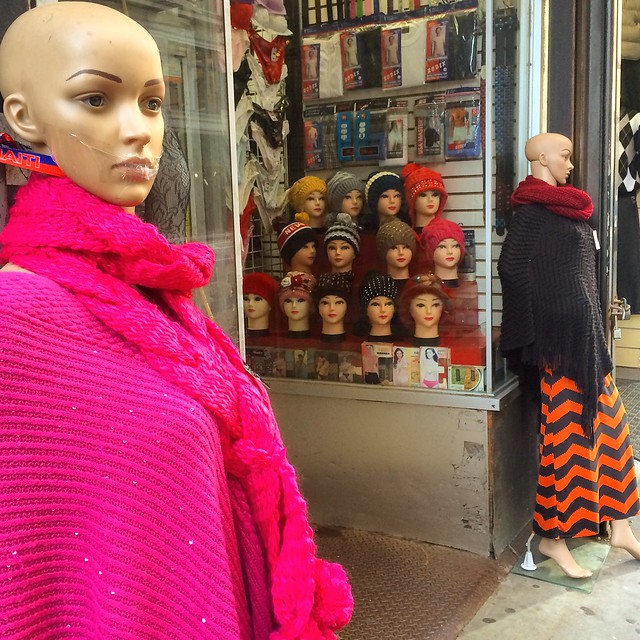
We all dream of immortality. Is Google eternal? Perhaps for a few years. In any case I want to start posting my photos here again. Here are a couple. More to follow.

TwoBaldMannequins
"Mannequins, Manhattan," Tim Connor, All rights reserved

CUMannequins
"Black haired mannequin, Manhattan," Tim Connor, All rights reserved

Wednesday, August 13, 2014

Critical mass: Writing something a lot of people are thinking

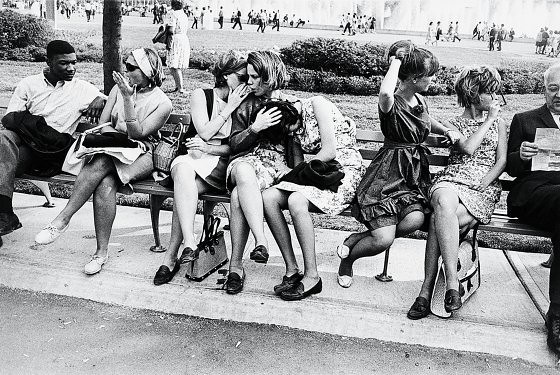
WorldsFair64_Winogrand
"New York World's Fair, 1964," Garry Winogrand, All rights reserved

To conclude his review of the Garry Winogrand show at the Met (editor's note: Winogrand's images are mostly unplanned shots of strangers going about their lives, like the example above), New York Magazine art critic Jerry Saltz wrote the following:

"Something we’ve been missing also becomes evident here. The whole world is now filled with incredible images—especially on Instagram and other social networks—that owe something to Winogrand’s, documenting life, change, and all the rest. Yet the art world and museums are not. Instead they tend to show oversize, very still pictures or images that investigate formal properties and ideas of display and presentation. I love many of those pictures, but what’s happening online on social media deserves far more serious scrutiny than it’s getting. If the art world doesn’t admit more of this sort of deceptively casual-seeming work, the outside world will reject more so-called art photography than it already does. That’s a divide that we don’t need to reestablish and widen."

About time.

Sunday, August 10, 2014

Fruit season

Fruit 1
"Court St, Brooklyn 1", Tim Connor, All rights reserved

Fruit 2
"Court St, Brooklyn 2," Tim Connor, All rights reserved

See more daily photos at http://instagram.com/timpconnor.

Saturday, July 19, 2014

Garry Winogrand: Mundane mysteries, clearly stated

"Six" by Garry Winogrand at Pace McGill Gallery

Review by Tim Connor
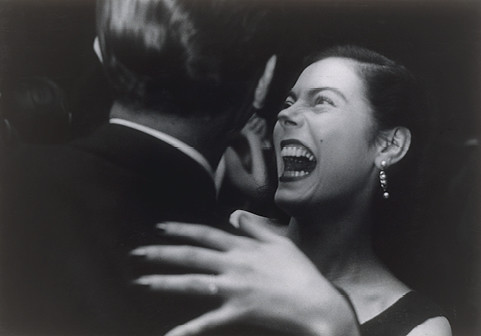
Winogrand_ElMorocco,NY_1955
"El Morocco, New York City, 1969" by Garry Winogrand

Pace McGill’s Garry Winogrand show, “Six,” might be thought of as a kind of Cliff Notes for the full-dress Winogrand career retrospective running this summer at the Met.  At Pace McGill, Winogrand’s well-known prints are large and crisp, and the crowds are minimal, but how much, after all, can one learn from an outline? 

Six images have been chosen for each of six categories  -- Animals, Public Relations, Street, Women, Central Park and Texas.  Aside from providing the title for the show, this 6 X 6 arrangement seems arbitrary and unimaginative for work that openly – even ferociously -- eschews any kind of shot-list mentality or after-the-fact categorization.  But perhaps curation is beside the point. These are Winogrands, and Pace McGill wants to sell them (11” x 14” print prices range from $5,000 to $65,000 – most are around $10,000).

To me, those prices don’t seem terribly high in this crazy art market. After all, John Szarkowski, the great photographic critic and kingmaker of the 1960s and 70s called Winogrand “…the central photographer of his generation.”  To be fair, this was by no means a universal assessment at the time – nor is it today. But I agree with Szarkowski, at least to the extent that Winogrand personified, more than any of his contemporaries, a major attitudinal shift toward photography that is still underway.
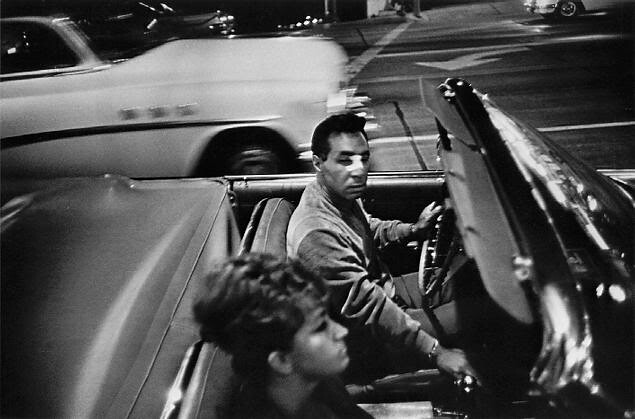
BandagedfaceDriver
"New York City couple"  by Garry Winogrand

Winogrand’s career developed within and against the ideas of an earlier generation of documentary and photojournalistic photographers who believed the best of their work could accurately describe social and historical truth and sometimes even change it. From Lewis Hines through W. Eugene Smith (and continuing today) their theory goes: shine a bright, public light on injustice, and you begin to attack and eliminate it.  This theory was underpinned by optimism. We are all humans with shared needs, problems and joys. And great photography proves it. This was the message of “Family of Man,” the legendary exhibit curated by Edward Steichen, mounted at MOMA in 1955, and then shown around the world.

In fact, Steichen selected two of  Winogrand’s pictures for “Family of Man.” But, from the beginning of his career, it was clear Winogrand was not that kind of photographer. His passion was for the photograph itself -- not for what it represented or could do. He was interested in human stories, but his stories resisted moral judgments.  They could be ambiguous. It was as though he invited viewers to provide their own captions. 

He went out in the morning to make great pictures but had no idea what they’d be. By way of journalistic intention, he followed his interests and obsessions. He went to places and events that he thought would serve him, then, instead of “covering,” them, reacted to whatever caught his attention. He felt no imperative to ask permission before or take moral responsibility after taking a shot. His frames were always sliced from reality, but they took no credit for being reality. Szarkowski called Winogrand’s images “figments of the real world.” First and last, they were pictures.
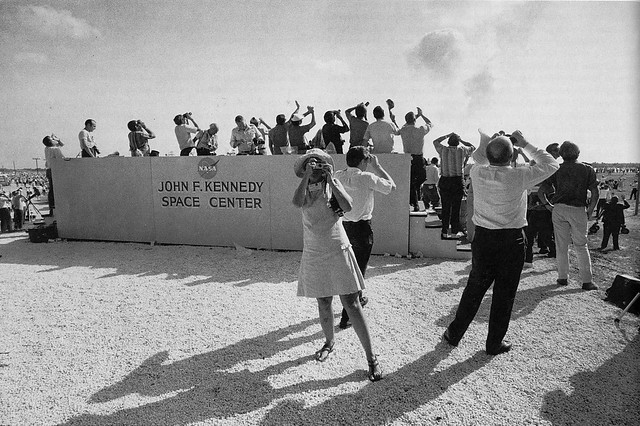
garry-winogrand_KennedySpaceCtr_1969
"Kennedy Space Center, Florida, 1969" by Garry Winogrand
Winogrand is famous for saying, “I photograph to see what something looks like photographed.” And he meant it. The idea was not to take sides or advance an agenda but to discover what his camera had seen. 

An example. Winogrand was against the Vietnam War. Yet his best-known shot of the protests, “Peace Demonstration, Central Park, 1970,” displayed in the exhibit’s Central Park section, shows a dark, gloomy day on Manhattan’s Great Lawn. In the foreground is a spindly, leafless tree. Around it and stretching to a horizon of East side buildings, a vast crowd of anti-war demonstrators sits or lies huddled on the cold ground. The sky above the protesters is thick with newly-released balloons that read as black in the black-and-white print. Perhaps the real balloons were red, not black, against the darkening sky that day. Or perhaps – let’s fantasize -- they were bombs falling. We really don’t know from the picture, just as we don’t know why the crowd is so passive about the spectacle
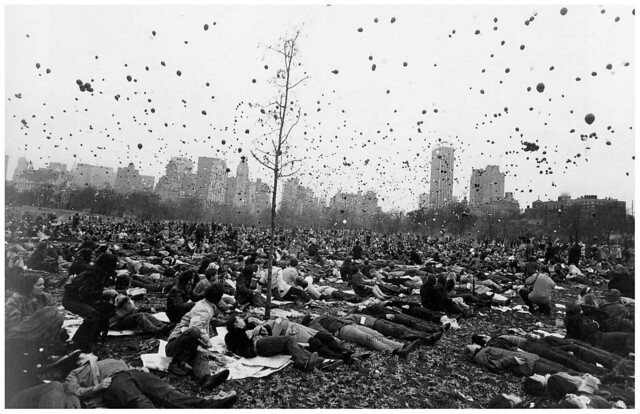
garry-winogrand-peace-demonstration-central-park-new-york-c-1970
"Peace demonstration, Central Park, 1970" by Garry Winogrand

As viewers 44 years later, the scene frankly looks sinister, almost apocalyptic. It goes firmly against our received idea of what an anti-Vietnam War demonstration is supposed to look like. Winogrand’s “historical” pictures are often different in that way. 

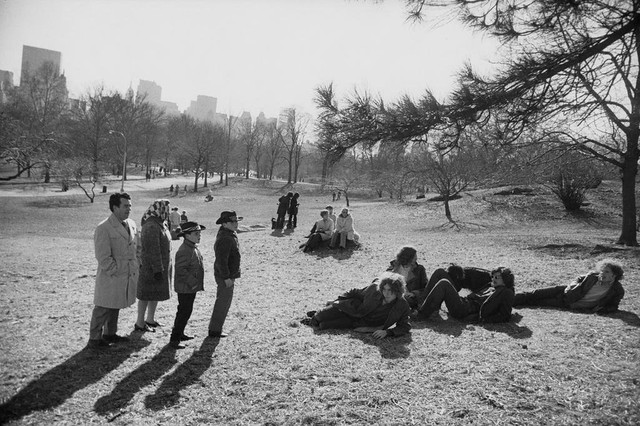
He was in fact a kind of anti-historian. In a 1971 picture, again from the show’s “Central Park” section – and again in cold but snowless weather -- a classic “straight” family of tourists (short-haired father in double-breasted trench coat; wife with hair tied in a scarf; two boys wearing cheap street-bought cowboy hats) stand gazing over five long-haired hippies (hatless, moustached, shades) lounging on the frozen grass. What is the family looking at? Perhaps we're at the outskirts of another demonstration. Why do the hippies so studiously ignore the family? Why do they – the cool insiders -- appear so rattled?   Could it be that, “Somethin’s happenin here but you don’t know what it is…”?  Could it be that Mr. and Mrs  Jones and the kids don’t care?
FamilyVsHippiesWinogrand
"Central Park, 1971" by Garry Winogrand

Winogrand shot without thinking too much – more frames, more rolls, than any of his contemporaries.  Then he edited , selecting what he considered to be the best pictures, not the ones he thought would please. For instance, the disturbing “Easter Sunday, Central Park, 1971” shows three young people obviously tripping, surrounded  by a curious, not necessarily sympathetic  crowd. 

One man is completely naked. His hands are raised, as though he’s invoking the heavens. The other two, a man and a woman, look agitated. There is no caption describing this scene, but the paranoid-ecstatic, staring eyes of all three trippers -- as though they are seeing god and the devil at the same time – tell the tale. 
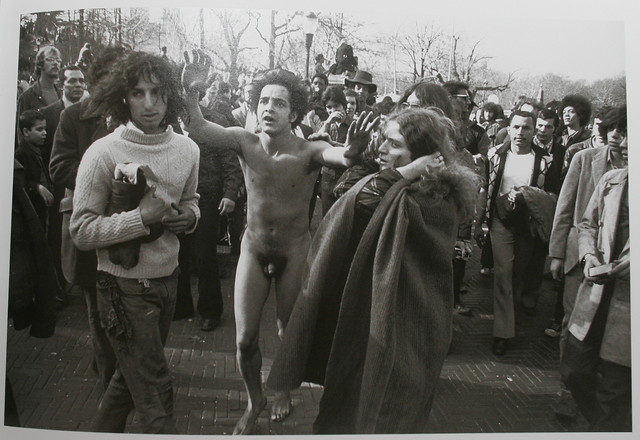
Trippers
“Easter Sunday, Central Park, 1971” by Garry Winogrand

Yes, but why are we looking at this picture? It’s not an anti-drug ad.  It’s also not, in any coherent historical sense, about the event that surrounds it.  In the end it’s just a fascinating “figment” -- at a time when fervently confused religious seekers in New York City might find Easter Sunday an auspicious time to drop acid and attend demonstrations. I guess that’s history too.

Supposedly, Garry Winogrand fell apart as a photographer after he moved to Los Angeles late in life. He continued to shoot but stopped editing, finally even stopped processing his film.  After his death, no less a personage than his old friend and mentor Szarkowski examined the massive take he had left behind – reportedly as many as 300,000 unedited images – and pronounced them unremarkable. Since then, experts at the Met have taken another look and are including some of the unseen shots in their retrospective.

What’s the verdict? Did he lose it? Was he great till the end? I hope so, but it doesn't really matter. Garry Winogrand’s  open-minded, follow-your-instincts, shoot-what’s-there aesthetic recorded the American 60s and 70s like no one else. His example has become the working mode of many thousands of today's shooters – both pros and amateurs -- worldwide. I think it’s safe to say that, working the way he did,  these photographers intuitively understand Winogrand’s  enigmatic dictum: “Nothing is more mysterious than a fact clearly stated.”

This review also appears in the current issue of New York Photo Review.

To read more of my reviews of photography, other visual arts, books and movies, click here.
Monday, June 30, 2014

More park pictures

Girls asleep
"Girls napping in stroller," Tim Connor, All rights reserved

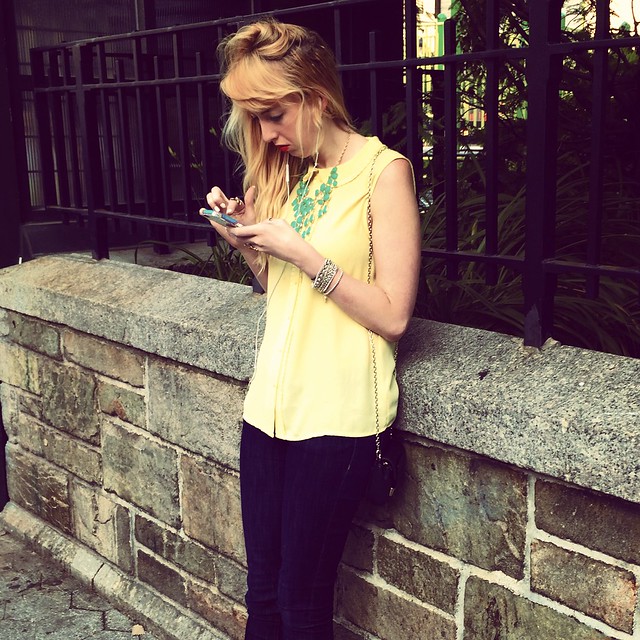
Girl texting
"Girl texting," Tim Connor, All rights reserved

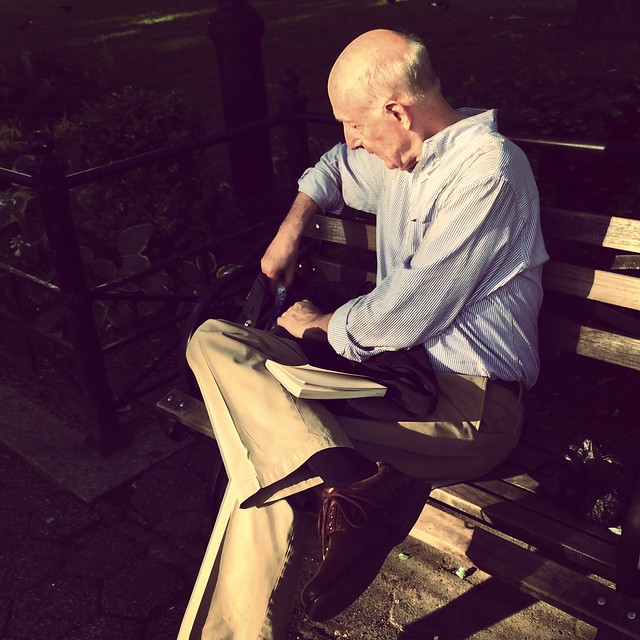
Man on park bench
"Man working from briefcase," All rights reserved

All posted originally on Instagram. You can search for me there as timpconnor.

Wednesday, June 18, 2014

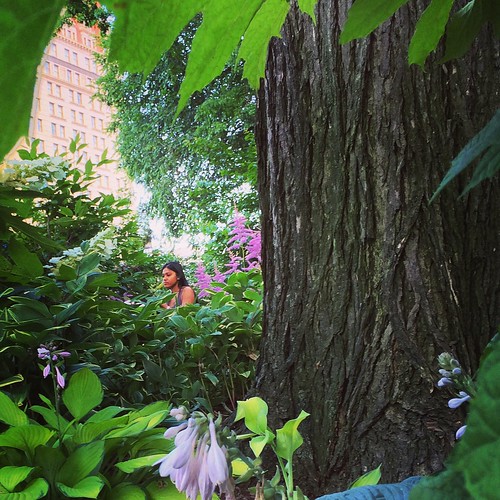
Strolling in the park after work

Boy in fountain
"Boy," Tim Connor, All rights reserved

Glimpse
"Glimpsed girl," Tim Connor, All rights reserved


Thursday, June 5, 2014

Truppe Fledermaus and the Carnival at the End of the World

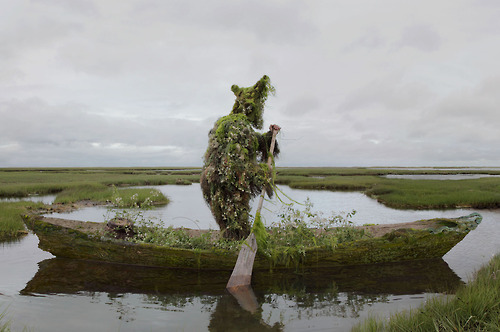
GreenmanRowing
"Greenman," Kahn and Selesnick, All rights reserved

“Truppe Fledermaus & the Carnival at the End of the World,” at Yancey Richardson, might be described as a performance of the imagination. Concocted by two English-born, U.S. educated artists, Nicholas Kahn and Richard Selesnick , the show creates just enough semi-plausible historical authenticity to soften up viewers for the artists’ outlandish – but not impossible – vision of the future.

Kahn and Selesnick have collaborated before – for the past 20 years in fact – creating fictitious histories from both the past and future (on both Earth and other planets) that combine impeccable pseudo-erudition with no-limits weirdness. I have to admit I’ve never seen anything quite like this work. The artists’ mastery of photography, drawing, printmaking, sculpture and creative writing is matched only by their showmen’s fervor to wow their audience. In fact, trying to think of comparisons, I could only come up with the Monty Python Flying Circus –likewise fervently theatrical, over-educated, British and willing to try anything.


These guys are having fun.
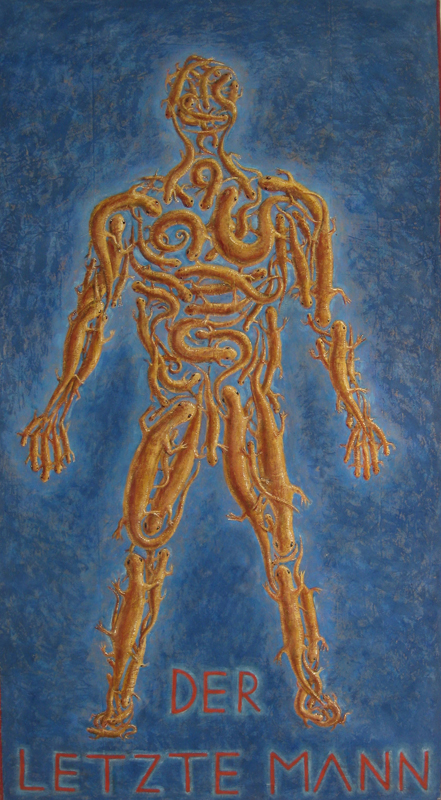
Der Letzte Mann(Last Man)_KahSelesnick
"Der Letztze Mann," Kahn and Selesnick, All rights reserved


The world conjured by this show is framed by an invented traveling theater of hustlers, freaks and spiritualists called “Truppe Fledermaus” (Bat Troupe). Next to the gallery entrance, an entire wall  is covered with posters and handbills advertising the Truppe’s strange offerings.  Stylistically, these ads -- with copy in German – refer to everything from German Expressionist cinema  -- “Ich bin Nosferatu” (I am the Vampyre) -- to fanciful medical charts – “Tod Frucht” (Death Fruit) – to a colorful, full-figured nude woman covered with roses that suggests P.T. Barnum via Manet  -- “Das Tatowierte Wunder” (The Tattooed Wonder).  

I’m not entirely sure why these ads are funny, but they made me laugh.  The artists’ decision to use the German language is part of it.  If you’re a linguistically unsophisticated American (like most of us) try booming out “Ich bin Nosferatu!” over and over in a small room and you’ll know why. This prejudice is unfortunate and probably worse than that (I remember my parents telling me about neighbors who refused to take Hitler seriously because his speeches on the radio made them laugh). But, here, as elsewhere in the show, Kahn and Selsenick seem determined to go with their guts. Funny is funny. I’m sure John Cleese would approve.

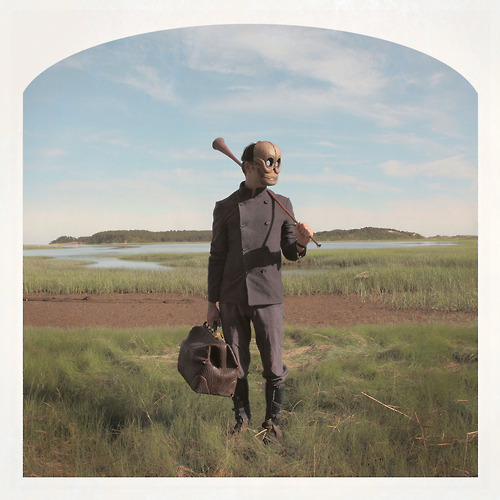
HieronoMan
"Demon man," Kahn and Selesnick, All rights reserved


In the room with the prints are a few sculptures – created, we are told, from “…ceramic, wax, Styrofoam, paint, plaster, glass antlers and silicone caterpillars.” Like the posters, the sculptures suggest a new world in which genetic boundaries are exotically shifting. For instance, a bust of a top-hatted man mounted on a tripod is densely covered with pitch black feathers, as though he is morphing toward a new consciousness as a crow. By now,  it’s clear this theme will repeat throughout the show. Still, with the tangible three-dimensionality of the sculptures, the idea gains a special kind of fetishistic power.  I’m guessing many people wouldn’t want this Crow Man to spend the night in their bedroom.

The remainder of the show (five walls out of six) consists of photographs. Taken in both black and white and color with an 8 X 10 view camera, many of these are aesthetically superb (Kahn and Selesnick studied photography together at Washington University). Their technical control makes them wonderfully incongruous with the subject matter, which is primitive and truly bizarre.  It’s not clear if the Truppe Fledermausers themselves are taking part in the activities or simply witnessing them. “At the end of the world” I’m not sure it matters.

Human populations have collapsed. Individuals and small groups of humans make their way on foot, by hand-drawn primitive wagons and carts or in rough canoes, through a bleak, boggy, apparently drowning world of rampant vegetation and mutant creatures.  When they gather in groups it seems to be for the purpose of creating strange tableux or engaging in wild revels of unclear purpose.

Nearly everyone wears a mask. From Hieronymous Bosch alone, the artists have stolen bird beaked, owl-eared and wide-eyed grinning demon masks. Furry bat (fledermaus) masks are also popular and, in a pinch, simple Ku Klux Klan-style bags with cut-out eyeholes, pulled down over the face, will do.

It’s a wild, wild world.

Climate change and rising sea levels are clearly the subtext here, although the artists’ invented future has little in common with what we might expect from a real post-warming planet. Instead of huge ruins and the ubiquitous trash of billions (whether or not killed off by plagues) -- we get deserted swamps, bogs, mudflats, dunes, beaches, rocky outlooks and placid bodies of water.

Apparently, we are returning forward to a world of harsh threats and magical remedies. In this world even the most basic technologies of the past have been erased.  In response Nature Herself seems to be trying something new. Parts are somehow being swapped among humans, other mammals, birds, fish and plants to produce bizarre human-other and other-other hybrids. Among the shambling-bramble-plant-human mixes alone, for example,  we see Yew Man, Lichen Man, Seaweed Man and the more generic Greenman, who starred in an earlier Kahn and Selesnick show, “The Pavilion of the Greenman,” in 1997.

All this may not convince as dystopia, but it thoroughly seduces as pure imagination.

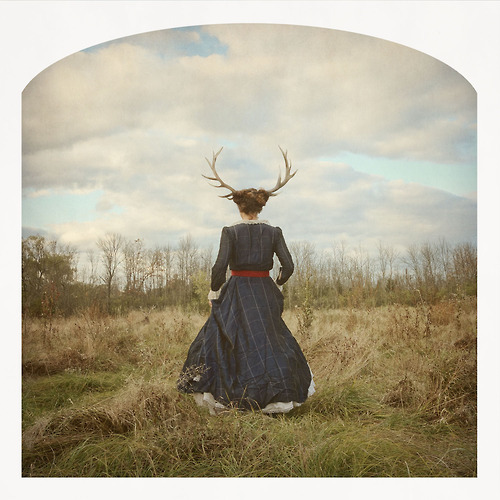
LadyHorns_KahnSelsenick
"Lady with antlers," Kahn and Selesnick, All rights reserved


I’ll end this review by describing two favorite pictures. Both represent what to me made this show so unusual  --  its willingness to go anywhere imagination might take it. We get jokes and parodies, horror and tragedy, winks and warnings, all blended into visual stories that range from dadaesque to heartwarming.

One: A young woman in Victorian dress is running away, across a drab, wintry field, holding up her petticoats.  From her piled-up hair two giant antlers rise against the sky. I can feel this woman’s distress. Suddenly, I realize it’s Jane Eyre fleeing in tears from Mr. Rochester.  I become a cynical English Lord in love. My legs are twitching to follow.  

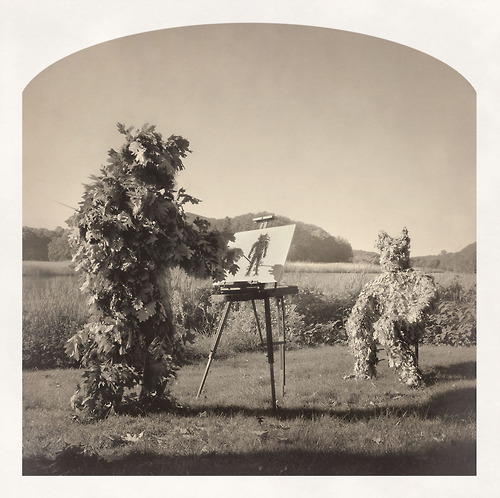
LeafManPainting_KahnSelsenick
"Leaf man painting Leaf man," Kahn and Selesnick, All rights reserved


Two:  Next to a curving river, Leaf Man, the artist, sights over his brush at the plein air portrait of his friend and subject, another Leaf Man. The two Leaf Men appear to be having a jolly chat. What a pleasant way to make art, they are saying.

Long live art! How do you say that in German?

This review also appears in The New York Photo Review.