Showing posts with label book. Show all posts

Tuesday, March 18, 2014

Philip Roth: A searing blast of love


Philip Roth, one of America's greatest post-war novelists, has stopped writing novels. But he apparently gives interviews. What follows is part of an interview he gave to Daniel Sandstrom, cultural editor of the Swedish newspaper, Svenska Dagbladet. Roth is saying (writing, I think) why he has found the U.S. so hospitable to writers.

"In a place so vast, no single geographic center from which the writing originates. Anything but a homogeneous population, no basic national unity, no single national character, social calm utterly unknown, even the general obtuseness about literature, the inability of many citizens to read any of it with even minimal comprehension, confers a certain freedom. And surely the fact that writers really don’t mean a goddamn thing to nine-tenths of the population doesn’t hurt. It’s inebriating.
Very little truthfulness anywhere, antagonism everywhere, so much calculated to disgust, the gigantic hypocrisies, no holding fierce passions at bay, the ordinary viciousness you can see just by pressing the remote, explosive weapons in the hands of creeps, the gloomy tabulation of unspeakable violent events, the unceasing despoliation of the biosphere for profit, surveillance overkill that will come back to haunt us, great concentrations of wealth financing the most undemocratic malevolents around, science illiterates still fighting the Scopes trial 89 years on, economic inequities the size of the Ritz, indebtedness on everyone’s tail, families not knowing how bad things can get, money being squeezed out of every last thing — that frenzy — and (by no means new) government hardly by the people through representative democracy but rather by the great financial interests, the old American plutocracy worse than ever.
You have 300 million people on a continent 3,000 miles wide doing the best they can with their inexhaustible troubles. We are witnessing a new and benign admixture of races on a scale unknown since the malignancy of slavery. I could go on and on. It’s hard not to feel close to existence here. This is not some quiet little corner of the world."

Excerpted from the NY Times Book Review, March 16, 2014

Saturday, December 21, 2013

My photo published in 'Exposure 2011'


"Due Date," Tim Connor, All rights reserved

A big sleek hardcover book arrived for me in the mail yesterday. It's the photo choices for "Exposure 2011,"  a contest sponsored by 'See.Me' (then known as 'Artists Wanted'). My entry (shown above) is one of perhaps a thousand in this beautiful 320-page tome -- a neat job, printed entirely on lustrous black stock.

I guess See.Me didn't try to publicize it because it's almost three years late (contest was 2011; copyright is 2012; in a few days it will be 2014). But, after all,  they did send it, just in time for Christmas, presumably to all the photographers, and I appreciate that.

Wednesday, November 20, 2013

Brandon Stanton's "Humans of New York"

Image3496a
"Humans of New York," Brandon Stanton, All rights reserved

Just a week after its publication, Brandon Stanton’s photo book, Humans of New York, jumped to number one on the Times best-seller list. To make the book, Stanton walked all five boroughs (but mostly Manhattan) with his camera, approached people he found interesting, started up conversations and asked to take their pictures. Not only did the people agree, they opened up for surprisingly unguarded portraits; many also gave Stanton intimate quotes for attribution, as though he was a trusted friend.

Does this sound like a classic New York artist’s fairy tale? Well, it is. And here comes  its modern twist: Stanton was not discovered by a John Szarkowski-style prince of taste but by millions of viewers on the internet. To become the people’s choice Stanton began showing his pictures on photoblogs and social media in 2010.  The last time I visited his “Humans of New York” (HONY) page on Facebook, it had been “liked” by 1,772,196 visitors, and each of the page’s hundreds of pictures had themselves inspired hundreds or thousands of comments.

These are astonishing numbers. What makes the pictures so popular? Certainly, Stanton’s well-made color portraits are uniformly pleasing. Straightforward and unfussy, they fill out a New York City “gorgeous mosaic” of demographic diversity with an eye for individual style and a flair for tripping the shutter at the perfect moment. Perhaps Stanton’s real gift, in fact, is his ability to create that moment – to persuade strangers to feel good about him, his project and ultimately themselves.

In addition, Stanton is a sympathetic interviewer. As he shoots, he asks big questions, such as “What is your biggest struggle?” The answers range from ironic (often very funny) quips to true attempts at self-revelation.  Later, Stanton combines his subjects’ edited answers with their pictures to create funny, swoony or sad little stories.
Image3496b
"Humans of New York," Brandon Stanton, All rights reserved

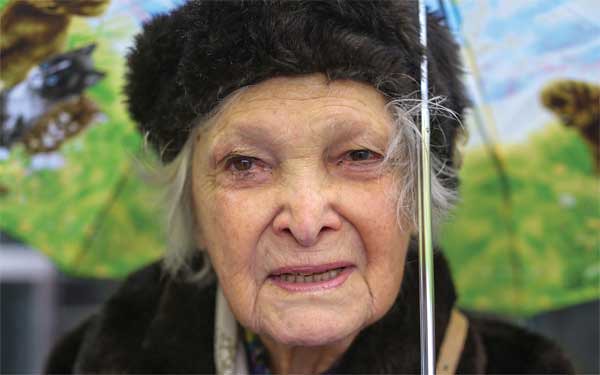
On a rainy street, for instance, he asks a mysteriously smiling young woman, “What was the happiest moment of your life?” The woman replies: “There are two. The day my baby was born, and last night.” Responding to another question, an elegant old woman in a fur hat  looks proudly at the lens and says, “When my husband was dying, I said, ‘Moe, how am I supposed to live without you?’ He told me, ’Take the love and spread it around.’ “

I’m told this collection moves many viewers to tears.  I’m guessing most of these are what people call ‘happy’ tears. Most viewers – like most of the people photographed -- seem helpless against Stanton’s optimistic charm and genuine affection.  In this book, buoyed up by his eager energy, dancers dance, lovers kiss and old grumps laugh aloud.  For a moment this friendly young man seems able to create an experience of deeply-felt community. 

His style, it seems to me, embodies our cultural moment’s  
ideal template for photographic portraiture. Everything is in the open. No pictures are taken without full permission. Editing and usage rights are theoretically collaborative. Recorded words are reliably accurate and respect the true context in which they were spoken. The final photographs represent a synergy of shooter and subject. Posted to the internet, they become a kind of collective. 

I’m guessing that most of Stanton’s subjects felt they were posing under just such an unwritten moral contract (legal realities may be different). No doubt they felt good about it. Stanton’s wide-open, democratic style is the flip side, after all, of the rampant insecurity and paranoia that curls more and more insistently through our high-tech society – and often surfaces around photography. “That man with the camera,” we fret.  “Is he pointing it at us? Is he the government, a stalker, a pervert? Is he looking at the kids?” Such fears may be extreme, but they’re not contemptible. There’s a reason for them to exist.

Image3496d
"Humans of New York," Brandon Stanton, All rights reserved

Nevertheless, as a critic, I’m concerned about this trend.  If photographers and their intentions are forced to endure such fear-driven vetting, will only feel-good, we-did-this-together projects like Stanton’s be able to thrive? I say this as a sincere fan of  “Humans of New York.” I admire its steady, non-judgmental acceptance of its subjects’ offerings. But I worry about photographers who use very different methods and mine very different veins.

levitt_artistcolor2
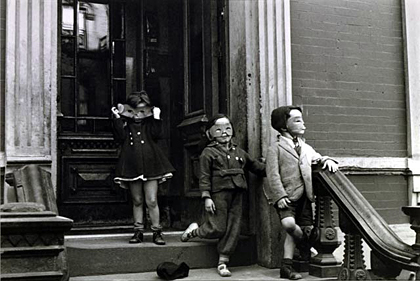
"Lower East Side Children," Helen Levitt, All rights reserved

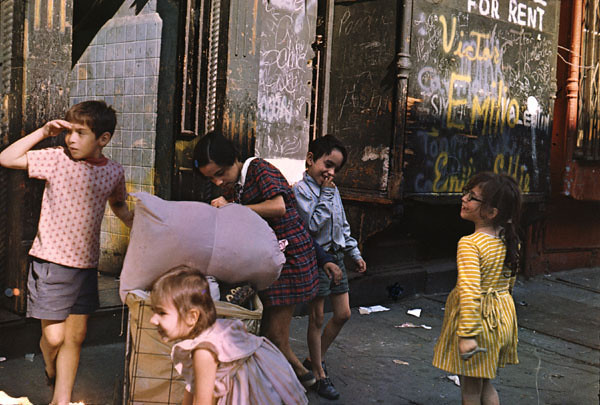
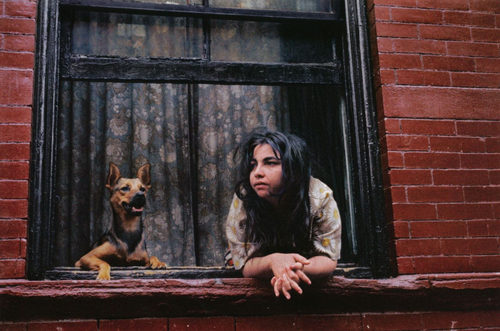
Take Helen Levitt, who died a few years ago. Regularly described as “shy and retiring,” she walked the streets of Harlem and the Lower East Side anonymously for 60 years, photographing and filming people -- most often, children – using cameras fitted with a right angle viewer, called a ‘Winkelsucher,’ that allowed Levitt to stand sideways to her actual subjects. In other words, she snuck shots in pursuit of what legendary author James Agee called “…a fleeting and half-secret world… most abundant in lyrical qualities.” 

tumblr_mvim4rnKDk1qaqnlfo1_500
"Girl at Window," Helen Levitt, All rights reserved

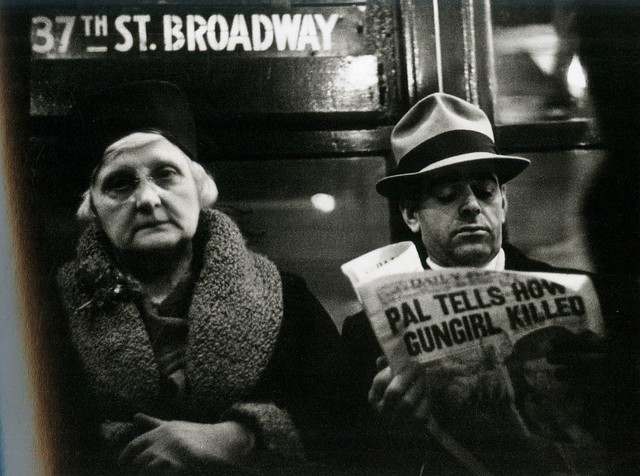
Levitt’s colleague and friend Walker Evans did something similar in his famous subway series, “Many Are Called.” With Levitt often sitting by his side, Evans rode the New York trains for weeks making exposures with a tiny camera through the buttonhole of his overcoat.  Riders among the daily mass migration rarely noticed, but there was nothing dishonest about the pictures. Looked at now, Evan’s pictures, like Levitt’s, are a triumph of humanist affirmation.

WalkerEvans-Subways
"Many Are Called," Walker Evans, All rights reserved

Does “Humans…” give us a truer look at New Yorkers than the street portraits of the past or today's by other photographers?  I’d say it gives us another kind of look – a familiar modern look, balanced on the tightrope between disguise and revelation. Call it a social media look.  My recommendation is: If you can’t afford the book, at least check out the website (humansofnewyork.com). It may be the first big mainstream collection that takes for granted the facebook selves – at once pleading and performative – that we willingly reveal to our linked-up world.

This review also appears in The New York Photo Review

Thursday, November 14, 2013

Taking the long view

Here is some gorgeous rhetoric by author Lee Billings from his book, Five Billion Years of Solitude, reviewed in this week's New York Times Book Review. This passage was chosen by Dennis Overbye, the reviewer.

"A planet becomes a vast machine, or an organism, pursuing some impenetrable purpose through its continental collisions and volcanic outpourings. A man becomes a protein-sheathed splash of ocean raised from rock to breathe the sky, an eater of sun whose atoms were forged in an anvil of stars."

Monday, March 26, 2012

Dystopia now

ScottDalton_S-05Blog
"Car bomb," Scott Dalton, All rights reserved

Are you obsessed with dystopia? (definition: "An imagined universe --usually the future of our own world -- in which a worst-case scenario is explored; the opposite of utopia") Or is it just me?

No, it's not just me. I started thinking about this when I realized how many of the books and movies I've read & seen recently are dystopian. Here's a rough list.

Books
Super Sad True Love Story, Gary Shteyngart, 2010 -- World is taken over by 3 mega corporate states. Everyone is the sum of his data. Everyone knows your score for Credit & Fuckability. Talking face to face is so unusual it's called "verbaling."
Sleepless, Charlie Huston, 2010 -- Created from experimenting on genetically modified corn, a mutant virus becomes a plague. The billions of victims will be sleepless till they die.
The Road, Cormac McCarthy, 2009 -- A nuclear holocaust wipes out most of the life on earth. Survivors wander in search of canned food or other humans they can kill & eat.
Never Let Me Go," Kazuo Ishiguro, 2005 -- A first-person story of children raised in a special school. They learn they are clones being raised to supply humans with organs. Eventually they will die on an operating table.
Cloud Atlas, David Mitchell, 2004 -- A book of six inter-related stories. To summarize the last two 1) Sonmi~451, a genetically-engineered fabricant server at Papa Song's diner is interviewed before her execution after she rebels against the capitalist totalitarian society that created and exploited her kind. 2) In a post-apocalyptic distant future. Zachry, a tribesman living a primitive life after most of humanity dies during "the Fall," is visited by Meronym, a member of the last remnants of technologically-advanced civilization.

Movies
Wall-E, 2008 -- A sweet & funny animated film. Also bitingly satirical. Humankind has buried the Earth under poisonous garbage. Everyone has gotten morbidly fat in the spaceships that escaped. They ride around in machines, listening to jingles & shopping. No one remembers Earth.
Children of Men -- At the time of the film, the last child born to humans has just died at the age of 38. A woman with a young child appears & becomes the target of both the totalitarian state in power & the brutal rebels they are trying to crush.
Rise of the Planet of the Apes -- A drug to cure Alzheimer's is mistakenly given to a chimpanzee, who shares it with other chimps being used in lab-experiments. Now they are all as intelligent as humans. As it becomes clear that the released final version of the drug is fatal to human beings, The chimps escape.
28 Days Later -- A mysterious, incurable virus has turned everyone in Great Britain into murderous, human-flesh-eating zombies. A band of uninfected try to get out of London & find refuge in the countryside. (watched a few years ago)

TV series
Battlestar Galactica, 2003-2009 -- In this series ( watched a few years ago)humans have created humanoid machines called cylons. When the cylons become conscious they attack the humans. A series of intergalactic wars ensue.
Jericho -- Only saw one episode. Someone has set off nuclear bombs in the U.S. In Kansas, where the series is set, it's town vs town . Men ride horses & shoot each other as the larger political forces are revealed .

Would love it if you'd add to this list. Comments welcome.

Thursday, February 16, 2012

Edward St. Aubyn -- a quote

"Irony is the hardest addiction of all. Forget heroin. Just try giving up irony, the deep-down need to mean two things at once, to be in two places at once, not to be there for the catastrophe of a fixed meaning."

Quoted from At Last, a novel by Edward St. Aubyn, reviewed by Francine Prose in the NY Times Book Review, 2/12/2012 .

Tuesday, January 31, 2012

Leonard Freed's "Police Work"

LFreedCopsBlackmanBlog
"Police Work: Man restrained by two policemen," Leonard Freed, All rights reserved

Two uniformed white cops hold down a struggling black man on the hood of a car. What does this photograph tell us?

The answer of course depends on who is looking. Are the cops heroes, risking their lives to hold back a crime wave? Or are they brutal occupiers, imposing the power of society’s elites on an oppressed minority?

In 1972, when photographer Leonard Freed assigned himself the task of documenting the working life of the New York City Police Department, this was a volatile question, one that could – and did – spark fights at bars and dinner tables all over the city.

According to a wall text at Freed’s “Police Work” show at MCNY, New York in the 70s was "…marked by heated controversies surrounding the NYPD – over civilian review of police misconduct, scandals within the department, soaring crime rates and the tension inherent in policing a city increasingly divided by race, class and the political upheavals of the Vietnam era.”

Freed was well suited for this controversial project. Born to a working class family from Brooklyn, he was a Magnum photographer who had shown considerable insight and sympathy for minorities with his 1967 book Black in White America.He was also fair-minded about cops. “They are not psychiatrists, they are not lawyers, they are not doctors,” he remarked. “They are blue-collar workers. ”

LFreedWomanCopKidsBlog
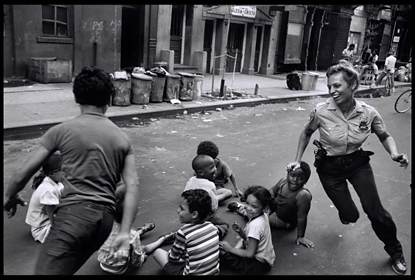
"Police Work: Policewoman with kids," Leonard Freed, All rights reserved

The photographs in this show reflect Freed’s even-handed approach. From a gang of cops tackling an anti-war demonstrator (one of the cops applies a choke hold) to a pretty blonde policewoman cavorting with neighborhood kids, the full range of “the job” is covered. To my mind, it is sometimes too well-covered. With seven years of contact sheets to choose from, the curators sometimes show us dutiful pictures of police process.A forensic expert in a lab coat “… studies the marking on a spent bullet; ” a young woman points to a police artist’s sketch …the composite of a suspect…” These are check-off-the-box pictures for bureaucrats.

Perhaps they are included to lower the show’s temperature. In the hyper-violent city of those years, Freed was often first to arrive, along with the police, at gruesome murder scenes . His pictures of these scenes (most viewable on the internet but not in the show) avoid the tabloid zest of his famous predecessor Weegee, but they are nevertheless ugly and disturbing . Only one is included in the exhibition -- an uncharacteristically neat visual narrative in which the victim is sprawled out-of-focus in the background and a till full of glinting coins protrudes into the foreground. About this picture Freed writes: “Homicide in a foodstore. The clerk was shot dead for the few dollars in the till.”

LFreedDetectSquadBestBlog
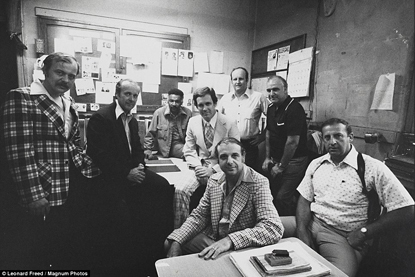
"Police Work: Precinct detective squad," Leonard Freed, All rights reserved

In general Freed’s work here is not inclined to visual homilies. His style is to get close, shoot without tricks, and let the photographs tell the story. In the hands of a brilliant and compassionate shooter like Freed, the technique works. These worldly, subtle, passionate pictures transport a viewer almost palpably into the life of a deteriorating New York City and its stressed-out inhabitants – on both sides of the law. They are well worth seeing.

Still, I had trouble committing myself to this show. Perhaps it was because the standard 8” x 10” and 11” x 14” black-and-white prints arrayed on the walls reminded me of photojournalism classes I had myself attended in the 1970s. I realized this show’s intentions – its rock-bottom faith in the power of honestly-made photographs to tell the truth – felt familiar. It was what we had all believed.

LFreedManHandcuffs2Blog
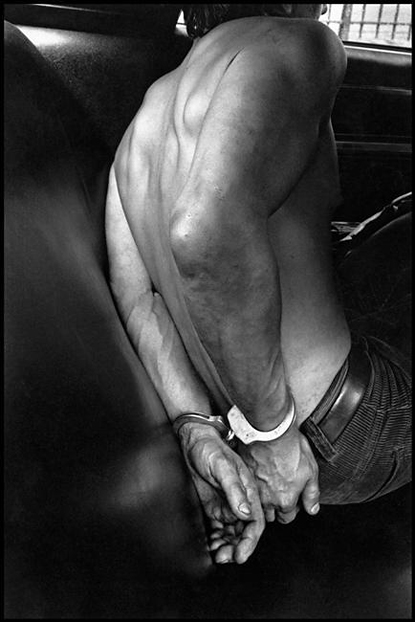
"Police Work: Arrested man in back seat," Leonard Freed, All rights reserved

But after Vietnam – and especially after the advent of digital cameras – many of us grew wary of photographic truth. The problem was not only the potential for technical manipulation of images. It was a new awareness of what is left out of the frame, left out of the edit – sometimes even by a person with the best intentions.

In fact, after seeing these pictures, I find I trust Leonard Freed. But can these pictures, in this place and selection and configuration, really tell the truth in 2012 about police work in 1970’s New York?

It depends on who is looking.

This review also appears in The New York Photo Review. Check it out.
More about Leonard Freed

Monday, January 23, 2012

"Wall dogs" featured in NY Times


" 'Contagion' painters," Tim Connor, All rights reserved

Today's New York Times slide show, called 'Wall Dogs' With Paint,' by Evan Sung, shows a wall mural painter at work. I photographed a wall dog crew, called Art FX Murals, doing similar work painting movie ads onto a 20-story blank wall.

See the results in my book, Big Movies.

See more of the pictures here.

Tuesday, January 10, 2012

Dmitri Mellos -- More street

By Dimitri Mellos
From Its Strangest Patterns, Dimiti Mellos, All rights reserved

"The conjunction of my photographic gaze with chance and happenstance is essential to my approach, as is an emphasis on the evanescence of these encountered poetic moments. I am interested in fleeting gestures and glances, the momentary field of interaction between passing strangers, the ephemeral dance of light and shadow and street life. I try to visually organize the chaos of the streets just enough to contain it in the photograph, but hopefully not much more than that." From introduction to Its Strangest Patterns

Dimitri's website

Monday, January 2, 2012

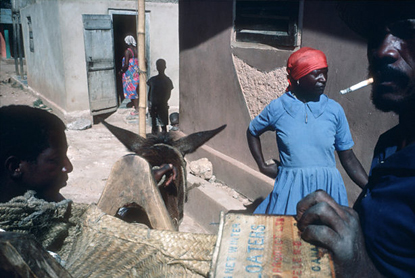
Alex Webb's "The Suffering of Light"

AWebb_BombardopolisHaiti_1986.Blog
"Bombardopolis, Haiti, 1986," Alex Webb, All rights reserved

Alex Webb visits places to which he is instinctively drawn & walks around taking pictures in color with a small camera. He has not varied this simple method in over 30 years. He is, he insists, a street photographer, a wanderer at ground level, hoping to encounter “…the unexpected, the unknown, or the secret heart of the known … just around the corner.”

Despite this simple formula, Webb’s work from the late 70s to the present – collected in “The Suffering of Light: 30 Years of Photographs” at Aperture Gallery -- is anything but simple. Made in Haiti, Cuba, Mexico, Congo, Turkey and other “places of cultural and often political uncertainty -- borders, islands, edges of societies … “, the pictures pay little attention to critical categories. They are loosely anchored in photojournalism -- Webb was elected to Magnum Photos early in his career. But they also freely cross and re-cross the increasingly blurry frontiers between journalism, documentary and so-called art photography (Webb’s work has been a major force in blurring those labels).

Colors are the deeds
The show’s title, “The Suffering of Light, ” is taken from Johann Wolfgang Von Goethe’s lovely metaphor, “Colors are the deeds and suffering of light.“ To Webb this is more than just a poetic formulation. Like most photographers of his generation (he is 59) he started out shooting black-and-white. In 1975, a few years before he shot this show’s first picture, Webb tells us, he took a trip to Haiti that “… transformed me – both as a photographer and as a human being. “ After a few more experiences in the tropics, he knew he had to deal with “… the intense, vibrant color of these worlds … somehow embedded in the cultures … so utterly different than the gray-brown reticence of my New England background.” In 1978 he began to work almost exclusively in color and continues to do so today.

AWebb_KampalaUganda_1980Blog
"Kampala, Uganda, 1980," Alex Webb, All rights reserved

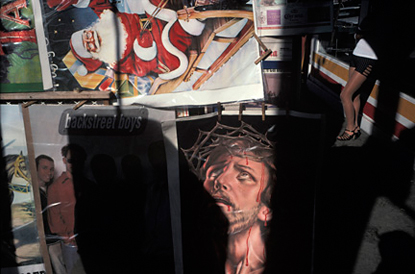
In the tropics Webb exposed Kodachrome film to saturate colors as deeply as possible in the full blaze of the southern sun. In the strong light, shadows become a rich, impenetrable black. In Webb’s palette these blacks are a sort of primary color. Far from denoting a lack of information, black becomes a fierce presence. It seems to tear away whole sections of pictures and swallow their hues. In some pictures doorways – or gorges and caves –open into a world of black, which seems to spawn abyssal shapes and creatures that cross back into this world. Like Webb’s clamorous reds and sensual pinks, or his alienating purples and melancholy blues (other descriptions may apply), black is here much more than a color.

Kodachrome is of course famous for its colors. When Webb began to rely on it in the 70s, it was a relatively slow film (ASA 25, 64 and 200), very contrasty, that gave bright, warm colors without overdosing into electric pop. The only drawback was that it could only be developed using Kodak’s proprietary process at major labs or the Kodak company itself. As new slide films proliferated, Kodachrome became hard to find outside cities or college towns. In the 80s many Kodachrome users simply accepted Kodak’s Ektachrome or the Fuji company’s Fujichrome , both decent but inferior films that could be developed by anyone using the E-6 process.
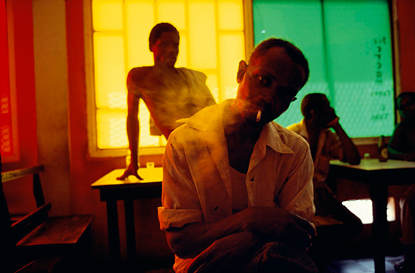
AWebb_GrenadaBarBlog
"Gouyave, Grenada, 1979," Alex Webb, All rights reserved

Interestingly, Webb stuck to his artistic guns. When the last two Kodachrome films went out of production (ASA 200 in 2007; ASA 64 in 2009), they had long been available only through specialized sources. But Webb continued to use Kodachrome till the bitter end, sending his film to Dwayne’s Photo in Parsons, Kansas, the last place to develop it. Dwayne’s closed its processing shop on July 14, 2010. Webb is now experimenting with a digital Leica and other color films, both positive and negative (see an interview about his recent work on Magnum Blog)

Thirty years of photographs
If this show is a retrospective of three decades, as its subtitle suggests, it’s remarkable that the passage of time is almost invisible. In poor streets around the world, it seems, 1979 is almost identical to 2009. Our much-vaunted digital revolution is nowhere to be seen, for instance; even styles of clothing and accessories have barely changed. The streets are full of the same old junk, the same worn-out furniture and broken concrete, year after year.

This may be an important truth. On the other hand Webb’s interests and style over the 30 years haven’t changed much either. We can perhaps read “Thirty years of photographs” as polite information, New England-style. This show is not the usual survey through time, designed to sum up an artistic journey as it unfolds. The summary here could feasibly read: Alex Webb found his work and figured out how to do it. Then he kept on doing it. (Good.)
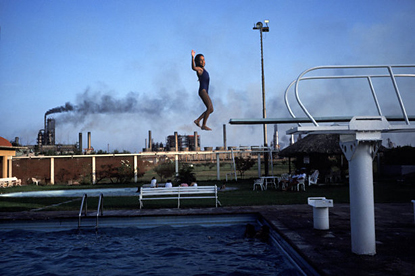
AWebb_MaderoMex_1983Blog
"Ciudad Madero, Mexico, 1983," Alex Webb, All rights reserved

I’m not implying that Webb has exhausted – or even, as far as I know, fully tapped – the human or aesthetic preoccupations that drive him. Covering distant conflicts by turning away from the usual cast of “newsmakers” and concentrating on the ordinary people affected by those conflicts has helped pioneer an open-form version of photojournalism that helps ameliorate the endless, boring shots of politicians as well as the bloodless navel-gazing so characteristic of most contemporary photography found in galleries. Although Webb’s images may sometimes provide an indelible glimpse of a time and milieu, they are not essentially about historical events or even places. They take us to new worlds and give us new ways to see them.

Styling reality
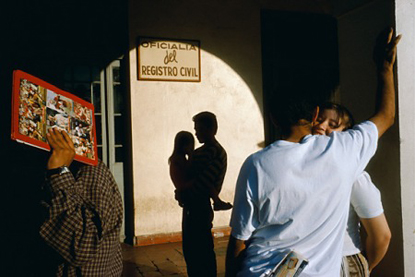
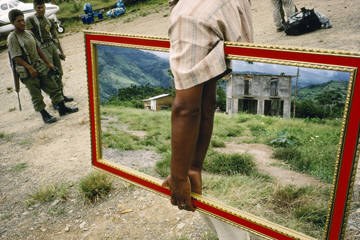
Webb’s solutions to visual problems can seem prodigiously complicated. Often his pictures are divided and/or framed internally by trees, statues, lampposts, windows, doorways, blast holes -- any device that marks off distinct worlds. The created mini-worlds are often oblivious or contradictory to one another; they may exist at different depths – and so be bigger and smaller -- in the larger picture frame. They may sport jarring colors, wild and domestic animals, dancing people or desolate landscapes. They may all seem to be going in different directions.
alex-webb-tijuana-mexico-1999
"Tijuana, Mexico, 1999," Alex Webb, All rights reserved

Add to this Webb’s evident fascination with doubling devices – mirrors, shadows, reflective metals, paintings, posters, billboards, photographs, graffiti – and his openness to intrusions -- truncated signs, mysterious limbs – from the unseen, out-of-frame world, and these pictures are pushing at the very limits of chaos. Yet the images somehow hold together. At the show’s opening I heard a young woman say about one of the pictures: “It’s a collage!” “Yeah, but no one put those pieces together,” replied her friend.” “No one could have ever put those pieces together!” said the first woman.

She’s right. These may be the most compositionally complex photographs around that don’t depend on photoshop for their effects. In a way, looking at Webb’s pictures is like watching an old-fashioned magic show. What transforms sleight-of-hand into magic is the ineluctable reality of the hands, sleeves and coins that we try to follow with our eyes. Here it’s the un-fakeable reality of children, women and men – shown in ensemble – as they spin from exuberance to despair in the kaleidoscopes of poverty and upheaval. If we saw these people conventionally isolated, picked out and framed to receive our pity or our anger, the impact would not be the same.

Webb takes us as far as an outsider can go into these realities. Perhaps the complexity of the pictures gives us a glimpse into the everything-at-once, grab-it-quick-if-you-want-it experience of living with no safety net in the developing world. There is irony in the fact that such near-to-bursting compositions are often achieved by traditional strategies. Graceful S-curves and Z-scriptions lead our eyes into the picture space; shapes entice; edges direct or surprise; colors repel or caress and, in the end, everything somehow balances, even if a horizon is skewed or a person left floating at an odd angle in space.

AWebb_Saut d'EauHaiti_1987Blog
"Saut d'Eau, Haiti, 1987," Alex Webb, All rights reserved

It’s not reality. It's art.

What interests me about my own response is that I don’t find this artifice fussy or over-obvious. It’s because there is no corresponding attempt to stage-manage the meaning. These pictures avoid being didactic. They are what they are. In fact, after I have registered admiration at their mastery, they confound me more often than they explain. They evoke ambiguity – or sometimes laughter – instead of certainty. They might be lyrical or horrendous, but they rarely evoke a simple response. Like their form, the meanings of these pictures are probably multiple and certainly complex.

Dancing in the streets
I heard Webb tell a fan at the opening: “I never know if I got it or not.” He was referring to the improvisational way he makes many of his best pictures -- the jumping-in moment as he senses the parts coming together. We might call it the hunter’s moment. It is that instant when eye, brain and body align, adrenaline surges and the trigger finger begins to tighten. For Webb and other street photographers, by the time the shutter closes, reality has already become something else.

Did he get it?

Of course Webb never knows. Nobody working this way ever knows for sure. And, of all contemporary photographers, Webb may be the one who keeps the most visual balls in the air. (Lee Friedlander loads up his frames similarly, but often with unmoving objects.) I’d argue that Webb’s particular genius as a street photographer lies in two things: 1) an extraordinary ability to imagine/see pictures in the swirling midst of complex, unscripted reality and 2) unusual skills for capturing those pictures in visually coherent compositions.
alexwebb_nuevolaredo1996Blog
"Nueva Laredo,Mexico, 1993," Alex Webb, All rights reserved

What goes into these skills? Well, not to be glib -- everything really. Everything read, seen, heard and experienced in a photographer’s life goes into his work. In addition, the photographer needs intuition, another gift. And he needs physical skills – not much discussed, but absolutely essential – to move to the right spot and shoot at the right moment while all the other elements in the picture are also moving.

In his book Frames of Mind: The Theory of Multiple Intelligences, Howard Gardner describes spatial intelligence – very roughly, the ability to manipulate spatial information as mental imagery – and bodily-kinesthetic intelligence – again roughly, the mastery of one's own physical movement, as exemplified by mimes, dancers and athletes. It seems to me that these ideas also describe what great “walking photographers” like Andre Kertesz, Henri Cartier-Bresson, Garry Winnogrand and Alex Webb actually do.

For photojournalists, shooting pictures has always been, first and foremost, about getting to the scene. For Webb and others who step on and off the photojournalism bus – who choose subjects for personal rather than news-driven reasons, come back to shoot over and over again and abandon the pretense of reportorial objectivity – it's like playing an old game in a brand new way. In this respect, it's interesting that in his book Gardner chose legendary Canadian hockey player Wayne Gretzky to illustrate bodily-kinesthetic intelligence.

A Canadian friend once described Gretzky to me as. “Small for the pros, skinny, not a fast skater, not a great slap shot…and the best who ever lived.” Hockey journalist Peter Gzowski explained it more technically: “Sometimes [Gretzky] will release the puck before he appears to be ready, threading the pass through a maze of players precisely to the blade of a teammate’s stick, or finding a chink in a goaltender’s armor and slipping the puck into it … before the goaltender is ready to react. What seems like luck or magic is neither. Given the probable movement of the other players, Gretzky knows exactly where his teammate is supposed to be.”
AWebb_PalmapampaPeru_1993Blog
"Palmapampa, Peru, 1993," Alex Webb, All rights reserved

From the evidence of these pictures, I’d suggest that Webb possesses a similar sort of talent. Seeing is one thing, but street photography also depends on highly-developed instinct, sure-footed physicality and perfect timing. Making his way down a street in the developing world, let's say -- physically “threading through the maze,” intent on “finding a chink” -- Webb is invariably an outsider. At least one set of eyes, possibly a dozen, are watching him carefully. He’s waiting for something to happen. What’s going on? What’s important? He’s taking in light, color, smells, shapes, the sky, buildings, signs, animals, machines. He’s registering the people as they move around him. Is that a picture? He can shoot more than one frame, but not many more, and maybe only one without changing the subtle mood he is trying to capture... No, it's gone. He keeps walking.

This is very different from a photographer shooting in his home town or suggesting changes to a model in front of his lens. Walking and photographing on the street in another country, another language requires an unusual trust in one's own inner resources. As well-known street photographer and teacher Tod Papageorge describes the process. "You walk out the door and—bang!—like everyone else, you're part of the great urban cavalcade...You're carrying an amazing little machine that, joined with a lot of effort, can pull poetry out of a walk downtown. All of the failed pictures you've ever made, all of the other photographs you've ever loved, even songs and lines from poems walk with you too, insinuating themselves into your decisions about what you'll make your photographs of, and how you'll shape them as pictures."

For over 30 years Webb has been brilliantly practicing his own version of living by his wits. The pictures in this show demonstrate a steadfast commitment to his ideas of what's important, what's true and what's beautiful. This reviewer agrees with him on all three counts. May he continue to walk and shoot pictures for another 30 years.

AWebb_PortAuPrince_1979Blog
"Port-au-Prince, Haiti, 1979," Alex Webb, All rights reserved
Thursday, December 1, 2011

Entering "Exposure 2011" contest

Blog_PaintersTown_TConnor_Exp2011
"Painting 'The Town,' " Tim Connor, All rights reserved
The picture above is part of a portfolio I'm submitting in the "cityscape" category of a competition called "Exposure 2011."

See my portfolio here.

Read what I wrote about my pictures:

"I first saw these images through the 12th-floor window of my office in Manhattan. Gigantic in scale, they appeared on the outer wall of a 21-story-high office tower a few blocks uptown and gradually took shape against the sky. First they were colored paint in seemingly random patterns. Then they became star-crossed lovers; machines at war; bank robbers dressed as sinister nuns; a bulldog as big as an elephant.

What surprised me most about these images – really they are nothing more than wildly scaled-up movie ads – is how disconcertingly intimate they can be. At this size – the size of a city building -- they transfigure my neighborhood skyline like a new slide clicking onto the wall in a dimly lit room.

The images are created by an intrepid team of mural artists (artfxmurals.com), who sketch and paint each poster with rollers and large brushes in a day or two, then, after the movies have opened, crank their scaffolds up and down the wall again, whitewashing everything. I’ve been photographing this process for over three years.

The light in Manhattan changes quickly, especially above the rushing street-level canyons, which fill with shadow early. I love all the manifestations of this New York light, but most of all -- for this project -- I love it at the end of day. As darkness gathers below in the grumbling rush hour streets, I'm blown away by these fierce (and/or silly) outsized fantasies, thrusting insistently into the light . Sometimes I enjoy imagining them as visitations from our cultural gods. Other times I'm just glad they make us look up and forget ourselves for a moment."

Preview the book from which the portfolio is taken.

Monday, January 10, 2011

Big Movies: The Book?

Hannibal, wearing his cask

The rite stuff

"Hannibal 1 and 2," Tim Connor, All rights reserved

I've been photographing these painted "upcoming movie" ads on the building wall across from my office since 2008. It's been fun, an excuse to take a break from desk work. It's been as easy as shooting fish in a barrel! Now I'm suddenly realizing the series could make a book. See my earlier book here:

I have to go back now & pull together my files. I've shot these pictures carefully but without much purpose. Time to see what I've got...

Thursday, August 5, 2010

My review transmutes to ink on paper

ZeyezLittleNeckBlvd
"Little Neck Parkway," Zheng Yaohua, All rights reserved
The picture above is from "On Their Sites: landscapes with private monuments," a fascinating project by New York-based photographer Zheng Yaohua (known as zeyez on Flickr) that explores private memories as they attach themselves to specific places. I am honored that a short essay I wrote about Zheng's work was included in his recent brochure about the piece.

You can read my review here.

The photo/childhood memory about George Tenet that I analyze is here.

Tuesday, February 9, 2010

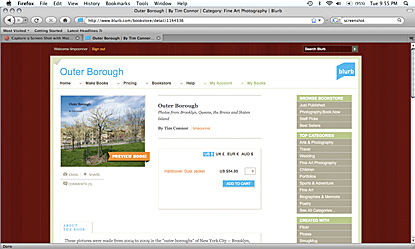
"Outer Borough," the book

Picture 1
Screenshot of my book, "Outer Borough," http://www.blurb.com/bookstore/detail/1144336

Here's my book "Outer Borough (you can virtually flip through its pages here.) You can buy it too -- 11" x 17" hardcover -- at cost, though unfortunately not cheap. Here are the images collected in a set on Flickr.

Monday, December 14, 2009

Helen Levitt's luck, by James Agee

New YorkHelenLevitt1942
"New York, c. 1942," Helen Levitt, All rights reserved
"Many people, even some good photographers, talk of the "luck" of photography, as if that were a disparagement. And it is true that luck is constantly at work. It is one of the cardinal creative forces in the universe, one which a photographer has unique equipment for collaborating with. And a photographer often shoots around a subject, especially one that is highly mobile and in continuous and swift development which seems to me as much his natural business as it is for a poet who is really in the grip of his poem to alter and re-alter the words in his line. It is true that most artists, though they know their own talent and its gifts as luck, work as well as they can against luck, and that in most good works of art, as in little else in creation, luck is either locked out or locked in and semi-domesticated, or put to wholly constructive work; but it is peculiarly a part of the good photographer's adventure to know where luck is most likely to lie in the stream, to hook it, and to bring it in without unfair play and without too much subduing it."

From James Agee's forward to Helen Levitt's "Ways of Seeing"

Saturday, October 31, 2009

Douglas Gayeton's "Slow: Life in a Tuscan Town"

slow10
Douglas Gayeton, All rights reserved
We celebrate iconic photographs that seem to encapsulate an event or era, but in fact they almost never do. Dorothea Lange's wonderful portrait of a migrant mother & two daughters from the Depression, for example, was true to the moment in which it was made; but the passage of time has turned it into a kind of history-lite icon for modern viewers. Lange's picture is only one facet of a complex reality, and most of us know it; but her unforgettable image becomes a compact takeaway version of the Depression that's hard to resist. We allow this perfectly defined moment -- worried mother, unhappy kids -- to stand in for the whole.

In the same way, pictures of our ancestors in the family album-- posed unsmiling in their Sunday best against studio backdrops or the old homestead -- misleadingly suggest lives devoid of laughter or passion. Do we really believe that everyone born before cheap, universal photography became available was frozen & grim ? Probably not, if we think about it. Yet we tend to accept these likenesses as true representations of their world.

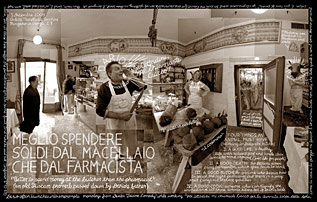
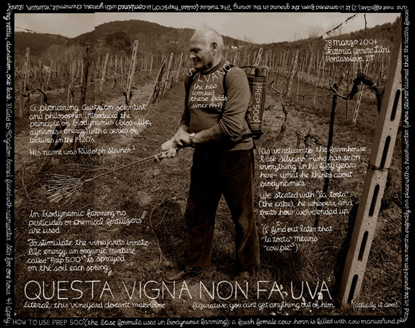
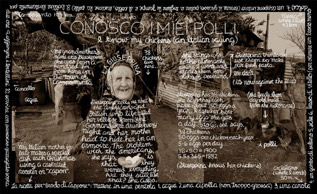
Douglas Gayeton confronts this problem in his series, "Slow: Life in a Tuscan Town," showcased in an exhibition, reception & book signing this Monday (Nov. 2) at Clic Gallery, 255 Centre St. (corner of Broome). How can a single unchanging image on paper represent ceaseless changes over time? How, especially, can moment-freezing photographic "glimpses" convey Gayeton's subject --"slow life..." the myriad, small-scale, subtle changes & behaviors that add up to life in a traditional rural Italian village? The way of life Gayeton seeks to record follows unchanging cycles, yet is endlessly improvisatory. It is hundreds, maybe thousands of years old -- and may disappear within the decade. How can Gayeton make us see this as a potential tragedy & not as just another earthy/exotic variant of the "family of man?"

slow_vineyardweb
Douglas Gayeton, All rights reserved
Gayeton is hardly the first to try to use, & at the same time, springboard from, the literal realism of the still photograph. From its invention, photographers felt limited by the medium & sought to expand the form . Pictures sought to conquer time with lantern slides & zoetropes -- which ultimately became film. Magazines -- most notably Life -- combined carefully edited & captioned pictures with journalistic text to create seamless narratives that had a beginning, middle and end. Going in the other direction in their paintings, Picasso, Braque & the Cubists broke narratives into multiple viewpoints, perspectives & sizes -- exactly like the output of a typical day with a camera.

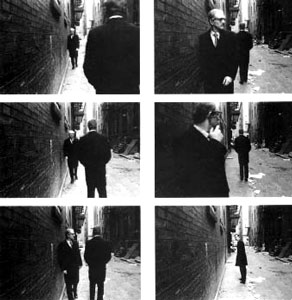
Today, artists like Duane Michaels, Paul Graham (who I wrote about here) and dozens of others continue to use unphotoshopped images to tell -- & subvert -- stories.

chance-meeting duane michals
"Chance encounter," Duane Michaels, All rights reserved
Gayeton's solution is what he (ambitiously) calls "flat film." The technique -- which often combines key images over time from a variety of viewpoints with text that records its own layers of space & sequence -- is charmingly explained in this video. For the critic it remains only to judge whether the method is successful.

I'd say it is, but with reservations. This show should be seen for its intimate pleasures as well as its satisfying scope. Gayeton has broken down the wall of strangeness that usually rises between photographer and subject and placed us, the viewer, directly into a world we would otherwise never enter. At the same time he has managed a much larger view & made it clear that we lose this world at our peril.

My reservations: It may be good marketing to link Gayeton's work with the Slow Food movement (the book's introduction is by Alice Waters); but the association may also misrepresent the work. Anti-standardization or not, slow fooders necessarily deal in propaganda, &, to be effective, propaganda must always deal in cliches or near-cliches. Thus we have a rich sepia tone on every image in this series -- as though their elegiac, past-in-present quality might be missed. Similarly, Gayeton's written commentary on the photos -- a witty English-Italian mix of quotes, nicknames, birth dates, overheard anecdotes, recipes, directions to out-of-frame sites of local interest & so on -- is rendered in schoolboy cursive, every letter meticulously & slowly made. Is this really necessary?

slow04
Douglas Gayeton, All rights reserved
Similarly, I can't avoid recording my frustration with the amount of text covering some of these photographs. Witty or not, the writing sometimes blocks the information, not to mention the beauty, one can get from the pictures alone. Gayeton's pictures are stunning in their own right. To me at least, they are as moving a testament to the vanishing way of life he loves as anything he or anyone could write. Couldn't some part of the text, I kept wondering, have gone elsewhere?

Thursday, September 10, 2009

Jim & Karla Murray's "Store Front..." show extended at Clic Gallery

VESUVIO415px
"Vesuvio's Bakery," James & Karla Murray, All rights reserved
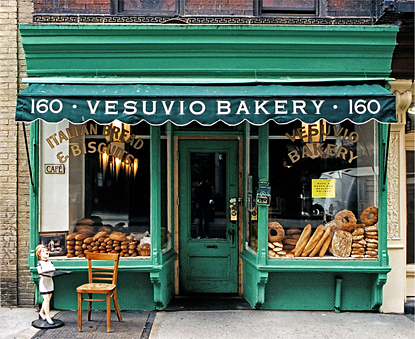
Jim & Karla Murray's "Store Front: The Disappearing Face of New York" show has been extended to September 27th at Clic Gallery at 255 Centre Street in Manhattan. I love the careful, almost formal treatment the Murray's give to these colorful neighborhood outposts -- crisp, straightforward, squared-up, unfussy. The light is chosen & handled for maximum information. Each store front is just what it is. But take a good look! What they are is pretty wonderful...

The Murrays approach these pictures in the tradition of Eugene Atget and Walker Evans, two photographers also moved by the half-improvisatory accretion of visual elements that go into the street face of "mom & pop" businesses. Evans especially was fascinated by signage & the arrangement of goods to be looked at by passersby; he called it "the pitch direct" & photographed it throughout his career. (I wrote about Atget, Evans & signage here).

The Murrays add glorious color to this venerable lineage. They also make a point of adding social & political concerns. These are not just photographs. "The stores have the city’s history etched in their facades. They tirelessly serve their community, sustaining a neighborhood’s diverse nature and ethnic background, in a city with an unmercifully fast pace and seemingly insatiable need for change. Each is as unique as the customers they serve and have at their heart, owners who share a commitment to provide a unique service and in turn cement a neighborhood’s foundation," they write. And, in fact, many of the store fronts the Murrays photographed are already gone, replaced by chains stores bearing the same logo, color scheme & promotional advertising as every other clone of their worldwide corporate brand.

See more Jim & Karla Murry pictures on Flickr & at their website. Their book is available here.

Thursday, April 30, 2009

Robert Frank was here

9._Frank_San_FranciscoBlog
"San Francisco, 1956," Robert Frank, All rights reserved

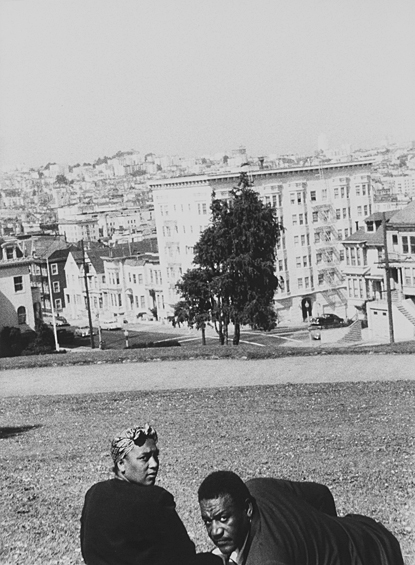
My friend Ted Sher wrote to say that this picture was "talking to" my "White boys" picture (see previous post).

Yeah, talking. In Frank's picture though, the voice is clotted with rage. It's a deadly serious whup-your-ass voice so unnerving it jolted Frank's camera up a compositional notch (I'm guessing) out of sheer terror. In my picture, the voice is relaxed, ironic. My title is playful. It invites the reader to be amused by the postmodern plethora of meanings for the term "white boy."

Like Frank, I took my picture without permission. But when I titled it, I knew -- guessed -- that my subjects, like me, would be able to parse the meanings of "white boy" with detachment, without fear. Franks's picture is different. He's the white boy. In his picture, what that means is anything but playful to the couple who feel their privacy has been invaded.

I'm guessing (again) that after taking this picture Frank hurried away, fearful & probably guilty. After all, what could he know about the future of the image that was coiled in the innards of his Leica? Now, more than 40 years later, the picture reveals in an instant the smouldering state of U.S. race relations in that era. It's a gift, a legacy to the generation -- both whites & blacks -- that came after. But I'm guessing that , to Frank at the time, this picture must also have been a source of conflicted feelings -- excitement mixed with shame.

More on this blog about Robert Frank:

Saturday, December 13, 2008

Chris Bonney's Vineyard seen

VineydImpressCBonney
"Vineyard Impressions" (book cover), Christopher Bonney, All rights reserved

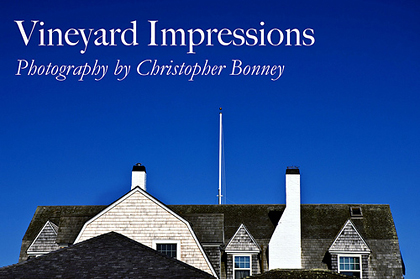
A lot of Flickr users have been enjoying Chris Bonney's take on Martha's Vineyard for years. Well, now he's gone & made a book of it! And a fine book it is, self-published through Blurb, which also sells it online & even offers a very nifty preview.

I've been looking at Chris's pictures a while & have concluded his biological clock is set very differently than mine. He's an early riser, early shooter, beneficiary of the gorgeous soft yellowy light that first caresses a night-washed world. It's a gentle but very precise light, one that suits the Vineyard's comfortable graces.

My favorite pictures by Chris tend to be over water . They remind me of the boating pictures by Thomas Eakins, the great 19th century American painter, whose style, like Chris's, is very exact in pursuit of pleasure.

Wednesday, April 30, 2008

Weird Kentucky

WoolridgeGrave
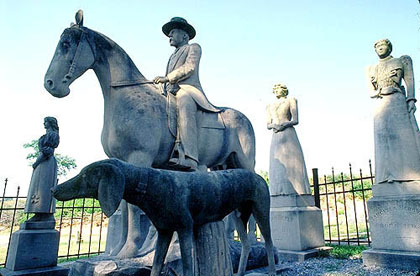
"Woolridge family cemetery," Tim Connor, All rights reserved

Some time last year I got an email from a guy in New Jersey who had found my photo (above) of the Woolridge monument in Mayfield, KY. When I called him (sorry I don't remember his name) , he told me he wanted to use the photo in a travel guide to be called Weird Kentucky (part of a travel series called Weird U.S.). We talked more about it, very pleasantly, but I noticed he wasn't mentioning money, so I did. We bargained a little, then agreed amiably on a modest price .


I joked I would put him on my blog if he paid me quickly & sent me a copy when the book got published. Well, I got a check within the week & yesterday got my signed copy! So here you go, sir!

WeirdKentucky
"Weird Kentucky," Sterling Publishing Co., All rights

I'm proud to be putting Weird Kentucky on my bookshelf, & I think you should own it too.

This handy compendium mixes charmingly strange locations you can actually visit in Kentucky -- e.g., a Biblically-themed 54-hole miniature golf course in Lexington where "...even the most jaded & seasoned professional miniature golfer will find himself challenged by the miracle holes, especially putting the Red Sea" -- & regionally-based mysteries, legends, unexplained phenomena, bloody secrets, roadside oddities, fabled people, bizarre beasts, & ghost stories to curdle the kiddy's blood around the campfire. Oh & of course the illustrations are lavishly creative.

Congratulations to publishers Mark Moran and Mark Sceurman & author Jeffrey Scott Holland.

Here's a Louisville-Courier Journal story , "Weird Kentucky develops a following."
Here's a link to the book's page on Amazon.
Here's a website called Unusual Kentucky.

You might also be interested in my account: Southern strategy: a photo tour through Tennessee and Kentucky. Scroll down the right hand side of this page to the link, under "Musings."