Showing posts with label photobusiness. Show all posts

Saturday, January 24, 2015

Thomas Struth: Striving for the big picture

Review by Tim Connor


As a photography student at Kunstakademie Düsseldorf in the 1970s, Thomas Struth learned to create big, highly detailed pictures with his classmates – now photographic luminaries -- Andreas Gursky, Thomas Ruff and Candida Hofer. At the time their teachers, the legendary husband-wife team, Bernd and Hilla Becher, taught a technically rigorous system to “objectively” document disappearing German architecture. According to the Becher system, subjects must be captured serially with a large-format camera using black-and-white film under a cloudless sky. All subjects must be shot from uniform distances and heights, printed with medium contrast at a prescribed size and shown together to facilitate comparison.

In his current show at the Met we see Struth’s homage to this exacting style -- a wall-sized grid of black-and-white prints showing well-known New York City intersections in 1978. Older New Yorkers may treasure or rue these pictures as memories, but the more salient point is that, soon enough, nobody will be alive to remember them. Still, there is much to admire in the way the pictures treat, not only the streets and buildings , but everything -- every parked car, overloaded trash can and  random walking-through-the-shot human -- with exactly the same crisp, non-judgmental clarity.

CrosbyStSoho1978_struth
"Crosby Street, Soho, 1978," Thomas Struth, All rights reserved
This is Struth’s first major project.  Afterward, his career moves on fast. Without abandoning the discipline and technique he has acquired from the Bechers, he begins to take on large ideas and issues. It is his willingness to do so that animates this show.

In the 80s Struth continues to shoot architecture and landscapes.  Like his schoolmate Gursky, he takes up color and begins to use photoshop to assemble from multiple viewpoints single images of large locations and structures. But, unlike Gursky, who over the years steadily creates more and more gigantic prints of larger and larger events, (the Chicago Board of Trade, the Olympics)  Struth’s big pictures seem uninterested in spectacle. Gursky wins worldwide acclaim by moving farther and farther away from what he photographs. Struth moves closer. His pictures, though still large and complex, become more and more about the people present or implied within the frame.  They radiate emotion that can be felt by anyone.

These qualities are best seen in the pictures the Met has collected from Struth’s three ongoing series – roughly titled, “Museum,” “Paradise” and “Technology.”

Struth’s “Museum” series comes from a simple idea. He photographs people looking at art and history in museums all over the world. Strictly realistic, rendered in sumptuous colors, these large, calm compositions at times resemble the Old Master paintings that appear in many of the prints. Yet the unrehearsed modern tourist crowds are always there too. Some museum-goers are reverent. Some are playing with their iphones and thinking about their lunch. They bring a  here-and-now immediacy to pictures meant to last. 

MuseumStruth
"Art Institute of Chicago,1990," Thomas Struth, All rights reserved
struthbigMuseum
"Museo Del Prado 7, 2005," Thomas Struth, All rights reserved

The balance between large ideas – the present and the past, the material and the spiritual, for example – makes me wonder if Struth is aiming for the cusp between them? Or do his museum pictures – like many of the old religion-based paintings depicted within them –incline toward moral lessons? If so, the messages are hard to recognize, extremely subtle. Yet the question continues to rise.

Asked about the Museum series, Struth said “… the ineffable spills into the ordinary and the spiritual aspirations of our ancestors intersect with the needs of the present.” It’s clear that with these works Struth is gesturing toward something beyond their quotidian content. In fact – like every artist -- he is imbuing lifeless materials with human energy. Where does that energy come from?

We get to decide for ourselves.

One thing I think we know.  In the Museum series the goal of this energy is no longer the same as it is in the old paintings. Unlike the paintings, the energy of the photographs is not directed at individual salvation.  We might think of its heaven as salvation for all.

familyofartistsretouchersTStruth
"Art Restorers at San Lorenzo Maggiore, Naples, Italy, 1988," Thomas Struth


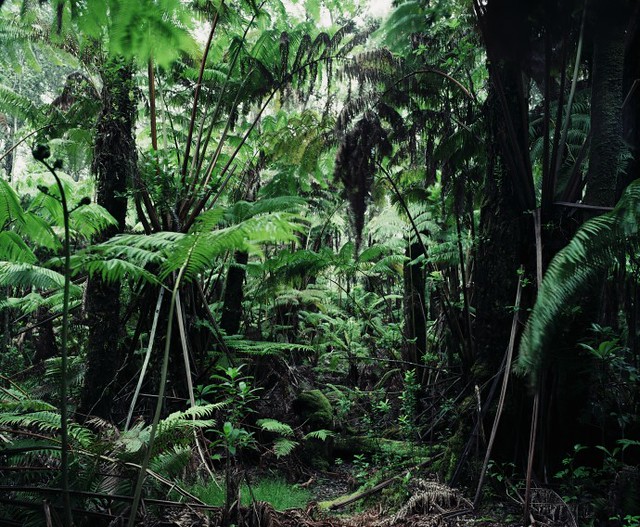
I think this becomes clear in Struth’s Paradise series. Photographed at ground level in various rainforests in Japan, Australia and South America, all the images in the series are called “paradise” and numbered.  Only one, “Paradise 13, Yakushima, Japan 1999,” is included in the show.  Yet, from this picture and others I have seen elsewhere, “paradise” seems a very odd title for Struth to have chosen.
“Paradise 13,” for example, is shot deep inside a low, wet, dark forest strewn with fallen trees and moss-covered boulders. It is certainly no Eden. Struth is well-known as an ardent environmentalist, and it’s hard to imagine him resorting to cheap irony. Some of the other forest “interiors” in this series are tangles of dazzling green, flooded with transforming light. They are beautiful to look at and, as we know, vital to the health of our planet.
 But – come to think of it – real rainforests are always unrestrained riots of hungry competitive life. They are always difficult for humans. Struth is making a difficult point. Our human instinct is to transform them to meet our needs. But the Earth too needs salvation.

Paradise17-TStruth
"Paradise 13," Thomas Struth

thomas-struth-growth-09-690x568
 "Paradise 9," Thomas Struth, All rights reserved

With the “Technology” series, Struth asks: Does the human genius for technology threaten our species? Does technology also offer hope? These too are ultimately spiritual questions.

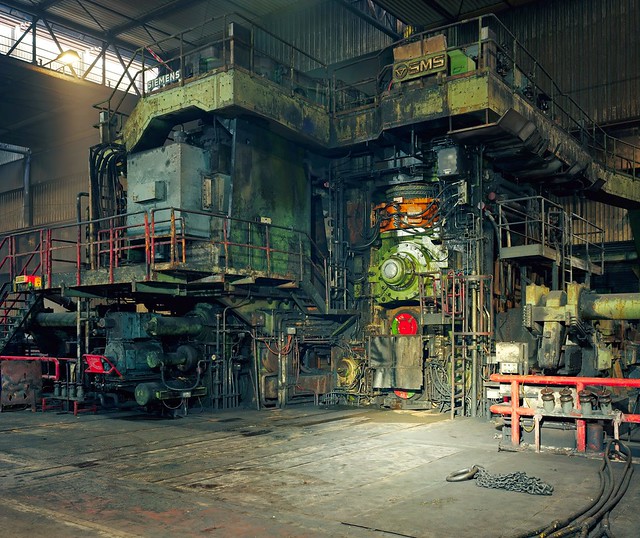
 Struth’s “Hot Rolling Mill, Thysen Krupp Steel, Duisburg, 2010,” takes us into the silent interior of a gigantic industrial machine. By choosing an old German steel mill and associating it with the name Krupp, Struth is deliberately evoking Hitler’s Third Reich and the murderous weapons with which Germany came close to conquering the world. And the picture itself -- a vast brutal wall of machinery in semi-darkness, grime-encrusted, its khaki greens punctuated with the faded, reds and oranges of catwalks and cables -- is indeed terrifying. Even worse, a thick chain is bolted to the steel-plate floor in the only area lit by a window. It took bravery to make this picture. Struth knows exactly what he is alluding to. 
5. Hot Rolling Mill,ThyssenKrupp Steel, Duisburg_Thomas Struth
"Hot Rolling Mill, Thysen Krupp Steel, Duisburg, 2010," Thomas Struth

If “Hot Rolling Mill” balances past and present, the most astonishing picture in the Technology series presents itself literally as a fulcrum between present and future.   Called “Figure 2, Charite, 2013,” the picture shows a woman strapped to a medical gurney suspended in mid air. Looping in from piled machines and monitors are dozens of wires, tubes and cables, all of which attach to her body. At first, we recoil from the image. It seems to be a Frankenstein-like experiment or perhaps some hideous torture. Then we notice that the room is spotless, the light is clear and the woman is young and blonde with beautiful skin.  We are confused. What are we looking at?
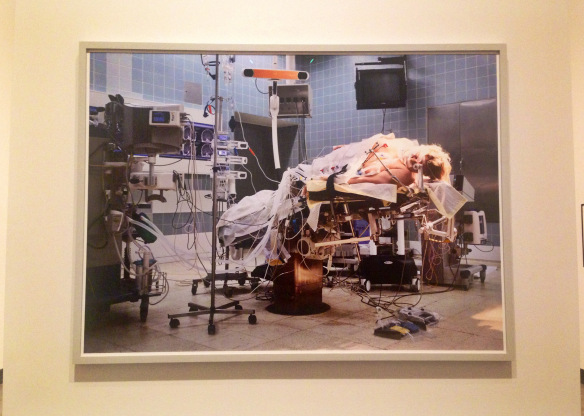
Figure2,Charite, 2013
"Figure 2, Charite, 2013," Thomas Struth, All rights reserved

It’s an operating theater in Berlin, where this anaesthesized young woman is about to undergo surgery to remove a brain tumor. With the woman’s full permission, Struth has photographed the moment before the doctors and nurses enter to begin. We learn in a caption that the woman survived and, two years, later is living comfortably. Still, we wouldn’t know that if we hadn’t been told. Is Struth intentionally frightening us with scary technology that is actually built and used to save lives?

I don’t think so. I think he is making full use of his freedom to challenge us.  Some things that at first seem repellent are beautiful. Struth’s mentors, the Bechers, photographed water towers, silos and blast furnaces they judged beautiful – and safe to photograph – in a defeated, divided Germany after a vicious war.  Now, more than a half century later, Struth again finds beauty in our still dangerous and increasingly complicated – but perhaps freer – world.  He makes big pictures for the world.

This review appears in The New York Photo Review


Saturday, July 19, 2014

Garry Winogrand: Mundane mysteries, clearly stated

"Six" by Garry Winogrand at Pace McGill Gallery

Review by Tim Connor

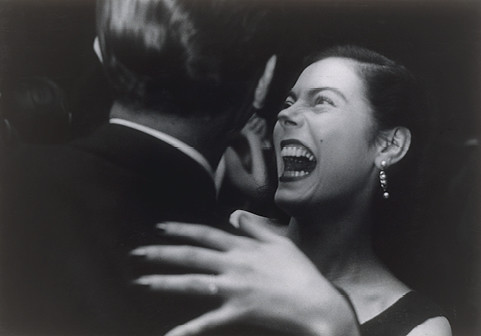
Winogrand_ElMorocco,NY_1955
"El Morocco, New York City, 1969" by Garry Winogrand

Pace McGill’s Garry Winogrand show, “Six,” might be thought of as a kind of Cliff Notes for the full-dress Winogrand career retrospective running this summer at the Met.  At Pace McGill, Winogrand’s well-known prints are large and crisp, and the crowds are minimal, but how much, after all, can one learn from an outline? 

Six images have been chosen for each of six categories  -- Animals, Public Relations, Street, Women, Central Park and Texas.  Aside from providing the title for the show, this 6 X 6 arrangement seems arbitrary and unimaginative for work that openly – even ferociously -- eschews any kind of shot-list mentality or after-the-fact categorization.  But perhaps curation is beside the point. These are Winogrands, and Pace McGill wants to sell them (11” x 14” print prices range from $5,000 to $65,000 – most are around $10,000).

To me, those prices don’t seem terribly high in this crazy art market. After all, John Szarkowski, the great photographic critic and kingmaker of the 1960s and 70s called Winogrand “…the central photographer of his generation.”  To be fair, this was by no means a universal assessment at the time – nor is it today. But I agree with Szarkowski, at least to the extent that Winogrand personified, more than any of his contemporaries, a major attitudinal shift toward photography that is still underway.
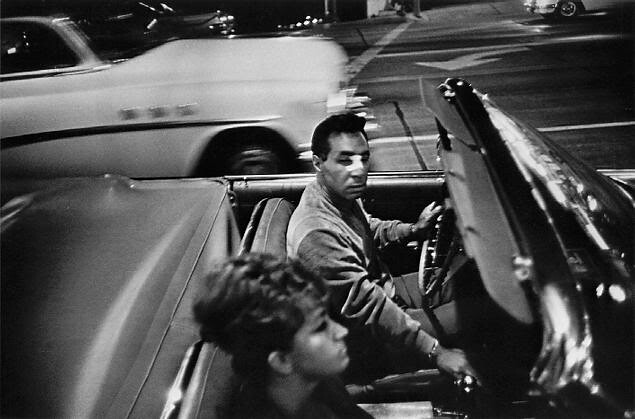
BandagedfaceDriver
"New York City couple"  by Garry Winogrand

Winogrand’s career developed within and against the ideas of an earlier generation of documentary and photojournalistic photographers who believed the best of their work could accurately describe social and historical truth and sometimes even change it. From Lewis Hines through W. Eugene Smith (and continuing today) their theory goes: shine a bright, public light on injustice, and you begin to attack and eliminate it.  This theory was underpinned by optimism. We are all humans with shared needs, problems and joys. And great photography proves it. This was the message of “Family of Man,” the legendary exhibit curated by Edward Steichen, mounted at MOMA in 1955, and then shown around the world.

In fact, Steichen selected two of  Winogrand’s pictures for “Family of Man.” But, from the beginning of his career, it was clear Winogrand was not that kind of photographer. His passion was for the photograph itself -- not for what it represented or could do. He was interested in human stories, but his stories resisted moral judgments.  They could be ambiguous. It was as though he invited viewers to provide their own captions. 

He went out in the morning to make great pictures but had no idea what they’d be. By way of journalistic intention, he followed his interests and obsessions. He went to places and events that he thought would serve him, then, instead of “covering,” them, reacted to whatever caught his attention. He felt no imperative to ask permission before or take moral responsibility after taking a shot. His frames were always sliced from reality, but they took no credit for being reality. Szarkowski called Winogrand’s images “figments of the real world.” First and last, they were pictures.
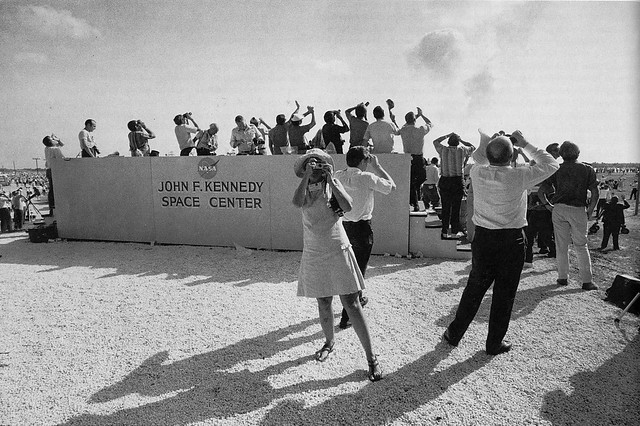
garry-winogrand_KennedySpaceCtr_1969
"Kennedy Space Center, Florida, 1969" by Garry Winogrand
Winogrand is famous for saying, “I photograph to see what something looks like photographed.” And he meant it. The idea was not to take sides or advance an agenda but to discover what his camera had seen. 

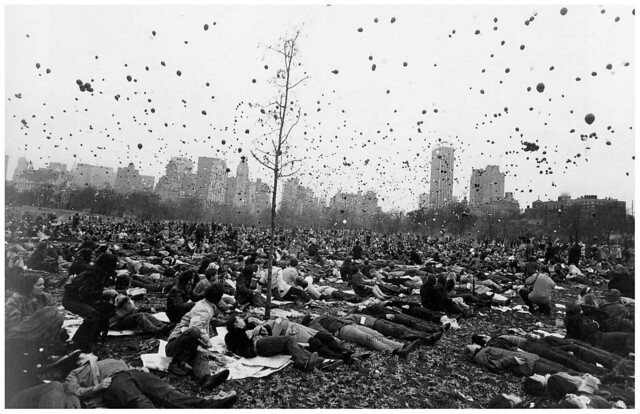
An example. Winogrand was against the Vietnam War. Yet his best-known shot of the protests, “Peace Demonstration, Central Park, 1970,” displayed in the exhibit’s Central Park section, shows a dark, gloomy day on Manhattan’s Great Lawn. In the foreground is a spindly, leafless tree. Around it and stretching to a horizon of East side buildings, a vast crowd of anti-war demonstrators sits or lies huddled on the cold ground. The sky above the protesters is thick with newly-released balloons that read as black in the black-and-white print. Perhaps the real balloons were red, not black, against the darkening sky that day. Or perhaps – let’s fantasize -- they were bombs falling. We really don’t know from the picture, just as we don’t know why the crowd is so passive about the spectacle
garry-winogrand-peace-demonstration-central-park-new-york-c-1970
"Peace demonstration, Central Park, 1970" by Garry Winogrand

As viewers 44 years later, the scene frankly looks sinister, almost apocalyptic. It goes firmly against our received idea of what an anti-Vietnam War demonstration is supposed to look like. Winogrand’s “historical” pictures are often different in that way. 

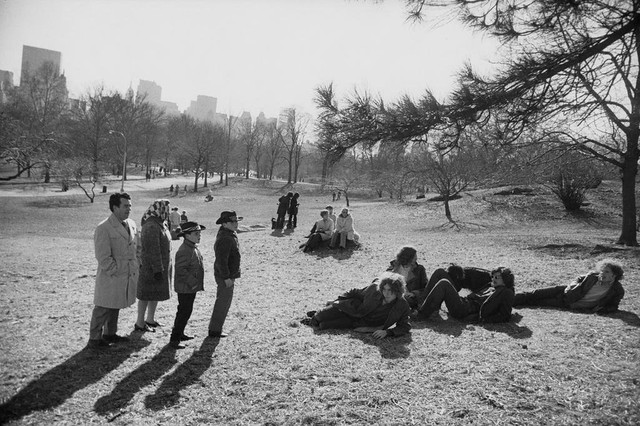
He was in fact a kind of anti-historian. In a 1971 picture, again from the show’s “Central Park” section – and again in cold but snowless weather -- a classic “straight” family of tourists (short-haired father in double-breasted trench coat; wife with hair tied in a scarf; two boys wearing cheap street-bought cowboy hats) stand gazing over five long-haired hippies (hatless, moustached, shades) lounging on the frozen grass. What is the family looking at? Perhaps we're at the outskirts of another demonstration. Why do the hippies so studiously ignore the family? Why do they – the cool insiders -- appear so rattled?   Could it be that, “Somethin’s happenin here but you don’t know what it is…”?  Could it be that Mr. and Mrs  Jones and the kids don’t care?
FamilyVsHippiesWinogrand
"Central Park, 1971" by Garry Winogrand

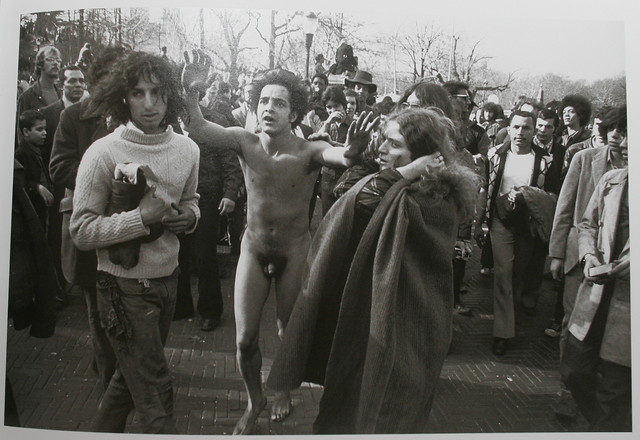
Winogrand shot without thinking too much – more frames, more rolls, than any of his contemporaries.  Then he edited , selecting what he considered to be the best pictures, not the ones he thought would please. For instance, the disturbing “Easter Sunday, Central Park, 1971” shows three young people obviously tripping, surrounded  by a curious, not necessarily sympathetic  crowd. 

One man is completely naked. His hands are raised, as though he’s invoking the heavens. The other two, a man and a woman, look agitated. There is no caption describing this scene, but the paranoid-ecstatic, staring eyes of all three trippers -- as though they are seeing god and the devil at the same time – tell the tale. 
Trippers
“Easter Sunday, Central Park, 1971” by Garry Winogrand

Yes, but why are we looking at this picture? It’s not an anti-drug ad.  It’s also not, in any coherent historical sense, about the event that surrounds it.  In the end it’s just a fascinating “figment” -- at a time when fervently confused religious seekers in New York City might find Easter Sunday an auspicious time to drop acid and attend demonstrations. I guess that’s history too.

Supposedly, Garry Winogrand fell apart as a photographer after he moved to Los Angeles late in life. He continued to shoot but stopped editing, finally even stopped processing his film.  After his death, no less a personage than his old friend and mentor Szarkowski examined the massive take he had left behind – reportedly as many as 300,000 unedited images – and pronounced them unremarkable. Since then, experts at the Met have taken another look and are including some of the unseen shots in their retrospective.

What’s the verdict? Did he lose it? Was he great till the end? I hope so, but it doesn't really matter. Garry Winogrand’s  open-minded, follow-your-instincts, shoot-what’s-there aesthetic recorded the American 60s and 70s like no one else. His example has become the working mode of many thousands of today's shooters – both pros and amateurs -- worldwide. I think it’s safe to say that, working the way he did,  these photographers intuitively understand Winogrand’s  enigmatic dictum: “Nothing is more mysterious than a fact clearly stated.”

This review also appears in the current issue of New York Photo Review.

To read more of my reviews of photography, other visual arts, books and movies, click here.

Thursday, July 5, 2012

Madonna to appear in TinHouse

PaintlessMadonnaBlog
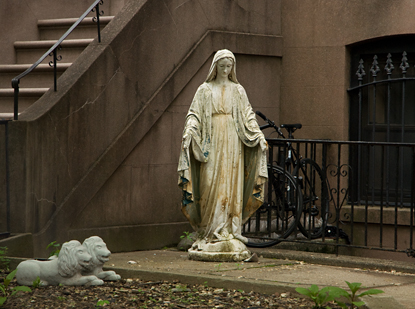
"Madonna with lions and bicycle," Tim Connor, All rights reserved

No, not that Madonna. I mean the one in my picture (above) from Carroll Gardens, Brooklyn. It sold to TinHouse, a very cool literary magazine published in Portland, OR. It will illustrate a personal essay set in Brooklyn, called "True Believer," by writer Charles D'Ambrosio. I can't wait to see it (September issue)

Tuesday, April 3, 2012

Photos for sale -- New York AIPAD 2012

Infidel_TimHetheringtonBlog
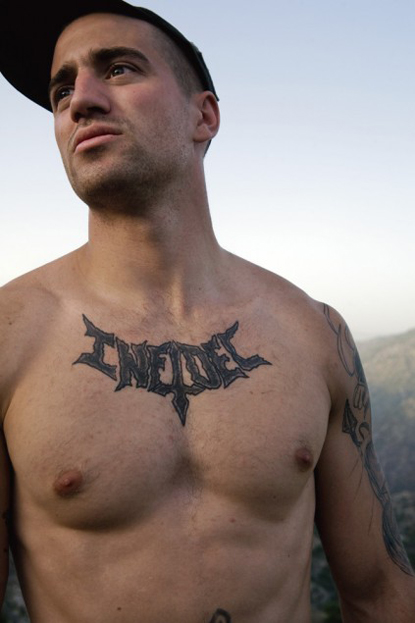
"Infidel," Tim Hetherington, All rights reserved

Directly across from the entrance to AIPAD 2012, a wall of large color prints by photojournalist Tim Hetherington shows young American soldiers in Afghanistan’s Korengal Valley in 2011. Pictured sleeping in their bunks or trying to relax between battles, the (all-male) soldiers are young, fit & invariably shirtless. They wear camouflage pants and boots and sport lurid tattoos – one, in purple, says “Infidel.” The soldiers radiate a slightly dinged-up, bad-boy quality that reminded me, in spite of myself, of meticulously rough-looking ad shoots for jeans by Levi or Diesel.

It wasn’t supposed to be this way. Hetherington (who, soon after leaving Afghanistan, was killed covering the overthrow of Quadaffi) made these pictures as part of a very different story. Even a cursory glance at his Afghan pictures from Korengal reveals a full awareness of how murderous and confusing the conflict was for these young Americans. In their frontier outpost, always under attack, the men responded by closing ranks and projecting attitude and fierceness outward. As presented by Yossi Milo, who reportedly took over Hetherington’s estate after his death, this context is absent. The men here are warrior beefcake. Their war has become a brand.

Perhaps there’s no point of complaining about sales people trying to sell. But what exactly are they trying to sell here?

In 2012 the AIPAD galleries in general offered a great number of unstaged pictures. For instance, I saw work everywhere by the great photojournalist Henri Cartier-Bresson, who died in 2004. His work was crisply printed, matted, mounted and priced at about $15,000. But I noticed something I hadn’t seen before. Every Cartier-Bresson picture featured an authoritative signature in black ink on the margin of the print. Many of the mattes even had neat windows x-actoed out to exhibit the master’s name. They were standardized.

Henri_Cartier_Bresson.Blog
Henri Cartier-Bresson, All rights reserved

It’s true that Cartier-Bresson himself wasn’t very interested in the printing and presentation of his pictures. His famous quote,“Hunters, after all, are not cooks,” expressed his point of view. But there’s something sad about the way his brave, humane work seems to be aging. As witnesses die and passions fade, the events he photographed become, more and more, the pictures he made of them. Increasingly aestheticized and commodified, these moments become the elegance and style of Cartier-Bresson’s rendering. The jolting heartbeats that inspired the pictures are going.

This AIPAD, in fact, convinced me that the black-and-white photographs of the Leica generation that included Cartier-Bresson – roughly from Andre Kertescz to Garry Winnogrand –are the new American canon. Included in this increasingly collectible category I saw prints by Bruce Davidson, Lee Friedlander, Helen Levitt, William Klein, Eliot Erwitt , Mary Ellen Mark and others.

Perhaps it’s time for this to happen. Though some photographers will always choose to shoot in black and white for its matchless abstract and metaphorical power, it has now become, after all, a historical process. Yet something is indeed lost as black and white images move slowly away from the mainstream into the realms of art and scholarship.

The most expensive black and white pictures from this group were shot by the unsentimental outsider Robert Frank, whose star continues to rise with current street photographers. Perhaps today’s shooters, with their ubiquitous digital SLRs, sense in Frank a combination of determination and despair they also feel. “We are driven to do this work, yes, but, really, what’s the point?” they ask. Does the seemingly timeless success of Frank’s images give them any answer?

Most of Frank’s work at this AIPAD was beautiful, but the prices were high even for less-than-stellar work. I saw an uninteresting 8 x 10 shot of two couples on a bench in a Reno marriage mill (from the same take as the more famous shot of one couple on the bench) selling for $125,000. A dark print from 1951 titled “London Bankers” went for a princely $250,000. Even more surprisingly, a truly bad print -- a 1955 image titled “Coney Island,” was so muddy and flat any good printer would have thrown it out (and Frank had a good one, Sid Kaplan). The print was priced at $50,000. Rock bottom for the new Frank.

RyanWeidemanCabCulture
"Cab Culture," Ryan Weideman, All rights reserved

Here’s a quick list of goodies you could have brought home from AIPAD 2012:

Portraits of Frida Kahlo by Nicholas Murray in black and white and carbon print color from her 1939 trip to New York City. Winter Works on Paper: $1,500 for the black and whites; $6,000 for the color.

From four different galleries, virtually identical Ansel Adam’s “Monolith, the Face of Half Dome, Yosemite National Park, 1927.” Approximately $20,000.

Taxi driver/photographer Ryan Weideman’s in-cab portraits of the famous or merely weird. My favorite, “Salsa Ride With Salsa Betty,” from 2002. Bruce Silverstein.

Wonderful 1950 nude from Weegee the Famous, who apparently cut up the negative to insert a tilted third eye into the middle of the model’s forehead. Henry Fieldstein, $6,500.

A miserably anxious Janis Joplin sitting backstage clutching her pint of Southern Comfort. By Jim Marshall, $9,000.

“Jewelry Store Window,” Andy Warhol, black and white. Looks exactly like the proud submission of someone taking their first photo class. Erick Franck, $9,000.

Notable omissions: The Chinese, the French and the Japanese were there. Where were the Germans? There was no August Sander but also no Loretta Lux. Perhaps Andreas Gursky wasn’t there because the Park Avenue Armory was too small. Oh well, maybe next year.