Showing posts with label society. Show all posts

Saturday, January 24, 2015

Thomas Struth: Striving for the big picture

Review by Tim Connor


As a photography student at Kunstakademie Düsseldorf in the 1970s, Thomas Struth learned to create big, highly detailed pictures with his classmates – now photographic luminaries -- Andreas Gursky, Thomas Ruff and Candida Hofer. At the time their teachers, the legendary husband-wife team, Bernd and Hilla Becher, taught a technically rigorous system to “objectively” document disappearing German architecture. According to the Becher system, subjects must be captured serially with a large-format camera using black-and-white film under a cloudless sky. All subjects must be shot from uniform distances and heights, printed with medium contrast at a prescribed size and shown together to facilitate comparison.

In his current show at the Met we see Struth’s homage to this exacting style -- a wall-sized grid of black-and-white prints showing well-known New York City intersections in 1978. Older New Yorkers may treasure or rue these pictures as memories, but the more salient point is that, soon enough, nobody will be alive to remember them. Still, there is much to admire in the way the pictures treat, not only the streets and buildings , but everything -- every parked car, overloaded trash can and  random walking-through-the-shot human -- with exactly the same crisp, non-judgmental clarity.

CrosbyStSoho1978_struth
"Crosby Street, Soho, 1978," Thomas Struth, All rights reserved
This is Struth’s first major project.  Afterward, his career moves on fast. Without abandoning the discipline and technique he has acquired from the Bechers, he begins to take on large ideas and issues. It is his willingness to do so that animates this show.

In the 80s Struth continues to shoot architecture and landscapes.  Like his schoolmate Gursky, he takes up color and begins to use photoshop to assemble from multiple viewpoints single images of large locations and structures. But, unlike Gursky, who over the years steadily creates more and more gigantic prints of larger and larger events, (the Chicago Board of Trade, the Olympics)  Struth’s big pictures seem uninterested in spectacle. Gursky wins worldwide acclaim by moving farther and farther away from what he photographs. Struth moves closer. His pictures, though still large and complex, become more and more about the people present or implied within the frame.  They radiate emotion that can be felt by anyone.

These qualities are best seen in the pictures the Met has collected from Struth’s three ongoing series – roughly titled, “Museum,” “Paradise” and “Technology.”

Struth’s “Museum” series comes from a simple idea. He photographs people looking at art and history in museums all over the world. Strictly realistic, rendered in sumptuous colors, these large, calm compositions at times resemble the Old Master paintings that appear in many of the prints. Yet the unrehearsed modern tourist crowds are always there too. Some museum-goers are reverent. Some are playing with their iphones and thinking about their lunch. They bring a  here-and-now immediacy to pictures meant to last. 

MuseumStruth
"Art Institute of Chicago,1990," Thomas Struth, All rights reserved
struthbigMuseum
"Museo Del Prado 7, 2005," Thomas Struth, All rights reserved

The balance between large ideas – the present and the past, the material and the spiritual, for example – makes me wonder if Struth is aiming for the cusp between them? Or do his museum pictures – like many of the old religion-based paintings depicted within them –incline toward moral lessons? If so, the messages are hard to recognize, extremely subtle. Yet the question continues to rise.

Asked about the Museum series, Struth said “… the ineffable spills into the ordinary and the spiritual aspirations of our ancestors intersect with the needs of the present.” It’s clear that with these works Struth is gesturing toward something beyond their quotidian content. In fact – like every artist -- he is imbuing lifeless materials with human energy. Where does that energy come from?

We get to decide for ourselves.

One thing I think we know.  In the Museum series the goal of this energy is no longer the same as it is in the old paintings. Unlike the paintings, the energy of the photographs is not directed at individual salvation.  We might think of its heaven as salvation for all.

familyofartistsretouchersTStruth
"Art Restorers at San Lorenzo Maggiore, Naples, Italy, 1988," Thomas Struth


I think this becomes clear in Struth’s Paradise series. Photographed at ground level in various rainforests in Japan, Australia and South America, all the images in the series are called “paradise” and numbered.  Only one, “Paradise 13, Yakushima, Japan 1999,” is included in the show.  Yet, from this picture and others I have seen elsewhere, “paradise” seems a very odd title for Struth to have chosen.
“Paradise 13,” for example, is shot deep inside a low, wet, dark forest strewn with fallen trees and moss-covered boulders. It is certainly no Eden. Struth is well-known as an ardent environmentalist, and it’s hard to imagine him resorting to cheap irony. Some of the other forest “interiors” in this series are tangles of dazzling green, flooded with transforming light. They are beautiful to look at and, as we know, vital to the health of our planet.
 But – come to think of it – real rainforests are always unrestrained riots of hungry competitive life. They are always difficult for humans. Struth is making a difficult point. Our human instinct is to transform them to meet our needs. But the Earth too needs salvation.

Paradise17-TStruth
"Paradise 13," Thomas Struth

thomas-struth-growth-09-690x568
 "Paradise 9," Thomas Struth, All rights reserved

With the “Technology” series, Struth asks: Does the human genius for technology threaten our species? Does technology also offer hope? These too are ultimately spiritual questions.

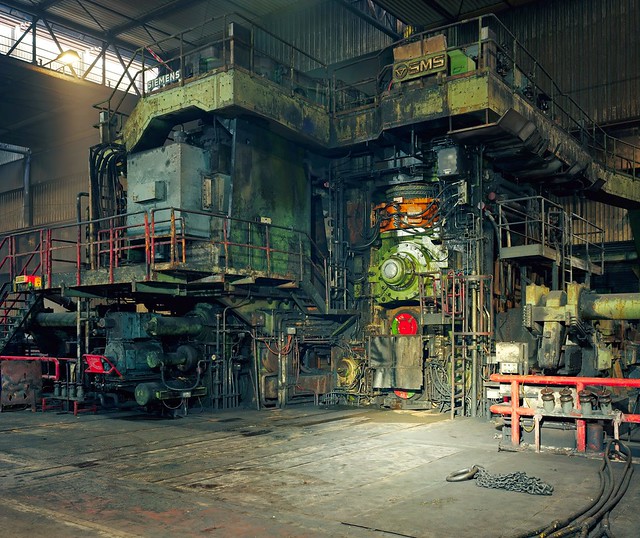
 Struth’s “Hot Rolling Mill, Thysen Krupp Steel, Duisburg, 2010,” takes us into the silent interior of a gigantic industrial machine. By choosing an old German steel mill and associating it with the name Krupp, Struth is deliberately evoking Hitler’s Third Reich and the murderous weapons with which Germany came close to conquering the world. And the picture itself -- a vast brutal wall of machinery in semi-darkness, grime-encrusted, its khaki greens punctuated with the faded, reds and oranges of catwalks and cables -- is indeed terrifying. Even worse, a thick chain is bolted to the steel-plate floor in the only area lit by a window. It took bravery to make this picture. Struth knows exactly what he is alluding to. 
5. Hot Rolling Mill,ThyssenKrupp Steel, Duisburg_Thomas Struth
"Hot Rolling Mill, Thysen Krupp Steel, Duisburg, 2010," Thomas Struth

If “Hot Rolling Mill” balances past and present, the most astonishing picture in the Technology series presents itself literally as a fulcrum between present and future.   Called “Figure 2, Charite, 2013,” the picture shows a woman strapped to a medical gurney suspended in mid air. Looping in from piled machines and monitors are dozens of wires, tubes and cables, all of which attach to her body. At first, we recoil from the image. It seems to be a Frankenstein-like experiment or perhaps some hideous torture. Then we notice that the room is spotless, the light is clear and the woman is young and blonde with beautiful skin.  We are confused. What are we looking at?
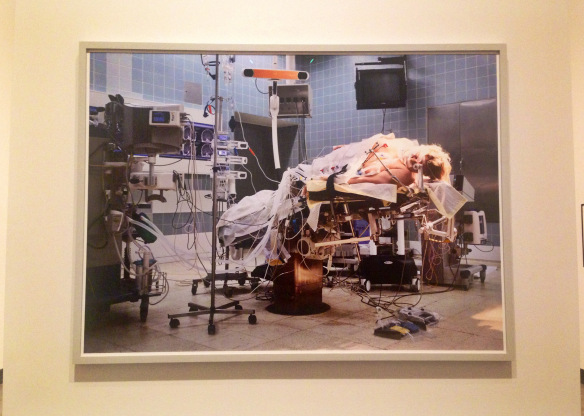
Figure2,Charite, 2013
"Figure 2, Charite, 2013," Thomas Struth, All rights reserved

It’s an operating theater in Berlin, where this anaesthesized young woman is about to undergo surgery to remove a brain tumor. With the woman’s full permission, Struth has photographed the moment before the doctors and nurses enter to begin. We learn in a caption that the woman survived and, two years, later is living comfortably. Still, we wouldn’t know that if we hadn’t been told. Is Struth intentionally frightening us with scary technology that is actually built and used to save lives?

I don’t think so. I think he is making full use of his freedom to challenge us.  Some things that at first seem repellent are beautiful. Struth’s mentors, the Bechers, photographed water towers, silos and blast furnaces they judged beautiful – and safe to photograph – in a defeated, divided Germany after a vicious war.  Now, more than a half century later, Struth again finds beauty in our still dangerous and increasingly complicated – but perhaps freer – world.  He makes big pictures for the world.

This review appears in The New York Photo Review



Saturday, December 20, 2014

The madonna and the whore

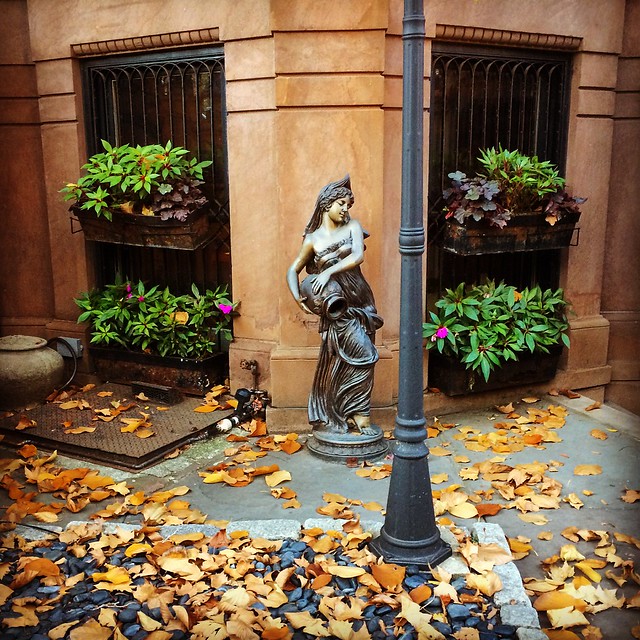
PerfectMadonna
"Madonna," Tim Connor, All rights reserved

Water Bearer
"Water girl," Tim Connor, All rights reserved

More photos on my Flickr site.

Saturday, December 13, 2014

Women of New York

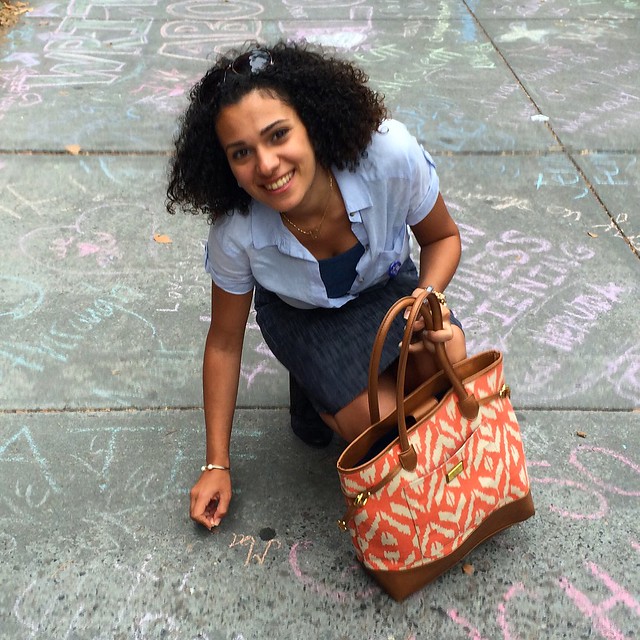
Sidewalk of love
"Sidewalk of love,"  Tim Connor, All rights reserved

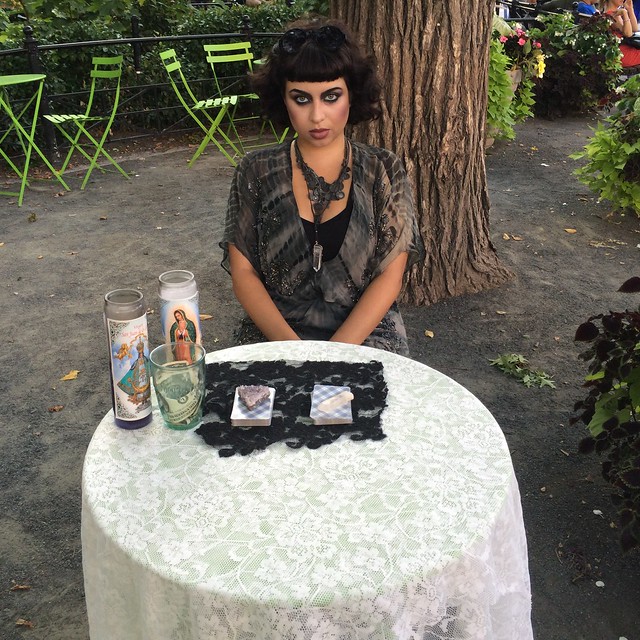
Read your cards?
"Tarot card reader"

Basketball girl (color)
"Basketball girl," Tim Connor, All rights reserved

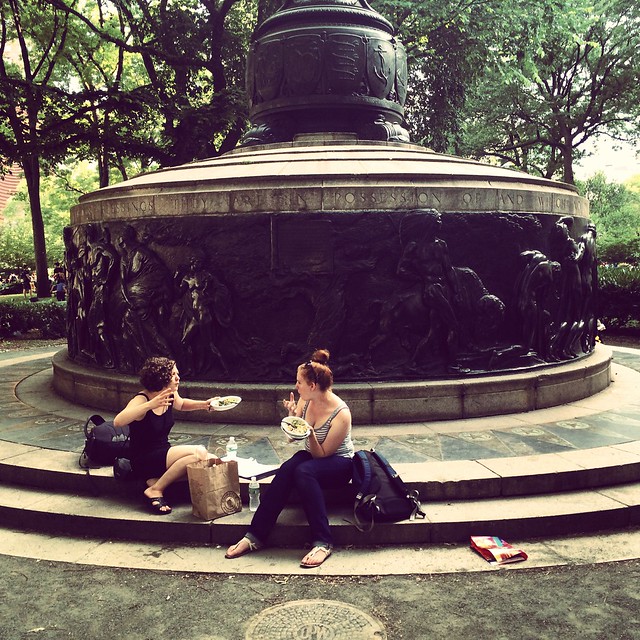
Lively lunch
"Lunch in Union Square," Tim Connor, All rights reserved

Topknot
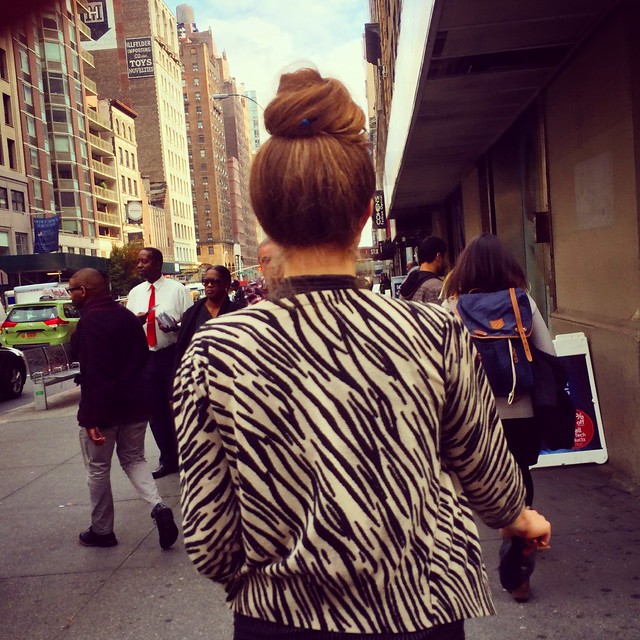
"Top knot," Tim Connor, All rights reserved

Coffeehouse
"A clean, well-lighted place," Tim Connor, All rights reserved

Thursday, December 11, 2014

Back to the blog

We all dream of immortality. Is Google eternal? Perhaps for a few years. In any case I want to start posting my photos here again. Here are a couple. More to follow.

TwoBaldMannequins
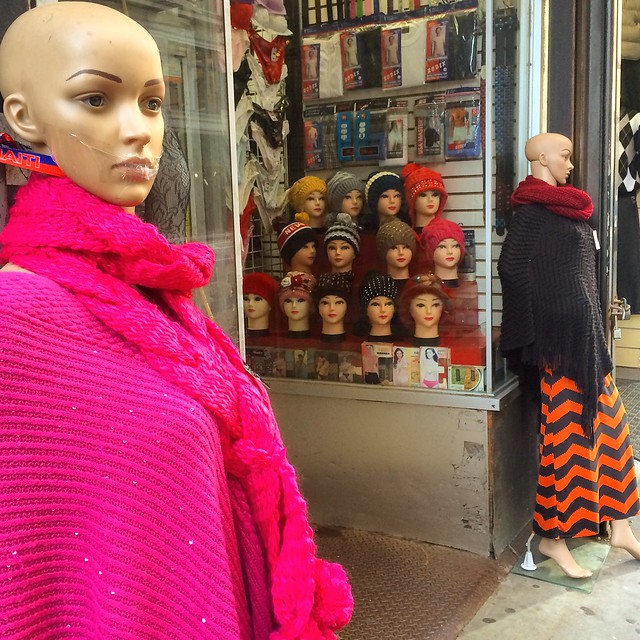
"Mannequins, Manhattan," Tim Connor, All rights reserved

CUMannequins
"Black haired mannequin, Manhattan," Tim Connor, All rights reserved

Wednesday, August 13, 2014

Critical mass: Writing something a lot of people are thinking

WorldsFair64_Winogrand
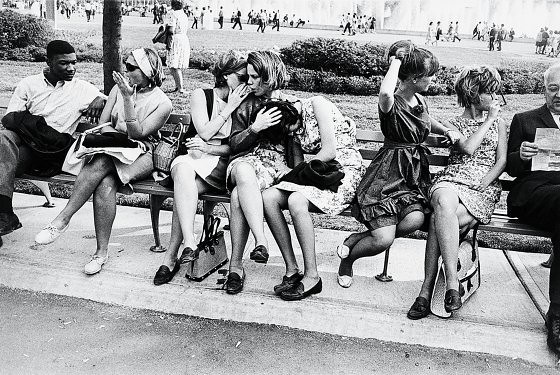
"New York World's Fair, 1964," Garry Winogrand, All rights reserved

To conclude his review of the Garry Winogrand show at the Met (editor's note: Winogrand's images are mostly unplanned shots of strangers going about their lives, like the example above), New York Magazine art critic Jerry Saltz wrote the following:

"Something we’ve been missing also becomes evident here. The whole world is now filled with incredible images—especially on Instagram and other social networks—that owe something to Winogrand’s, documenting life, change, and all the rest. Yet the art world and museums are not. Instead they tend to show oversize, very still pictures or images that investigate formal properties and ideas of display and presentation. I love many of those pictures, but what’s happening online on social media deserves far more serious scrutiny than it’s getting. If the art world doesn’t admit more of this sort of deceptively casual-seeming work, the outside world will reject more so-called art photography than it already does. That’s a divide that we don’t need to reestablish and widen."

About time.

Thursday, June 5, 2014

Truppe Fledermaus and the Carnival at the End of the World

GreenmanRowing
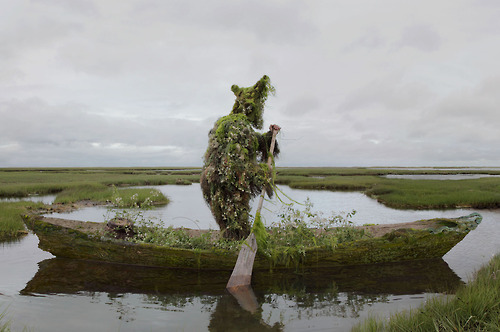
"Greenman," Kahn and Selesnick, All rights reserved

“Truppe Fledermaus & the Carnival at the End of the World,” at Yancey Richardson, might be described as a performance of the imagination. Concocted by two English-born, U.S. educated artists, Nicholas Kahn and Richard Selesnick , the show creates just enough semi-plausible historical authenticity to soften up viewers for the artists’ outlandish – but not impossible – vision of the future.

Kahn and Selesnick have collaborated before – for the past 20 years in fact – creating fictitious histories from both the past and future (on both Earth and other planets) that combine impeccable pseudo-erudition with no-limits weirdness. I have to admit I’ve never seen anything quite like this work. The artists’ mastery of photography, drawing, printmaking, sculpture and creative writing is matched only by their showmen’s fervor to wow their audience. In fact, trying to think of comparisons, I could only come up with the Monty Python Flying Circus –likewise fervently theatrical, over-educated, British and willing to try anything.


These guys are having fun.
Der Letzte Mann(Last Man)_KahSelesnick
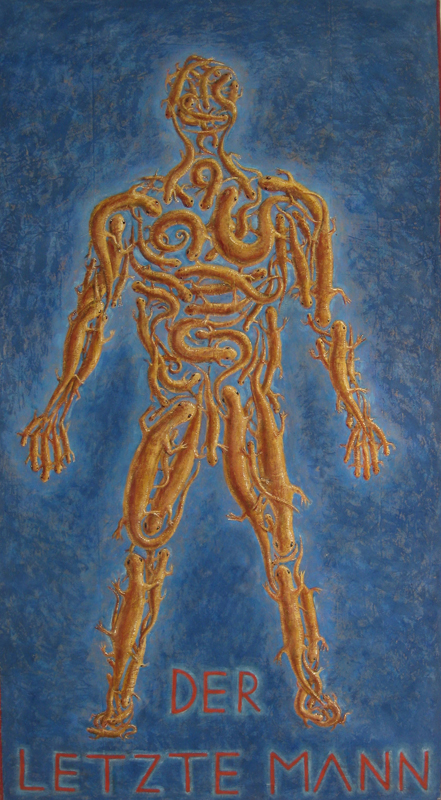
"Der Letztze Mann," Kahn and Selesnick, All rights reserved


The world conjured by this show is framed by an invented traveling theater of hustlers, freaks and spiritualists called “Truppe Fledermaus” (Bat Troupe). Next to the gallery entrance, an entire wall  is covered with posters and handbills advertising the Truppe’s strange offerings.  Stylistically, these ads -- with copy in German – refer to everything from German Expressionist cinema  -- “Ich bin Nosferatu” (I am the Vampyre) -- to fanciful medical charts – “Tod Frucht” (Death Fruit) – to a colorful, full-figured nude woman covered with roses that suggests P.T. Barnum via Manet  -- “Das Tatowierte Wunder” (The Tattooed Wonder).  

I’m not entirely sure why these ads are funny, but they made me laugh.  The artists’ decision to use the German language is part of it.  If you’re a linguistically unsophisticated American (like most of us) try booming out “Ich bin Nosferatu!” over and over in a small room and you’ll know why. This prejudice is unfortunate and probably worse than that (I remember my parents telling me about neighbors who refused to take Hitler seriously because his speeches on the radio made them laugh). But, here, as elsewhere in the show, Kahn and Selsenick seem determined to go with their guts. Funny is funny. I’m sure John Cleese would approve.

HieronoMan
"Demon man," Kahn and Selesnick, All rights reserved


In the room with the prints are a few sculptures – created, we are told, from “…ceramic, wax, Styrofoam, paint, plaster, glass antlers and silicone caterpillars.” Like the posters, the sculptures suggest a new world in which genetic boundaries are exotically shifting. For instance, a bust of a top-hatted man mounted on a tripod is densely covered with pitch black feathers, as though he is morphing toward a new consciousness as a crow. By now,  it’s clear this theme will repeat throughout the show. Still, with the tangible three-dimensionality of the sculptures, the idea gains a special kind of fetishistic power.  I’m guessing many people wouldn’t want this Crow Man to spend the night in their bedroom.

The remainder of the show (five walls out of six) consists of photographs. Taken in both black and white and color with an 8 X 10 view camera, many of these are aesthetically superb (Kahn and Selesnick studied photography together at Washington University). Their technical control makes them wonderfully incongruous with the subject matter, which is primitive and truly bizarre.  It’s not clear if the Truppe Fledermausers themselves are taking part in the activities or simply witnessing them. “At the end of the world” I’m not sure it matters.

Human populations have collapsed. Individuals and small groups of humans make their way on foot, by hand-drawn primitive wagons and carts or in rough canoes, through a bleak, boggy, apparently drowning world of rampant vegetation and mutant creatures.  When they gather in groups it seems to be for the purpose of creating strange tableux or engaging in wild revels of unclear purpose.

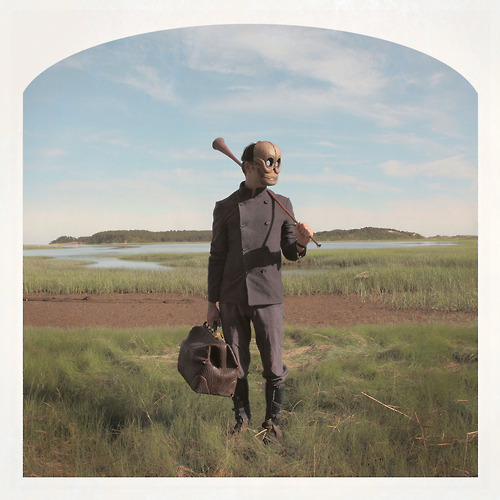
Nearly everyone wears a mask. From Hieronymous Bosch alone, the artists have stolen bird beaked, owl-eared and wide-eyed grinning demon masks. Furry bat (fledermaus) masks are also popular and, in a pinch, simple Ku Klux Klan-style bags with cut-out eyeholes, pulled down over the face, will do.

It’s a wild, wild world.

Climate change and rising sea levels are clearly the subtext here, although the artists’ invented future has little in common with what we might expect from a real post-warming planet. Instead of huge ruins and the ubiquitous trash of billions (whether or not killed off by plagues) -- we get deserted swamps, bogs, mudflats, dunes, beaches, rocky outlooks and placid bodies of water.

Apparently, we are returning forward to a world of harsh threats and magical remedies. In this world even the most basic technologies of the past have been erased.  In response Nature Herself seems to be trying something new. Parts are somehow being swapped among humans, other mammals, birds, fish and plants to produce bizarre human-other and other-other hybrids. Among the shambling-bramble-plant-human mixes alone, for example,  we see Yew Man, Lichen Man, Seaweed Man and the more generic Greenman, who starred in an earlier Kahn and Selesnick show, “The Pavilion of the Greenman,” in 1997.

All this may not convince as dystopia, but it thoroughly seduces as pure imagination.

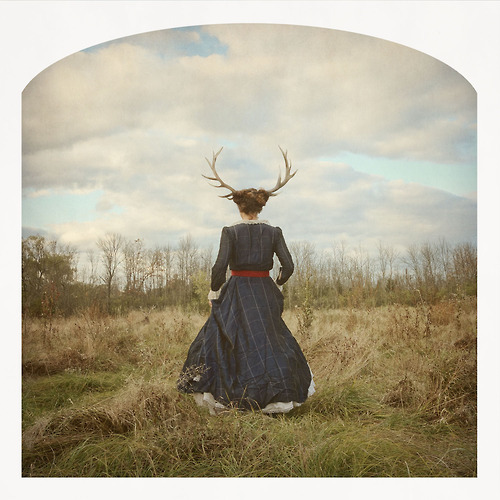
LadyHorns_KahnSelsenick
"Lady with antlers," Kahn and Selesnick, All rights reserved


I’ll end this review by describing two favorite pictures. Both represent what to me made this show so unusual  --  its willingness to go anywhere imagination might take it. We get jokes and parodies, horror and tragedy, winks and warnings, all blended into visual stories that range from dadaesque to heartwarming.

One: A young woman in Victorian dress is running away, across a drab, wintry field, holding up her petticoats.  From her piled-up hair two giant antlers rise against the sky. I can feel this woman’s distress. Suddenly, I realize it’s Jane Eyre fleeing in tears from Mr. Rochester.  I become a cynical English Lord in love. My legs are twitching to follow.  

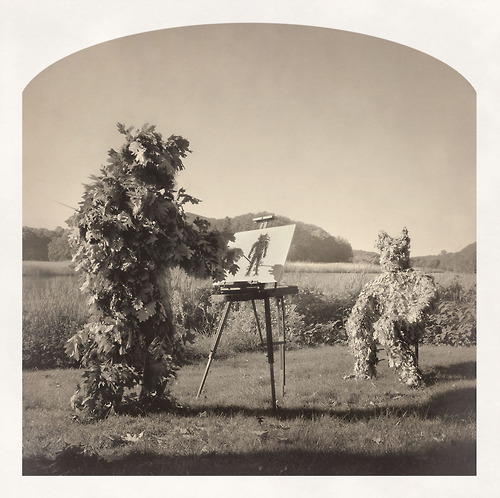
LeafManPainting_KahnSelsenick
"Leaf man painting Leaf man," Kahn and Selesnick, All rights reserved


Two:  Next to a curving river, Leaf Man, the artist, sights over his brush at the plein air portrait of his friend and subject, another Leaf Man. The two Leaf Men appear to be having a jolly chat. What a pleasant way to make art, they are saying.

Long live art! How do you say that in German?

This review also appears in The New York Photo Review.

Monday, March 3, 2014

Instagram

To make instagram: Shoot picture with phone camera, process through phone app with standardized filter choices, then phone to your network. Share.


"My favorite shawarma shop," Tim Connor, All rights reserved

"Schoolday instructions," Tim Connor, All rights reserved


"Taking a call," Tim Connor, All rights reserved

http://instagram.com/

Monday, January 27, 2014

Fay Weldon -- an excerpt that made me laugh

From an essay in The NY Times Book Review: "Writers of a Certain Age," by British novelist Fay Weldon. Funny, sad and too true.

"Like the gap between rich and poor, the gap between young and old widens. The New Young increasingly resent theNew Old -- those whom medical science keeps in their prime without the will to accept obscurity and fade away gracefully. There are more of us, and we don't look nearly as nice as the New Young. We move slowly, get in their way on the sidewalk, lose our glasses, hold up the line using coins not cards, take forever texting, irritate by asking for help with smartphones, can't manage tablets and take forever in the powder room. Having destroyed the planet, the New Old now encroach upon Facebook and Twitter, invented by the young for the young, to try to sell our own books. For the New Young it must seem intolerable, but for us, what a great boon it is to be judged by our words and ideas, not by our looks."

Monday, January 20, 2014

The arc of war


"Marines, Korean War," David Duncan, All rights reserved

I remember the first war photograph that got to me. I must have been about 11. It was a picture by David Douglas Duncan in an old Life Magazine of two U.S. Marines, heads ducked down, rifles in their hands, running toward a battle in Korea. The first Marine wore his helmet at a rakish angle and sported a pencil-thin mustache like the young Ernest Hemingway. As he raced past the camera toward possible death, he managed a grim, tiny smile. I was smitten.

I think most, if not all, boys are drawn to fantasies of war. For me Duncan’s picture lit up visions of nonchalant courage and noble sacrifice that were already present in my adolescent consciousness. Later, I learned the photo was an honest depiction. Far from a propagandist, Duncan, an ex-Marine, had covered World War II, then the Korean War –always from the perspective of the troops in the field. Shooting in Vietnam, he had turned against the war and published two photo books — I Protest (1968) and War Without Heroes (1970).

Such attitudes – for or against war — are studiously avoided in “War/Photography: Images of Armed Conflict and its Aftermath” at the Brooklyn Museum. Sprawled across multiple panels, this large, ambitious collection presents over 400 pictures by 255 photographers from over a dozen nations. The curators declare their intention to explore “the general progression – the arc – of every war ” and divide the pictures into sections on “recruitment, training, embarkation, daily routine, battle, death and destruction, homecoming, and remembrance.” The exhibit covers an astonishing 166 years worth of wars — from the Mexican American War (1846-1848) to the recent conflicts associated with the Arab Spring (2010).


"Drill sergeant, Parris Island," Thomas Hoepker, All rights reserved

The curator’s scholarly approach is very good at putting to rest contentious myths about certain well-known photographs. For instance, was the World War II shot of American soldiers raising the flag on Mount Suribachi at Iwo Jima a spontaneous action or premeditated propaganda? It turns out it was a little of both. The flag-raising captured by Joe Rosenthal’s iconic photo was improvised as a way to signal to thousands of troops still fighting on the island below that the mountain had been taken. However, it wasn’t the first flag that had been raised that day. A smaller flag in a less visible spot had been hoisted (and photographed) a short time earlier. The one that became world-famous was a replacement, and, yes, homeland PR was a big part of the reason.

In fact, propaganda (sometimes just natural bias) can be found in pictures from all sides in this show. Famous American photographers like Margaret Bourke-White and Edward Steichen, for example, did their bit for the war effort in World War II by creating beautiful compositions of grand battleships in naval processions and sleek fighter planes taking off, accompanied by the cheers of onlooking troops. It’s hard to fault the photographers’ intentions. That was their job, after all, and, in time of war, they obviously wanted to make their country look good. It is only while looking at pictures of the pulverized landscapes and shattered human bodies these graceful machines can leave behind that one remembers their murderous purpose.

"Untitled," Wesley David Archer, All rights reserved


Easier to classify, if not to forgive, are the fabricators. Before small cameras, fast films and Photoshop, fakes were harder to create than today–– but they were also easier to get away with. In World War I, for instance, a man named Wesley David Archer produced a mesmerizing shot of a war plane in flames with its pilot falling below it through space. The plane’s wings bear the Iron Cross, which would make the pilot German. How marvelous! There was only one problem: Archer had created and photographed the whole scene in his studio as part of a money-making scam. Later, he went on to become a well-known model-maker in Hollywood.

"Valentine with her daughters, Amelie and Inez, Rwanda, 2006," Jonathan C Torgovnik, All rights reserved

Such dishonesty (certainly at the level of posing or on-scene cropping) will always exist in photography, but, to my mind, the most important pictures in this show represent a relentless visual boring at the truth about the real experience of war. This body of pictures has been building up since photographers like Robert Capa began carrying small, versatile cameras to the war zones of the 1930s. It continued through the appalling horror and mega death of World War II and Korea, but it wasn’t until the Vietnam War that truly disturbing images became widely available in the United States. With the publication of Eddie Adam’s photograph of South Vietnam’s National Chief of Police summarily executing a Viet Cong guerilla in 1968 and Nick Ut’s 1972 shot of napalmed Vietnamese children running in agony down a road, the floodgates finally opened. Included in the show are incomparable images by Don McCullin, Horst Faas, Larry Burrows and others, widely credited with helping to end the war.
"Assault with helicopters, Vietnam," Horst Faas, All rights reserved
Today many of us are privileged – and, if we read newspapers and use the internet, even compelled — to look at truly painful color photographs of both combatants and victims from the world’s far-flung conflicts. As this show demonstrates, a steady flow of war images by a loose multinational corps of male and female freelancers is now a given. Surprisingly free from allegiance to ideologies or nationalistic prejudices, most of these pictures honor and grieve both civilian and military suffering. At their most provocative they even open chinks of compassion for the others – the enemies who fight against and try to kill our loved ones.
"Viet Cong soldier, Vietnam," Don McCullin, All rights reserved
Let me give an example. A 10-foot-long full color image from Afghanistan by French photographer Luc Delahaye shows a very young man lying dead in a shallow, dusty pit. He is wearing a thin cotton shirt beneath an empty ammunition vest, baggy pajama-like pants and dusty black socks. His legs are neatly folded like a well-behaved boy. Indeed, if not for the small wound in his neck, he could almost be a gangly post-adolescent boy taking a nap. Then we notice something. He is wearing socks. But where are his boots? Stolen, we realize.Who is this abandoned and desecrated boy?
Delahaye tells us in a single word: “Taliban.”
If I had looked at this picture when I was 11, I would have turned away confused and upset. That’s good.

Saturday, November 2, 2013

Apocalypse in miniature: Lori Nix's 'More from The City'

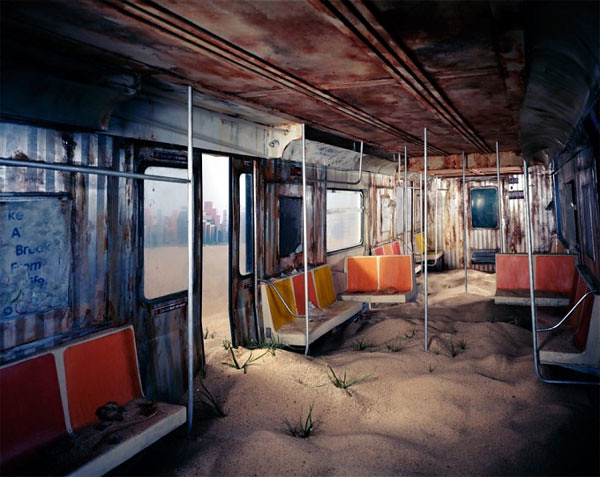
NixPix_Subway
"Subway," Lori Nix, All rights reserved


While never completely out of fashion, apocalyptic fantasy art was once the realm of disillusioned outsiders. No longer. Baying forth directly from the deep pockets of corporate high tech, today’s sleek, dystopian movies, TV, video games and other visual media now dominate our imaginative culture. At the same time apocalypse-themed fiction and nonfiction books and journalism drive much of our intellectual discourse. No civilization has ever been more thrilled by its own demise.

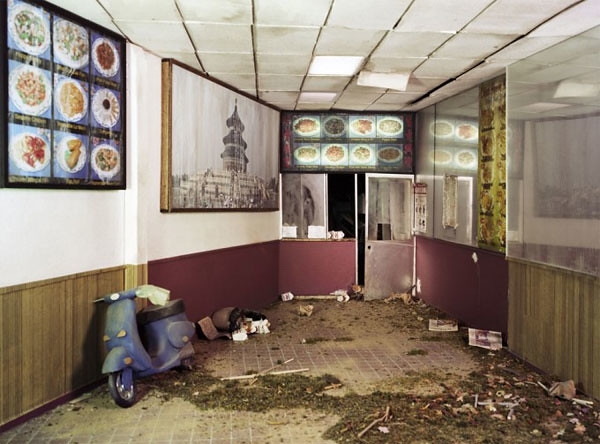
Photographer Lori Nix’s end-of-the-world show, “The City,” at Clampart covers this familiar territory but not without staking out its own brand of modesty and wit. A self-proclaimed “danger and disaster” artist, Nix admits to being “fascinated, maybe even a little obsessed, with the idea of the apocalypse.” Her show imagines a New York City in which all humans have been suddenly terminated, leaving behind only their objects and buildings. This “post-human” metropolis is depicted in large color prints of iconic public spaces — a library, a shoe store, a Chinese take-out restaurant, etc.

Nix’s works are first constructed as scaled-down dioramas (about five-feet-long) and then photographed with an 8 X 10 view camera and printed from the negatives. To create, assemble and record each diorama takes Nix and her partner, Kathleen about seven months. In the process the two women meticulously build and paint an astonishing variety of miniature objects – from pool tables to encyclopedias to laundromat washing machines. 

The verisimilitude of the little worlds is remarkable. But Nix’s miniature power tools are, after all, not CGI and her old-school archival color printing is not Photoshop. Her interiors are sometimes flawed. Not often, and not by much, but enough so a close viewer will notice. For instance, the show’s advertising shot, a cunningly realistic B subway train, forever stalled and filling up with sand at the Brooklyn end of the Manhattan Bridge, looks across a sand-locked East River to a rudimentary stage-set drawing of the Manhattan skyline. Why not make the skyline look as real as everything else?

NixPix_ChineseTakeOut
"Chinese Take-Out," Lori Nix, All rights reserved


I’m guessing Nix wants her pictures to inspire awe and unease at a distance and then––as the viewer takes a closer, more leisurely view––provide pleasure and a few chuckles. Her “Chinese Take-Out” picture, for example, brilliantly conjures the formulaic elements of such places – basic store front décor, a picture of ancient temple from the old country, standard OSHA “First aid for choking” poster and two sets of what-you-see-you-get food photos of General Tso’s Chicken, Vegetable Lo Mein and other dishes, identified in Mandarin and English. The fabricators have taken great pains to “distress” the interior with dirt and grime and to strew around red-stamp-labeled take-out containers and authentic-looking pages from a tiny New York Times. But when Nix places a blue delivery scooter right at the front of the room, it’s impossible to miss that it’s a child’s toy. And, look, what’s that sneaking through the open kitchen door? It’s a stuffed red fox. Should I be surprised when a quick Google search reveals that – according to Chinese tradition — the fox is a signal from the spirits of the dead?

NixPix_Casino
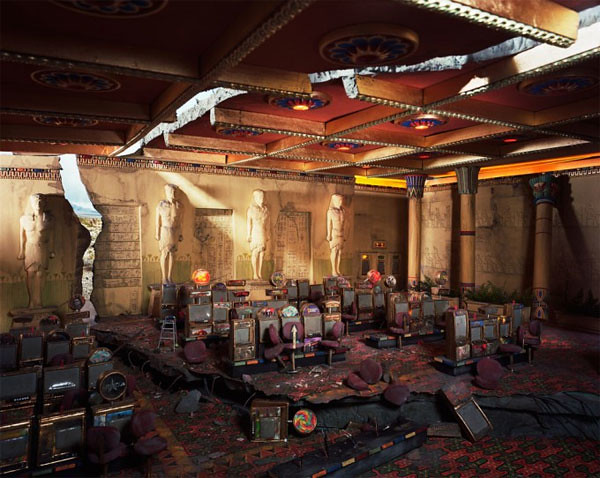
"Casino," Lori Nix, All rights reserved


I don’t think so. After scheming and tinkering for over half a year on these pint-sized replicas, I imagine very little – if anything – has been missed. What’s more, the playfulness turns up in the other pictures, too. For instance, in “Space Center,” imagined as a once proud, now desolate museum of human flight, two hawks are busily nesting in what’s left of a Mars Rover. In “Casino,” the ceiling is torn open like a tomb to reveal cheesy replicas of dynastic Egyptian guardian statues standing against walls covered with hieroglyphics. The floor is filled with rusting slot machines that bear names like “Strike It Rich.” One of them is called “Doomsday.”

I’m glad that Lori Nix is making pictures of disaster we can really look at. With its low-tech craft and slow-dawning gags her work feels personal – to her and to us. We are invited into a very still, and sad — and undeniably ridiculous — made-up world. It occurs to me this may be a better place to contemplate human folly than shoulder to shoulder with a movie star as he mows down zombies.

Originally published in The New York Photo Review
Friday, October 4, 2013

Phone among phones

2 street phones
"Two street phones" by Tim Connor, All rights reserved

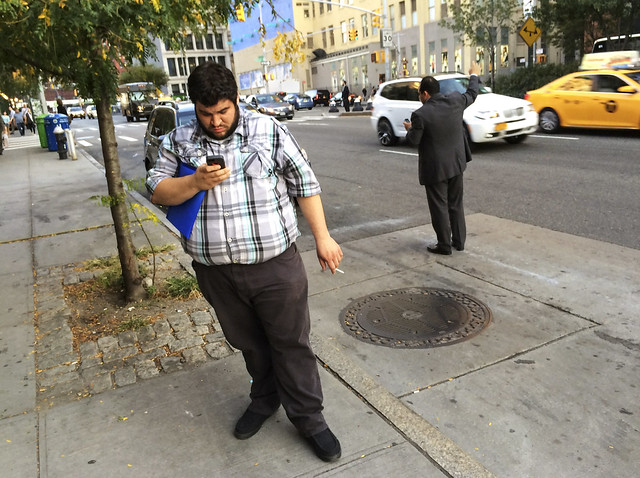
Taken with my new iphone 5S. I didn't buy this phone/camera to shoot Gary Winnogrand-style street snaps, but that's about all I've done so far. The FS camera is well-suited to nervy spontaneous shooting, though it's awkward as hell (I keep shooting pictures of my big pink figures). For one thing the Fs's fully automatic white balance and metering systems  handle mixed NYC color and light brilliantly so far. I'm pleased with the quality.

But, way more important, shooting with a phone seems to excuse my voyeuristic perfidy! I' m just a guy with a phone! No one is worried about a guy with a phone. Look,  everybody is walking around with them-- handling them, playing with them, peering at them, listening and talking to them, tapping and swiping at them. What could be more harmless?

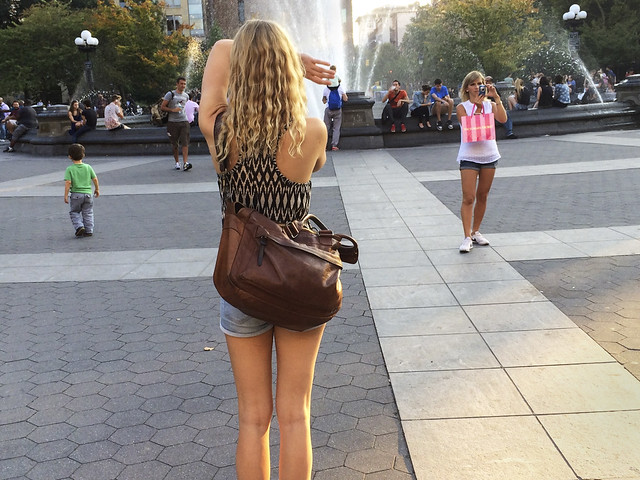
Two girls and a small boy at Washington Square
"Two girls and a small boy, Washington Square" by Tim Connor, All rights reserved


Saturday, March 23, 2013

A different kind of history

JackWFamily_RussellLee
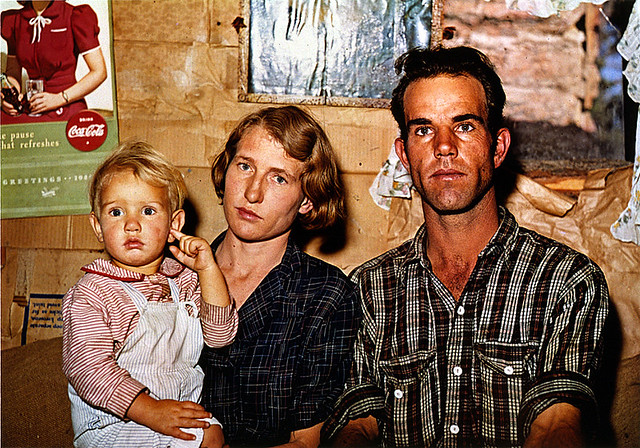
Russell Lee, Jack Whinery, Homesteader and Family, Pietown, New Mexico, September, 1940

The 31 photographers included in "Everyday America, Photographs from the Berman Collection," at Kasher Gallery cover more than 75 years of  America’s story, but the people and events scholars might deem the proper content of our national history are not here. Instead the photographers present a sort of hodgepodge history of images anyone might have noticed -- and possibly thought unremarkable. Here’s a partial list of subjects: houses, shopkeepers, vehicles, lovers, amusement parks, suburbs, couples, orchards, graves, dancers, motels, kids, train trestles, shoppers, barber shops (I could go on and on).
This is a different kind of history, and I don’t mean to make fun of it. On the contrary, arranging the pictures outside a historical context seems in keeping with their essential idea – they were shot in history, not about it. By not attaching the photographers’ names and picture titles alongside the works, the curators go further toward isolating the images in their own discrete moments (catalogs are readily available). I found the disorientaion refreshing. The experience became just me and the images – like peering though a viewfinder moving randomly through time.
And the pictures are superb.  Roughly grouped under the rubric of “documentary,” the photographers avoid sentimentality and (except for one mocking photo by Martin Parr) post-modern irony. Their tool of choice is most often a large, unwieldly 4x5 or 8x10 view camera, which requires fixed intentions and emphasizes clarity and specificity.
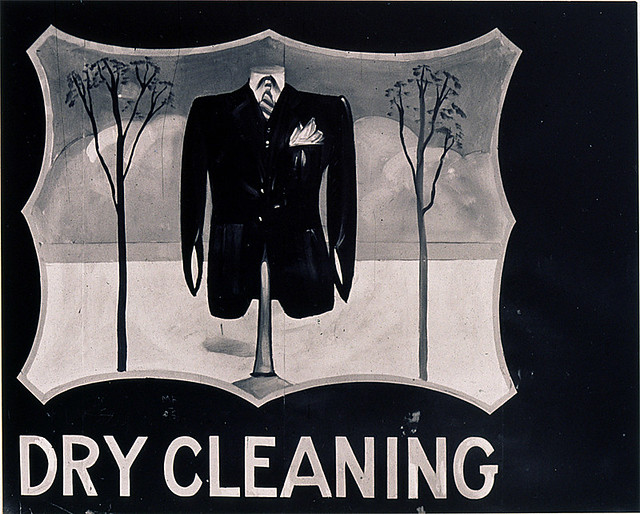
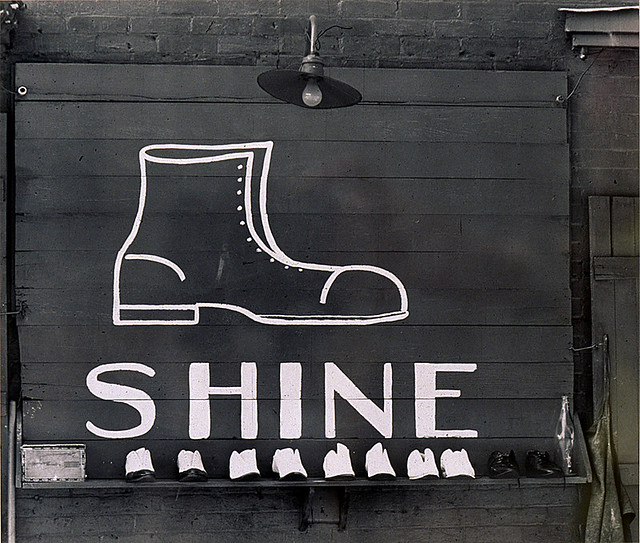
Arguably, almost all the styles in this show can be understood as versions of Walker Evans’ style. And, indeed, Evans -- with the largest number and often the best pictures in the show -- is the star here. We see, for example, his fascination with the art and language of commercial displays – he called them “the pitch direct” –echoed in pictures by Aaron Siskind and John Vachon and expanded to church signs and scribbled graffiti by Dorothea Lange and Helen Levitt.

DryCleaning_WalkerEvans
Walker Evans, Outdoor Advertising Sign (Dry Cleaning) near Baton Rouge, Louisiana 1935”

Shine_WalkerEvansWalker Evans, “Shoeshine Shine in a Southern Town, 1936”
It was Evans who first understood that the written word in public is important socially and aesthetically.  His homage to skilled and graceful sign-painting  in  Outdoor Advertising Sign (Dry Cleaning) near Baton Rouge, Louisiana, 1935” and minimalist white-paint-on-black board in  Shoeshine Shine in a Southern Town, 1936,” for instance, show us that – long before MBAs discovered them -- brands were, for good or evil,  indelible.   
Or they can be chaotic, as Robert Frank shows in his 35mm. New York street shot, “Untitled (Poultry Store Front), 1950s. ” In the shot a messy script, daubed on a sign above a trash-filled sidewalk, maniacally proclaims “1-pound giblets for $3” over and over and over.  This is Frank working characteristically against the grain. He is no doubt well aware that the signs’ thumbed-nose to craftsmanship represents a social change.  What has happened to Evans’ folk artist/sign painter? Is he drunk?   Or has be been replaced by a machine?
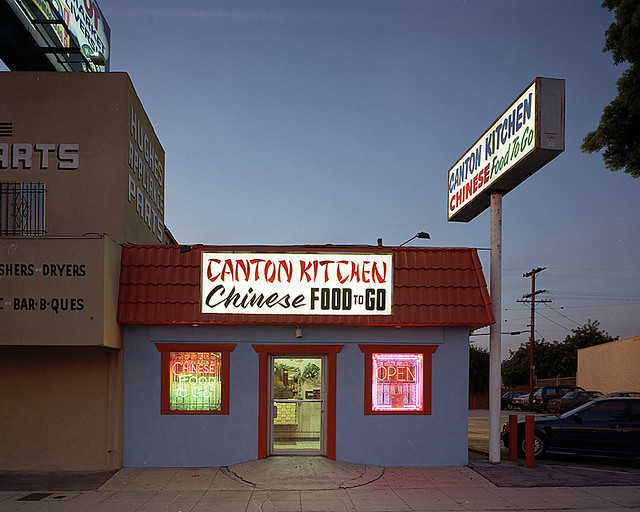
The transformation of the show’s themes over time is one of its great pleasures. For instance, John Humble, a west coast photographer has photographed the streets and buildings of Los Angeles in large-format color since the 1970s. His color shot of a low-slung fast-food restaurant, the show’s “12511 Venice Blvd, Mar Vista (Canton Kitchen), 1997” at first seems garish with multiple signs and neon windows.  But we soon understand that  Humble’s picture is in its way as modest and precise as one of Evans.

CantonKitchen

John Humble, 12511 Venice Blvd., Mar Vista (Canton Kitchen), January 8, 1997
What’s different in this picture (aside from the color) is the rest of the world. The Canton Kitchen itself, a place about the size of a Manhattan studio apartment, is crouched in the shadow of an appliance parts warehouse under an illuminated billboard and, on the other side, pushed up against a nondescript parking lot. Given this, and the fact that no one walks in L.A., it’s hardly surprising that four signs are needed -- one of them towering above the tiny building (Chinese FOOD to GO). We’re not in 1930s Connecticut anymore.  
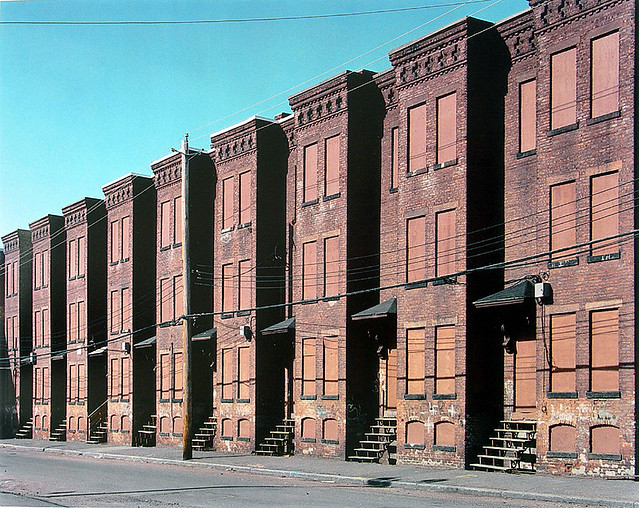
Numerous examples from the show make clear that Evans was drawn to deserted, closed and boarded-up buildings, a theme repeated here by William Christenberry, Jack Delano, David Husom and Mitch Epstein, among others. But where Christenberry’s freshly-painted white church, in Hale County, Alabama in the 1970s, for example, exudes hope despite the boards nailed over its windows, Epstein’s bricked-up factories in Holyoke, Massachusetts in 2000 emanate despair. Buildings have a spirit, just like living creatures.  

It was Evans’ great gift to infuse inanimate objects with a tender life most photographers grant only to other human beings. But, perhaps as a corollary of this, he seemed reluctant throughout his career to make intimate portraits, preferring to pose people in the midst of larger scenes, if at all. (An exception – perhaps a telling one – is his New York City series of subway portraits, shot in secret, spy-camera-style.)

BoardedRowHsesHolyoke_MitchEpstein

Mitch Epstein, Newton Street Row Houses, (Brownstone Building), Holyoke, Massachusetts, 2000
Could an unconscious aping of Evans’ people-shyness by curators or collector explain why so few portraits are in this show? It’s a real surprise, given the size of the space, that all the significant people pictures can be grouped in one corner.  Clearly, this is not because they’re unconvincing or weak. On the contrary, this section of the show may be its liveliest.
This is in spite of the fact that many of the portraits in “Everyday America” are not “everyday” at all. They are classic black and white prints by Dorothea Lange, Margaret Bourke-White and other Depression-era shooters of refugee families and young working men fleeing the dust-bowl.  These dramatic pictures are interesting, but there’s something musty and old-fashioned about them. They were widely published at the time and are now so well-known as a genre it’s hard to really see them clearly. But then comes an early color shot by FSA photographer Russell Lee to pierce through the decades.
In Lee’s picture, “Jack Whinery, Homesteader and Family, Pietown, New Mexico, September, 1940,” (see it top of this review) a handsome young working-class man and his blonde, blue-eyed wife, holding their toddler son, stare resolutely into the camera.  Behind them is the cardboard-covered wall of their new rough-built shack with plastic stretched over an unframed window. A swatch of flowered fabric for curtains is tentatively pinned up near the window. A Coca-cola poster is hanging on the wall. 
To me this picture says, “We are a God-fearing, can-do American family, and we are not afraid.” My question might be, Why not? The Great Depression is still hanging on, and another great war is looming in Europe.  Yet, as a viewer, I believe in this family. Here in America they’ll make it, I'm sure. In the final reel, I tell ourselves, everything will work out.

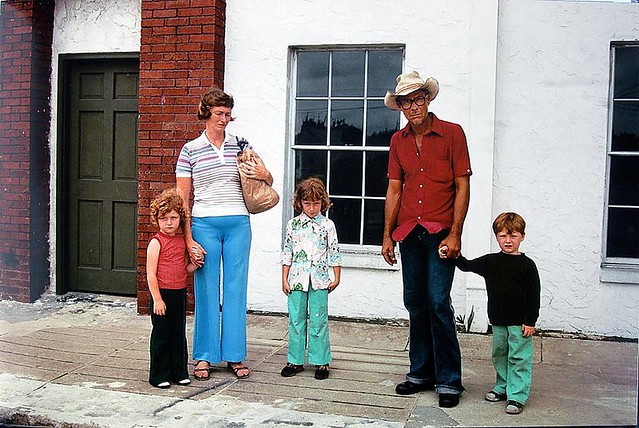
RedHairedFamily_MitchEpstein
Mitch Epstein, Ybor City, Florida (Mother with Brown Paper Bag), 1983
By 1983, when Mitch Epstein made “Ybor City, Florida (Mother with Brown Paper Bag), ” belief is harder to come by. In Epstein’s picture a thin man in a ragged straw hat glares belligerently at the camera. Behind him, dressed in cheap, ill-fitting clothes and clutching an old paper bag, his wife and three young children stand apart, round-shouldered, looking down at the sidewalk or off to the side, anywhere but at the camera. They are waiting for the shame to end. But it won’t. 
What has changed?
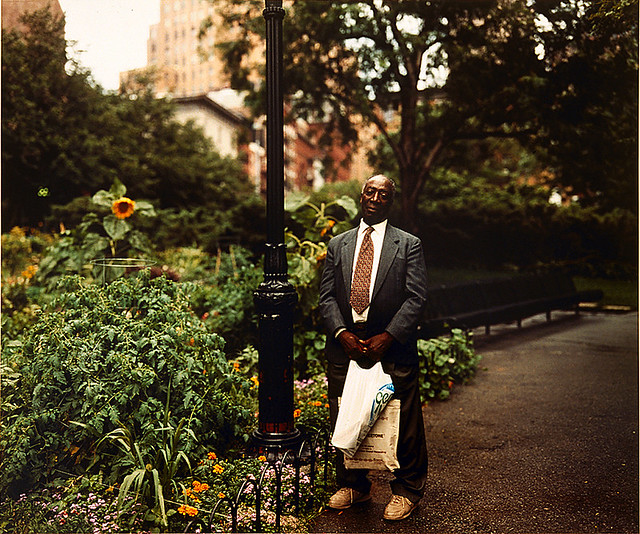
Flash forward to 1997. Joel Sternfeld ‘s “A Man Walking Home, Washington Market Park, NYC” shows a well-dressed late-middle-aged black man standing by a lamppost in a lush city park in an upscale neighborhood. The man leans back, smiling, balancing two shopping bags. We see that he is next to a garden. Tomatoes are growing. A sunflower nods its golden head. The man’s mood seems peaceful, friendly. After so many years, he looks like he feels at home.  
BlackManNYC_JoelSternbergJoel Sternfeld, A Man Walking Home, Washington Market Park, New York, August, 1997
What has changed?

Wednesday, March 6, 2013

Other Landscapes Under the Sun


Michael Benson’s “Planetfall” at Hasted-Kraeutler        Reviewed by Tim Connor


 MBenson_UltraVioletSunBlog
"Ultraviolet Sun," Michael Benson, All rights reserved
 Human imagination has been soaring into the heavens for millions of years, but it wasn’t until 1961 that Russian cosmonaut Yuri Gagarin actually left Earth’s atmosphere.  Between 1969 and 1972 twelve Americans walked on the moon, but that’s as far as human bodies ever got. Increasingly, in recent years, space travel has meant virtual ride-alongs on remotely-piloted robotic spacecraft with engineered senses. It is from these otherworldly robots that writer-photographer Michael Benson mined visual data for his powerful exhibit, “Planetfall,” at Hasted-Kraeutler.
To show the solar system “…through the lens of art,” Benson used raw frames culled from NASA and European Space Station missions from 2000 to 2012 (astonishingly, all spacecraft data is free and stored on the internet.) “It’s all online. I browse from home,” Benson says of his method.  He curated by “…sifting through tens of thousands of raw frames – in effect panning for gold.” Next came image processing, compositing and mosaicking to make the final photographs.

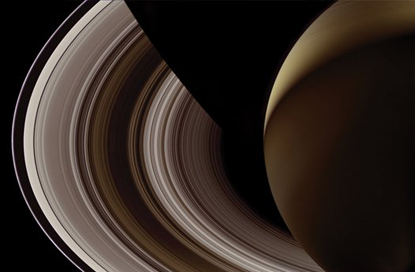
It’s no surprise that “Planetfall’s”  images are technically extraordinary. Some of the pictures of Mars, for instance, were made with NASA’s HIRISE camera, which has a 19.7-inch aperture, allowing it to render images of one foot per pixel. Such cameras create images that astonish, not only because they really exist but also because they seem impossible (or faked). The show’s images of Saturn’s rings, for example, have a rigid, abstract geometric precision that makes them appear to be machines. On the other hand, Io, Jupiter’s highly volcanic fifth moon, looks like a hunk of pocked and mouldy yellow cheese.
MBenton_NightSaturnBlog
"Saturn at Night," Michael Benson, All rights reserved
But science is only the beginning here. Without some emotional content most of the pictures in this show would amount to little more than strongly-lit dead rocks or migrating cauldrons of swirling gas. Benson’s art is to make the distant, inhospitable places in our solar system seem accessible, if not to human travelers, then at least to a viewer’s feelings. One way he does this is to emphasize universal commonalities – shapes, colors, gravitational logic, the behavior of wind, light, fire and so on.  We see how alien it is out there -- but it’s not so alien we can’t feel connected.

Benson explains this approach with a quote from theoretical physicist Werner Heisenberg: “We have to remember that what we see is not nature herself, but nature exposed to our method of questioning.” In “Eclipse of the Sun by the Earth,” for instance, an orangey-red hemisphere of sun emerges from Earth’s shadow literally boiling --in fact, half-exploding -- with heat.    From the writhing gases on the sun’s surface, hellish flowers seem to be blooming, their centers blazing  with incandescent yellows. A viewer is hard-pressed not to back away from this ferocious image. And this is not just a reaction to its imagined heat. This sun appears to be in a violent rage. We can feel its uncontrolled wrath. There is danger in this wrath – and beauty too. We can glimpse why ancient people gave such strong personalities to their god-planets and stars.

MBenson_SunsetMarsBlog
"Sunset on Mars," Michael Benson, All rights reserved
It’s interesting that Benson finds very different metaphors in his pictures of Earth’s nearest sibling, Mars.  The planet’s red rock and sand deserts , barren valleys and far-off low ranges of hills are not so different from views found on our own planet. Thus Benson’s “Sunset on Mars” is weirdly familiar, even with its tiny, distant sun and magenta-tinted atmosphere.

Why, I wondered, is this Martian sunset so much more melancholy than any I’ve seen on Earth?  Perhaps it’s because this and the other Martian photographs in the show seem to bear out a mood detectable in our long-standing, obsessive fantasies about vanished civilizations on the Red Planet.  The NASA photographs are detailed; they show no canals. Yet the Mars in these pictures seems spent, desolated; its time over; its ripeness gone. Something must have happened ...

MBenson_HomewardBoundBlog
"Sun on the Pacific," Michael Benson, All rights reserved

Here I’m in mythical territory, of course. But perhaps I’m not being whimsical. Could the cautionary feel of the Mars pictures reveal an aspect of Benson’s curatorial intentions? Here’s a piece of evidence. My favorite picture in “Planetfall,” titled “Sun on the Pacific,” shows a softly curving Earth horizon pushed up against an inky black crescent of space. When I first gazed at this picture’s large-scale print on the wall, I felt oddly weightless, a speck floating dreamlike above blue and pink clouds that framed a golden gleam of sunlight on a peaceful ocean.  And then I realized my point of view – the point of view Benson had chosen for me -- was a spaceship cruising the last leg of its homeward journey. And the Earth had never looked more beautiful.
More evidence. In a recent interview Michael Benson said the following: “I’ve looked at thousands of images [of Earth] from space over the last few months, and many images show evidence of planetary distress. For instance you can see smoke filling the air of the entire continent of South America due to the burn off of jungles. My view is that an honest look at the early twenty-first century solar system needs to include visual evidence of climate change here on the third planet. “
Also published in New York Photo Review, 03/2012