Showing posts with label massmedia. Show all posts

Saturday, January 24, 2015

Thomas Struth: Striving for the big picture

Review by Tim Connor


As a photography student at Kunstakademie Düsseldorf in the 1970s, Thomas Struth learned to create big, highly detailed pictures with his classmates – now photographic luminaries -- Andreas Gursky, Thomas Ruff and Candida Hofer. At the time their teachers, the legendary husband-wife team, Bernd and Hilla Becher, taught a technically rigorous system to “objectively” document disappearing German architecture. According to the Becher system, subjects must be captured serially with a large-format camera using black-and-white film under a cloudless sky. All subjects must be shot from uniform distances and heights, printed with medium contrast at a prescribed size and shown together to facilitate comparison.

In his current show at the Met we see Struth’s homage to this exacting style -- a wall-sized grid of black-and-white prints showing well-known New York City intersections in 1978. Older New Yorkers may treasure or rue these pictures as memories, but the more salient point is that, soon enough, nobody will be alive to remember them. Still, there is much to admire in the way the pictures treat, not only the streets and buildings , but everything -- every parked car, overloaded trash can and  random walking-through-the-shot human -- with exactly the same crisp, non-judgmental clarity.

CrosbyStSoho1978_struth
"Crosby Street, Soho, 1978," Thomas Struth, All rights reserved
This is Struth’s first major project.  Afterward, his career moves on fast. Without abandoning the discipline and technique he has acquired from the Bechers, he begins to take on large ideas and issues. It is his willingness to do so that animates this show.

In the 80s Struth continues to shoot architecture and landscapes.  Like his schoolmate Gursky, he takes up color and begins to use photoshop to assemble from multiple viewpoints single images of large locations and structures. But, unlike Gursky, who over the years steadily creates more and more gigantic prints of larger and larger events, (the Chicago Board of Trade, the Olympics)  Struth’s big pictures seem uninterested in spectacle. Gursky wins worldwide acclaim by moving farther and farther away from what he photographs. Struth moves closer. His pictures, though still large and complex, become more and more about the people present or implied within the frame.  They radiate emotion that can be felt by anyone.

These qualities are best seen in the pictures the Met has collected from Struth’s three ongoing series – roughly titled, “Museum,” “Paradise” and “Technology.”

Struth’s “Museum” series comes from a simple idea. He photographs people looking at art and history in museums all over the world. Strictly realistic, rendered in sumptuous colors, these large, calm compositions at times resemble the Old Master paintings that appear in many of the prints. Yet the unrehearsed modern tourist crowds are always there too. Some museum-goers are reverent. Some are playing with their iphones and thinking about their lunch. They bring a  here-and-now immediacy to pictures meant to last. 

MuseumStruth
"Art Institute of Chicago,1990," Thomas Struth, All rights reserved
struthbigMuseum
"Museo Del Prado 7, 2005," Thomas Struth, All rights reserved

The balance between large ideas – the present and the past, the material and the spiritual, for example – makes me wonder if Struth is aiming for the cusp between them? Or do his museum pictures – like many of the old religion-based paintings depicted within them –incline toward moral lessons? If so, the messages are hard to recognize, extremely subtle. Yet the question continues to rise.

Asked about the Museum series, Struth said “… the ineffable spills into the ordinary and the spiritual aspirations of our ancestors intersect with the needs of the present.” It’s clear that with these works Struth is gesturing toward something beyond their quotidian content. In fact – like every artist -- he is imbuing lifeless materials with human energy. Where does that energy come from?

We get to decide for ourselves.

One thing I think we know.  In the Museum series the goal of this energy is no longer the same as it is in the old paintings. Unlike the paintings, the energy of the photographs is not directed at individual salvation.  We might think of its heaven as salvation for all.

familyofartistsretouchersTStruth
"Art Restorers at San Lorenzo Maggiore, Naples, Italy, 1988," Thomas Struth


I think this becomes clear in Struth’s Paradise series. Photographed at ground level in various rainforests in Japan, Australia and South America, all the images in the series are called “paradise” and numbered.  Only one, “Paradise 13, Yakushima, Japan 1999,” is included in the show.  Yet, from this picture and others I have seen elsewhere, “paradise” seems a very odd title for Struth to have chosen.
“Paradise 13,” for example, is shot deep inside a low, wet, dark forest strewn with fallen trees and moss-covered boulders. It is certainly no Eden. Struth is well-known as an ardent environmentalist, and it’s hard to imagine him resorting to cheap irony. Some of the other forest “interiors” in this series are tangles of dazzling green, flooded with transforming light. They are beautiful to look at and, as we know, vital to the health of our planet.
 But – come to think of it – real rainforests are always unrestrained riots of hungry competitive life. They are always difficult for humans. Struth is making a difficult point. Our human instinct is to transform them to meet our needs. But the Earth too needs salvation.

Paradise17-TStruth
"Paradise 13," Thomas Struth

thomas-struth-growth-09-690x568
 "Paradise 9," Thomas Struth, All rights reserved

With the “Technology” series, Struth asks: Does the human genius for technology threaten our species? Does technology also offer hope? These too are ultimately spiritual questions.

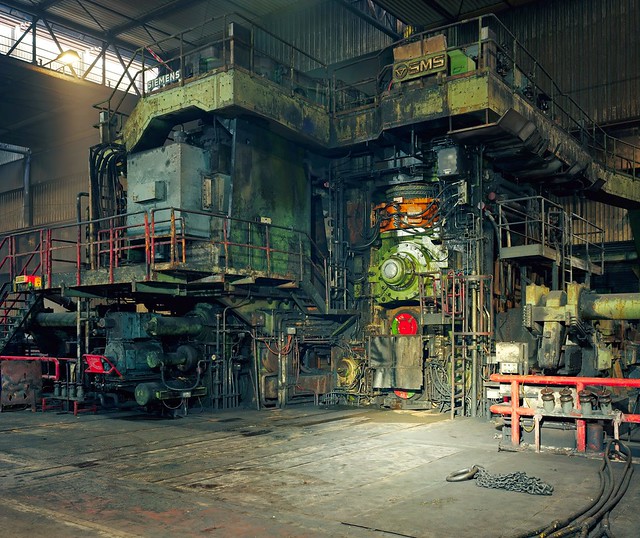
 Struth’s “Hot Rolling Mill, Thysen Krupp Steel, Duisburg, 2010,” takes us into the silent interior of a gigantic industrial machine. By choosing an old German steel mill and associating it with the name Krupp, Struth is deliberately evoking Hitler’s Third Reich and the murderous weapons with which Germany came close to conquering the world. And the picture itself -- a vast brutal wall of machinery in semi-darkness, grime-encrusted, its khaki greens punctuated with the faded, reds and oranges of catwalks and cables -- is indeed terrifying. Even worse, a thick chain is bolted to the steel-plate floor in the only area lit by a window. It took bravery to make this picture. Struth knows exactly what he is alluding to. 
5. Hot Rolling Mill,ThyssenKrupp Steel, Duisburg_Thomas Struth
"Hot Rolling Mill, Thysen Krupp Steel, Duisburg, 2010," Thomas Struth

If “Hot Rolling Mill” balances past and present, the most astonishing picture in the Technology series presents itself literally as a fulcrum between present and future.   Called “Figure 2, Charite, 2013,” the picture shows a woman strapped to a medical gurney suspended in mid air. Looping in from piled machines and monitors are dozens of wires, tubes and cables, all of which attach to her body. At first, we recoil from the image. It seems to be a Frankenstein-like experiment or perhaps some hideous torture. Then we notice that the room is spotless, the light is clear and the woman is young and blonde with beautiful skin.  We are confused. What are we looking at?
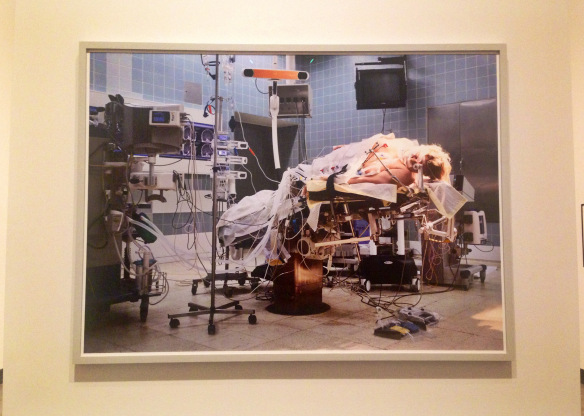
Figure2,Charite, 2013
"Figure 2, Charite, 2013," Thomas Struth, All rights reserved

It’s an operating theater in Berlin, where this anaesthesized young woman is about to undergo surgery to remove a brain tumor. With the woman’s full permission, Struth has photographed the moment before the doctors and nurses enter to begin. We learn in a caption that the woman survived and, two years, later is living comfortably. Still, we wouldn’t know that if we hadn’t been told. Is Struth intentionally frightening us with scary technology that is actually built and used to save lives?

I don’t think so. I think he is making full use of his freedom to challenge us.  Some things that at first seem repellent are beautiful. Struth’s mentors, the Bechers, photographed water towers, silos and blast furnaces they judged beautiful – and safe to photograph – in a defeated, divided Germany after a vicious war.  Now, more than a half century later, Struth again finds beauty in our still dangerous and increasingly complicated – but perhaps freer – world.  He makes big pictures for the world.

This review appears in The New York Photo Review


Saturday, December 13, 2014

Random art

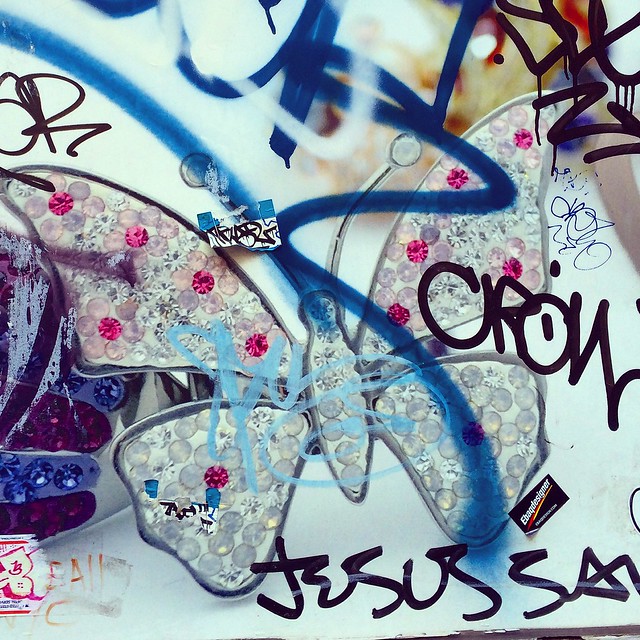
TaggedButterfly
"Butterfly enhanced," Tim Connor, All rights reserved

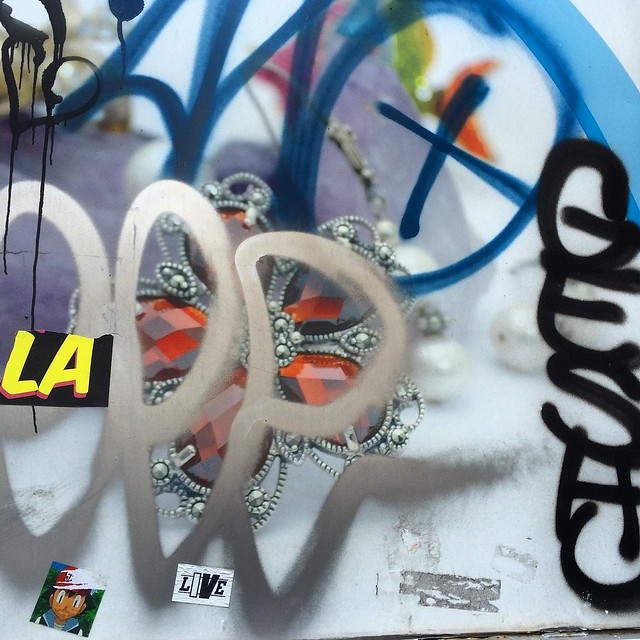
Collage2
"LA Live," Tim Connor, All rights reserved

Friday, May 23, 2014

A photographer looks at Swoon

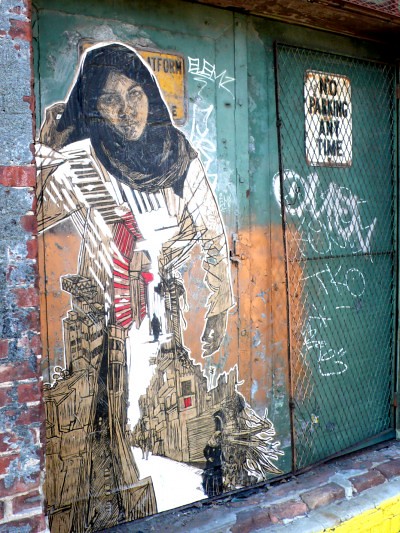
brooklyn-street-art-swoon-jaime-rojo-10-09-400x533
"Street art by Swoon, Brooklyn, NY," Jaime Rojo
I saw my first street installation by the New York artist, Caledonia Dance Curry, known as Swoon, years ago in the Gowanus section of Brooklyn. Gowanus was then a mix of aging and abandoned low-rise factories, warehouses, loading docks and junk-filled lots. It was a favorite destination for taggers and graffiti artists, who took advantage of its off-hours’ emptiness to paint their rowdy bright-colored works on its many blank walls. For me Gowanus was a quiet place to walk on weekends and take pictures.

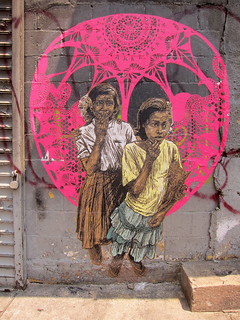
Swoon’s street art in Gowanus and, later, in other parts of the city, always stopped me and made me look. Despite its obvious sophistication, the work has the intensity of a child. Her prints, made from drawings on paper, cut out and carefully wheat-pasted at selected locations, are stylized portraits that often morph from (or into) other creatures and places. They’re over-sized, but not too big — the figures a little larger than human. Sometimes, Swoon cuts out lines and wedges from the portraits or creates lace-like additions and lets the walls shine through the openings. Color is also used on the prints – but sparingly.
swoon
"Two girls, street art by Swoon"
One of the things I always liked about these outdoor installations was that they are suddenly there; they are not signaled or heralded in any way. After mounting, they are left to the elements and the unpredictable mercies of passersby. Swoon makes sure to locate her prints where ordinary people will see them – and maybe not see them as art. Naturally, they are much photographed and subsequently circulated through photo-sharing sites to a potentially unlimited audience online. 

Dramatic and of-the-moment, the best of these repeatedly shared photographs – along with the offhand brilliance of the her art-name, Swoon – have no doubt done a great deal to spread Curry’s reputation and differentiate her from the other talented artists who use similar methods (I’ll mention, for example, Brian Adam Douglas — moniker Elbow Toe – whose work I also saw on Gowanus walls).

I know Swoon’s placement of her work is an expression of her conviction that art needs to move out of the studio and take back public visual space from advertisers and brand masters. It’s a conviction shared by Swoon’s British counterpart, Banksy, and thousands of other less-well-known artists worldwide. But, unlike Banksy, with his stenciled, laugh-out-loud provocations, Swoon’s approach is essentially romantic.

This renders her outdoor prints especially vulnerable. Made of paper, they’re organic and destined to fade, fray and fall away under the constant onslaughts of wind and weather. This is exactly the opposite of the results the art world strives for and, arguably, the most radical aspect of Swoon’s work. It’s also the aspect, I’d argue, that excites street photographers, who approach these prints, not as precious art to be recorded, but as elements of a particular moment’s concatenation of light, shape, color and meaning.
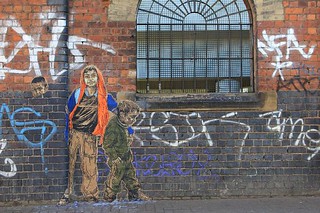
Swoon-Street-Art-London-18
"Street art by Swoon, London"

I was thinking about these ideas as I entered Swoon’s monumental installation, “Submerged Motherlands,” last weekend at the Brooklyn Museum. “Motherlands” fills a large high-ceilinged room, centered on a wonderful 60-foot-high fabricated tree covered with thousands of long strands of dyed fabric. The tree is flanked by a small charmingly decorated structure, called a “nest” or “hive,” where visitors can rest. “The Miss Rockaway Armada” and “The Swimming Cities of Switchback Sea,” two large ramshackle wooden rafts full of junk and tools turn out to be what’s left of Swoon-and-company’s amazing art-flotation adventures, on the Mississippi and the Hudson respectively, in the summers from 2006 to 2008. Swoon’s portraits in different sizes are spread throughout the space.


I didn’t get much from the exhibit notes, which adopt a sort of fantasy tone to suggest the show is about climate change and refer vaguely to Doggerland, a once-populated area between England and the Continent that went under as sea levels rose about 6,000 years ago. But it occurred to me that, even if the waters were rising outside the Museum, we would all feel cozy and well cared for in this exhibit. And, in fact, at that moment a museum guard politely warned me to not get too close to the art.

This show seemed to me a very long way from Swoon’s audacious collective raft projects of a few years ago – she has referred to the raft armadas as enactments of her childhood dreams. Perhaps the show is even farther from another kind of dream – say, a solitary print on a Gowanus wall as the February light is slipping away fast.

To confirm this, I looked more closely at the portraits that populate the show. Crisply reprinted in different sizes, many of them standing on their own, all are recycled. Perhaps this isn’t so strange. I’m aware that Swoon likes to repeat images and spread the notion of a kind of family around the city, but here, in a major museum show, in her hometown I thought she might show something new.

But there they are – Swoon’s mother and friends, portraits from Haiti and Mexico, a beautiful woman breastfeeding her baby, two grizzled toothless men with casts on their arms, laughing. Why do they feel so empty?
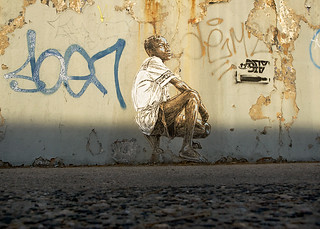
SwoonBoyUnionSt2011
"Boy looking up, by Swoon," Tim Connor
I think the answer is context. Here at the museum I’m part of a swirling, cheerful crowd in a magnificent high-ceilinged, sky-lit room. Everyone is talking. Everyone is taking pictures with tiny point-and-shoots and camera phones. It seems almost like an alternate to looking. As soon as shooters have their picture, they turn away and move on. A new normal?

I recognize a print of a black boy in a decorated tunic and shorts squatting on the ground, glaring upward. It’s an image I photographed on a heavily-tagged wall in Gowanus (on Union Street in 2011, it turns out). I remember crouching way down, almost to street level, to frame the picture. Afterwards, I looked at the boy for a long time. Alone on the street, I felt I understood his tense posture, his angry look. Not here.

Researching this article, I listened to Swoon talk on video about how her big collective projects had been exhausting experiences from which she needed time to recover. She called them “going outside” projects and said that afterwards she needed to “come inside” by accepting gallery or museum help to work on her own art.

That sounded (and sounds) reasonable to me. But, as I left this show, I really just wanted to urge Swoon to “go back outside” soon. 

This article also appears in The New York Photo Review.

Monday, March 3, 2014

Instagram

To make instagram: Shoot picture with phone camera, process through phone app with standardized filter choices, then phone to your network. Share.


"My favorite shawarma shop," Tim Connor, All rights reserved

"Schoolday instructions," Tim Connor, All rights reserved


"Taking a call," Tim Connor, All rights reserved

http://instagram.com/

Tuesday, December 3, 2013

Persistent mystery

Handout man / Emma's Dilemma
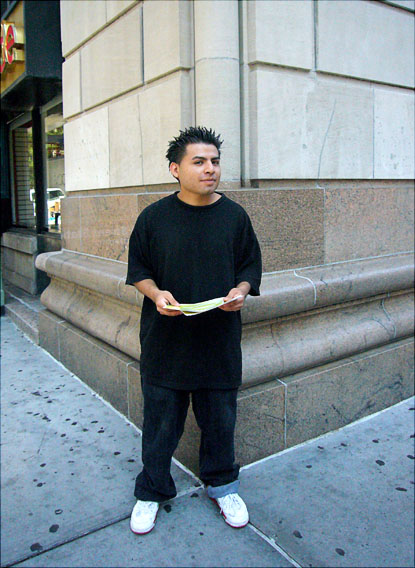
"Handout man, Manhattan," Tim Connor, All rights reserved

I'm not much of a numbers' man, but occasionally I like to look at Flickr's  stat summaries for photos I've posted. Some surprise me. The picture above, for instance, has been viewed 26,016 times.

That's a lot of views.

I don't get it. I understand how this one, received 12,530 views:

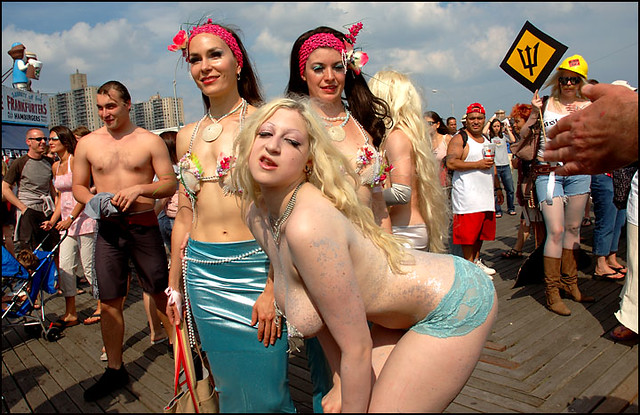
blonde
"Drunk blonde with Siamese twins, the Mermaid Parade," Tim Connor, All rights reserved

But the kid handing out Emma's Dilemma coupons on Park Ave. South I don't get.  I shot this picture  in 2007. It ended up in a show called " 'New' New Yorkers" at Judson Church in 2009. I stopped trying to photograph street handout people soon afterward because most of my potential subjects declined -- very nervously -- to be shot. They were afraid I had something to do with Immigration.

So how does this picture draw 26,016 people to come to my modest little blog page? What's your theory?

My submissions to " 'New' New Yorkers" are here. 


Wednesday, November 20, 2013

Brandon Stanton's "Humans of New York"

Image3496a
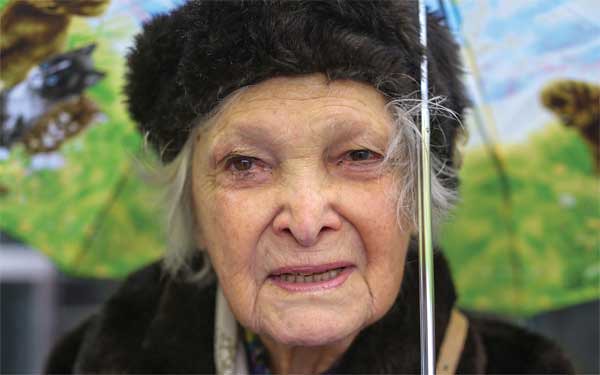
"Humans of New York," Brandon Stanton, All rights reserved

Just a week after its publication, Brandon Stanton’s photo book, Humans of New York, jumped to number one on the Times best-seller list. To make the book, Stanton walked all five boroughs (but mostly Manhattan) with his camera, approached people he found interesting, started up conversations and asked to take their pictures. Not only did the people agree, they opened up for surprisingly unguarded portraits; many also gave Stanton intimate quotes for attribution, as though he was a trusted friend.

Does this sound like a classic New York artist’s fairy tale? Well, it is. And here comes  its modern twist: Stanton was not discovered by a John Szarkowski-style prince of taste but by millions of viewers on the internet. To become the people’s choice Stanton began showing his pictures on photoblogs and social media in 2010.  The last time I visited his “Humans of New York” (HONY) page on Facebook, it had been “liked” by 1,772,196 visitors, and each of the page’s hundreds of pictures had themselves inspired hundreds or thousands of comments.

These are astonishing numbers. What makes the pictures so popular? Certainly, Stanton’s well-made color portraits are uniformly pleasing. Straightforward and unfussy, they fill out a New York City “gorgeous mosaic” of demographic diversity with an eye for individual style and a flair for tripping the shutter at the perfect moment. Perhaps Stanton’s real gift, in fact, is his ability to create that moment – to persuade strangers to feel good about him, his project and ultimately themselves.

In addition, Stanton is a sympathetic interviewer. As he shoots, he asks big questions, such as “What is your biggest struggle?” The answers range from ironic (often very funny) quips to true attempts at self-revelation.  Later, Stanton combines his subjects’ edited answers with their pictures to create funny, swoony or sad little stories.
Image3496b
"Humans of New York," Brandon Stanton, All rights reserved

On a rainy street, for instance, he asks a mysteriously smiling young woman, “What was the happiest moment of your life?” The woman replies: “There are two. The day my baby was born, and last night.” Responding to another question, an elegant old woman in a fur hat  looks proudly at the lens and says, “When my husband was dying, I said, ‘Moe, how am I supposed to live without you?’ He told me, ’Take the love and spread it around.’ “

I’m told this collection moves many viewers to tears.  I’m guessing most of these are what people call ‘happy’ tears. Most viewers – like most of the people photographed -- seem helpless against Stanton’s optimistic charm and genuine affection.  In this book, buoyed up by his eager energy, dancers dance, lovers kiss and old grumps laugh aloud.  For a moment this friendly young man seems able to create an experience of deeply-felt community. 

His style, it seems to me, embodies our cultural moment’s  
ideal template for photographic portraiture. Everything is in the open. No pictures are taken without full permission. Editing and usage rights are theoretically collaborative. Recorded words are reliably accurate and respect the true context in which they were spoken. The final photographs represent a synergy of shooter and subject. Posted to the internet, they become a kind of collective. 

I’m guessing that most of Stanton’s subjects felt they were posing under just such an unwritten moral contract (legal realities may be different). No doubt they felt good about it. Stanton’s wide-open, democratic style is the flip side, after all, of the rampant insecurity and paranoia that curls more and more insistently through our high-tech society – and often surfaces around photography. “That man with the camera,” we fret.  “Is he pointing it at us? Is he the government, a stalker, a pervert? Is he looking at the kids?” Such fears may be extreme, but they’re not contemptible. There’s a reason for them to exist.

Image3496d
"Humans of New York," Brandon Stanton, All rights reserved

Nevertheless, as a critic, I’m concerned about this trend.  If photographers and their intentions are forced to endure such fear-driven vetting, will only feel-good, we-did-this-together projects like Stanton’s be able to thrive? I say this as a sincere fan of  “Humans of New York.” I admire its steady, non-judgmental acceptance of its subjects’ offerings. But I worry about photographers who use very different methods and mine very different veins.

levitt_artistcolor2
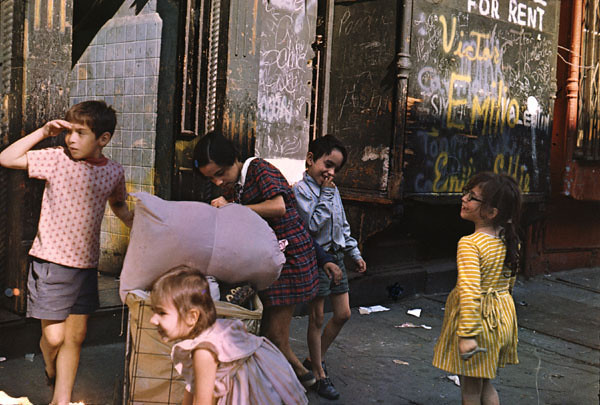
"Lower East Side Children," Helen Levitt, All rights reserved

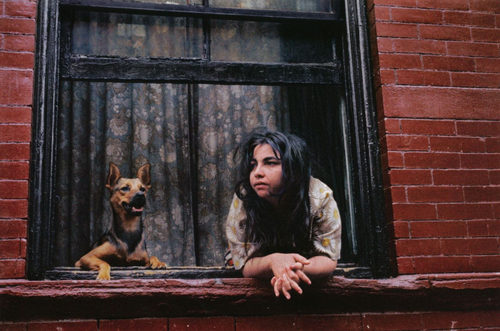
Take Helen Levitt, who died a few years ago. Regularly described as “shy and retiring,” she walked the streets of Harlem and the Lower East Side anonymously for 60 years, photographing and filming people -- most often, children – using cameras fitted with a right angle viewer, called a ‘Winkelsucher,’ that allowed Levitt to stand sideways to her actual subjects. In other words, she snuck shots in pursuit of what legendary author James Agee called “…a fleeting and half-secret world… most abundant in lyrical qualities.” 

tumblr_mvim4rnKDk1qaqnlfo1_500
"Girl at Window," Helen Levitt, All rights reserved

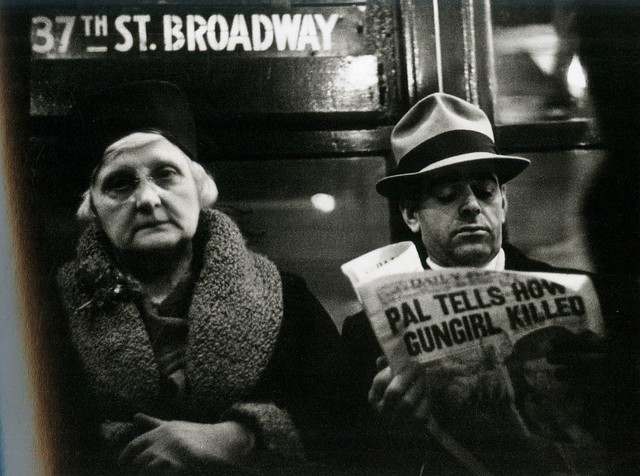
Levitt’s colleague and friend Walker Evans did something similar in his famous subway series, “Many Are Called.” With Levitt often sitting by his side, Evans rode the New York trains for weeks making exposures with a tiny camera through the buttonhole of his overcoat.  Riders among the daily mass migration rarely noticed, but there was nothing dishonest about the pictures. Looked at now, Evan’s pictures, like Levitt’s, are a triumph of humanist affirmation.

WalkerEvans-Subways
"Many Are Called," Walker Evans, All rights reserved

Does “Humans…” give us a truer look at New Yorkers than the street portraits of the past or today's by other photographers?  I’d say it gives us another kind of look – a familiar modern look, balanced on the tightrope between disguise and revelation. Call it a social media look.  My recommendation is: If you can’t afford the book, at least check out the website (humansofnewyork.com). It may be the first big mainstream collection that takes for granted the facebook selves – at once pleading and performative – that we willingly reveal to our linked-up world.

This review also appears in The New York Photo Review
Thursday, November 14, 2013

Taking the long view

Here is some gorgeous rhetoric by author Lee Billings from his book, Five Billion Years of Solitude, reviewed in this week's New York Times Book Review. This passage was chosen by Dennis Overbye, the reviewer.

"A planet becomes a vast machine, or an organism, pursuing some impenetrable purpose through its continental collisions and volcanic outpourings. A man becomes a protein-sheathed splash of ocean raised from rock to breathe the sky, an eater of sun whose atoms were forged in an anvil of stars."

Saturday, November 2, 2013

Apocalypse in miniature: Lori Nix's 'More from The City'

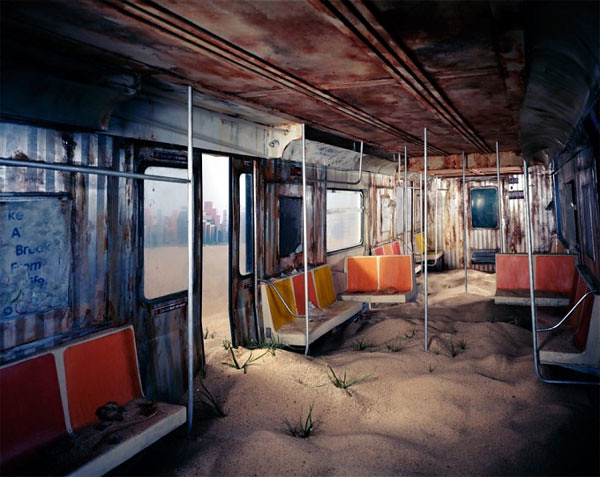
NixPix_Subway
"Subway," Lori Nix, All rights reserved


While never completely out of fashion, apocalyptic fantasy art was once the realm of disillusioned outsiders. No longer. Baying forth directly from the deep pockets of corporate high tech, today’s sleek, dystopian movies, TV, video games and other visual media now dominate our imaginative culture. At the same time apocalypse-themed fiction and nonfiction books and journalism drive much of our intellectual discourse. No civilization has ever been more thrilled by its own demise.

Photographer Lori Nix’s end-of-the-world show, “The City,” at Clampart covers this familiar territory but not without staking out its own brand of modesty and wit. A self-proclaimed “danger and disaster” artist, Nix admits to being “fascinated, maybe even a little obsessed, with the idea of the apocalypse.” Her show imagines a New York City in which all humans have been suddenly terminated, leaving behind only their objects and buildings. This “post-human” metropolis is depicted in large color prints of iconic public spaces — a library, a shoe store, a Chinese take-out restaurant, etc.

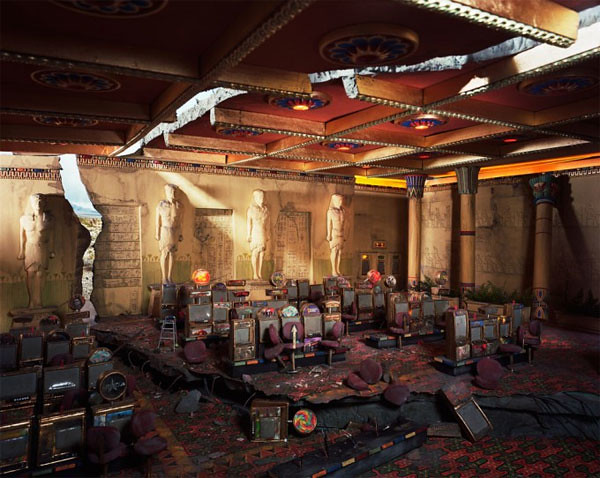
Nix’s works are first constructed as scaled-down dioramas (about five-feet-long) and then photographed with an 8 X 10 view camera and printed from the negatives. To create, assemble and record each diorama takes Nix and her partner, Kathleen about seven months. In the process the two women meticulously build and paint an astonishing variety of miniature objects – from pool tables to encyclopedias to laundromat washing machines. 

The verisimilitude of the little worlds is remarkable. But Nix’s miniature power tools are, after all, not CGI and her old-school archival color printing is not Photoshop. Her interiors are sometimes flawed. Not often, and not by much, but enough so a close viewer will notice. For instance, the show’s advertising shot, a cunningly realistic B subway train, forever stalled and filling up with sand at the Brooklyn end of the Manhattan Bridge, looks across a sand-locked East River to a rudimentary stage-set drawing of the Manhattan skyline. Why not make the skyline look as real as everything else?

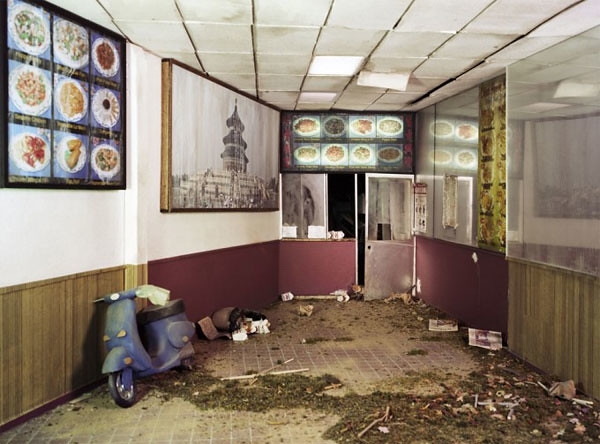
NixPix_ChineseTakeOut
"Chinese Take-Out," Lori Nix, All rights reserved


I’m guessing Nix wants her pictures to inspire awe and unease at a distance and then––as the viewer takes a closer, more leisurely view––provide pleasure and a few chuckles. Her “Chinese Take-Out” picture, for example, brilliantly conjures the formulaic elements of such places – basic store front décor, a picture of ancient temple from the old country, standard OSHA “First aid for choking” poster and two sets of what-you-see-you-get food photos of General Tso’s Chicken, Vegetable Lo Mein and other dishes, identified in Mandarin and English. The fabricators have taken great pains to “distress” the interior with dirt and grime and to strew around red-stamp-labeled take-out containers and authentic-looking pages from a tiny New York Times. But when Nix places a blue delivery scooter right at the front of the room, it’s impossible to miss that it’s a child’s toy. And, look, what’s that sneaking through the open kitchen door? It’s a stuffed red fox. Should I be surprised when a quick Google search reveals that – according to Chinese tradition — the fox is a signal from the spirits of the dead?

NixPix_Casino
"Casino," Lori Nix, All rights reserved


I don’t think so. After scheming and tinkering for over half a year on these pint-sized replicas, I imagine very little – if anything – has been missed. What’s more, the playfulness turns up in the other pictures, too. For instance, in “Space Center,” imagined as a once proud, now desolate museum of human flight, two hawks are busily nesting in what’s left of a Mars Rover. In “Casino,” the ceiling is torn open like a tomb to reveal cheesy replicas of dynastic Egyptian guardian statues standing against walls covered with hieroglyphics. The floor is filled with rusting slot machines that bear names like “Strike It Rich.” One of them is called “Doomsday.”

I’m glad that Lori Nix is making pictures of disaster we can really look at. With its low-tech craft and slow-dawning gags her work feels personal – to her and to us. We are invited into a very still, and sad — and undeniably ridiculous — made-up world. It occurs to me this may be a better place to contemplate human folly than shoulder to shoulder with a movie star as he mows down zombies.

Originally published in The New York Photo Review
Friday, October 4, 2013

Phone among phones

2 street phones
"Two street phones" by Tim Connor, All rights reserved

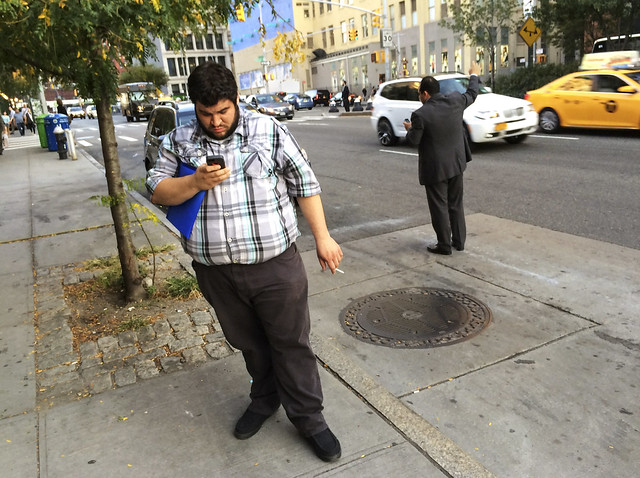
Taken with my new iphone 5S. I didn't buy this phone/camera to shoot Gary Winnogrand-style street snaps, but that's about all I've done so far. The FS camera is well-suited to nervy spontaneous shooting, though it's awkward as hell (I keep shooting pictures of my big pink figures). For one thing the Fs's fully automatic white balance and metering systems  handle mixed NYC color and light brilliantly so far. I'm pleased with the quality.

But, way more important, shooting with a phone seems to excuse my voyeuristic perfidy! I' m just a guy with a phone! No one is worried about a guy with a phone. Look,  everybody is walking around with them-- handling them, playing with them, peering at them, listening and talking to them, tapping and swiping at them. What could be more harmless?

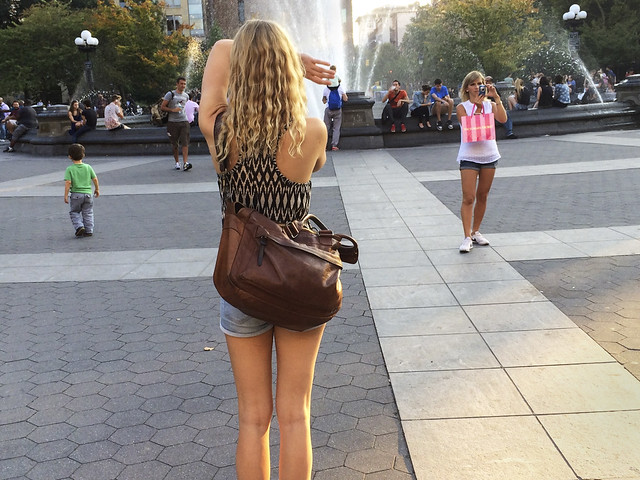
Two girls and a small boy at Washington Square
"Two girls and a small boy, Washington Square" by Tim Connor, All rights reserved


Friday, May 18, 2012

Alex Webb -- photos of a toxic town

AlexWebb -- Treece, Kansas
"Room in abandoned house," Alex Webb, All rights reserved

I happened on a horrifying but rather sweet article about a lead-and-zinc-mining town called Treece in the flatlands of Kansas. Everybody (except one stubborn couple) has left Treece to avoid the rampant toxicity of its dirt, plants, animals, water and air.

There are wonderful photos by Alex Webb accompanying the piece. Maybe his photos are why I chose the word 'sweet' above. Or maybe it's just me. When it's safely in the past, human folly and its consequences can seem merely melancholy. Easy to forgive, especially in the springtime.

Yeah, even at our most greedy, it's hard to wipe out everything! But we do keep trying.

Read my review of Alex Webb's recent NY show, 'The Suffering of Light'

Monday, March 26, 2012

Dystopia now

ScottDalton_S-05Blog
"Car bomb," Scott Dalton, All rights reserved

Are you obsessed with dystopia? (definition: "An imagined universe --usually the future of our own world -- in which a worst-case scenario is explored; the opposite of utopia") Or is it just me?

No, it's not just me. I started thinking about this when I realized how many of the books and movies I've read & seen recently are dystopian. Here's a rough list.

Books
Super Sad True Love Story, Gary Shteyngart, 2010 -- World is taken over by 3 mega corporate states. Everyone is the sum of his data. Everyone knows your score for Credit & Fuckability. Talking face to face is so unusual it's called "verbaling."
Sleepless, Charlie Huston, 2010 -- Created from experimenting on genetically modified corn, a mutant virus becomes a plague. The billions of victims will be sleepless till they die.
The Road, Cormac McCarthy, 2009 -- A nuclear holocaust wipes out most of the life on earth. Survivors wander in search of canned food or other humans they can kill & eat.
Never Let Me Go," Kazuo Ishiguro, 2005 -- A first-person story of children raised in a special school. They learn they are clones being raised to supply humans with organs. Eventually they will die on an operating table.
Cloud Atlas, David Mitchell, 2004 -- A book of six inter-related stories. To summarize the last two 1) Sonmi~451, a genetically-engineered fabricant server at Papa Song's diner is interviewed before her execution after she rebels against the capitalist totalitarian society that created and exploited her kind. 2) In a post-apocalyptic distant future. Zachry, a tribesman living a primitive life after most of humanity dies during "the Fall," is visited by Meronym, a member of the last remnants of technologically-advanced civilization.

Movies
Wall-E, 2008 -- A sweet & funny animated film. Also bitingly satirical. Humankind has buried the Earth under poisonous garbage. Everyone has gotten morbidly fat in the spaceships that escaped. They ride around in machines, listening to jingles & shopping. No one remembers Earth.
Children of Men -- At the time of the film, the last child born to humans has just died at the age of 38. A woman with a young child appears & becomes the target of both the totalitarian state in power & the brutal rebels they are trying to crush.
Rise of the Planet of the Apes -- A drug to cure Alzheimer's is mistakenly given to a chimpanzee, who shares it with other chimps being used in lab-experiments. Now they are all as intelligent as humans. As it becomes clear that the released final version of the drug is fatal to human beings, The chimps escape.
28 Days Later -- A mysterious, incurable virus has turned everyone in Great Britain into murderous, human-flesh-eating zombies. A band of uninfected try to get out of London & find refuge in the countryside. (watched a few years ago)

TV series
Battlestar Galactica, 2003-2009 -- In this series ( watched a few years ago)humans have created humanoid machines called cylons. When the cylons become conscious they attack the humans. A series of intergalactic wars ensue.
Jericho -- Only saw one episode. Someone has set off nuclear bombs in the U.S. In Kansas, where the series is set, it's town vs town . Men ride horses & shoot each other as the larger political forces are revealed .

Would love it if you'd add to this list. Comments welcome.

Thursday, March 15, 2012

David LaChapelle's "Earth Laughs With Flowers"

LadyGagaPinkRoom415
"Lady Gaga, Pink Room," David LaChapelle, All rights reserved

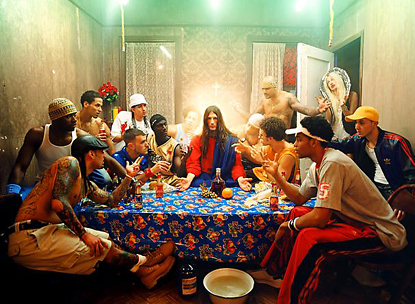
Since Andy Warhol anointed him in the 1980s, David LaChapelle has reigned as the naughty boy of American photography. Unlike Warhol, whose provocations could be tangential and snide, LaChapelle’s outrages are disarmingly direct. In his most famous pictures semi-nude celebrities cavort in richly detailed sprees of lavish self-indulgence and orgiastic simulated sex. In others bewildered-looking models lift off the planet – raptured! -- in a sudden uprush of blown clothing and white light. In still others attractive young people impersonate characters in cracked, religious parables – the Madonna (original version), say, as a bleached-blonde Hollywood starlet wearing only a thong, or Jesus Christ himself, surrounded by deep-ghetto homeboys. One never knows.

ButNoManMovedMeTillTheTideWentPastMySimpleShoe
"But No Man Moved Me Till the Tide Went Past My Simple Shoe," David LaChapelle, All rights reserved

LaChapelle’s pictures are meticulously created in a high-gloss, color-popping, hyper-realistic style, but no one is likely to mistake them for reality. Even the professional actors who appear in these fantasies seem compelled to chew the scenery. Their performances may be inevitable, given the sets, hair, wardrobe, lighting and props, which push past fabulous into giddy realms of extreme high camp. Yet the pictures somehow work. Despite the sleek narcissism, rampant nudity and wall-to-wall gender-bending (intended to shock), they somehow feel accessible, even good-natured. LaChapelle’s pictures crackle with subversive – or at least hilarious – ideas, rude energy and laughter. They are full of juicy life.

Thus, as a fan, I take no pleasure in reporting that LaChappelle’s latest show of 10 large floral still-lifes, “Earth Laughs With Flowers,” is a bore. According to the gallery’s press release, the show is the latest result of LaChapelle’s decision in 2006 – having already conquered the worlds of fashion photography, celebrity portraiture, music video and documentary film – to “minimize his participation in commercial photography and return to his roots by focusing on fine art photography.”

LaChapelle_ConcerningTheSoul415
"Concerning the Soul," David LaChapelle, All rights reserved

That sounds good. Expanded horizons, more freedom! But LaChapelle’s new photographs, the release continues “… appropriate the traditional Baroque still life in order to explore contemporary vanity, vice, the transience of earthly possessions and, ultimately, the fragility of humanity.”

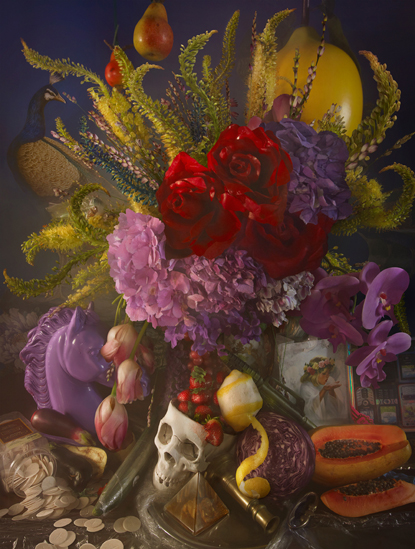
Wait a minute. From Lady Gaga wearing only bubbles to Baroque still life? I do my research. Apparently, LaChapelle’s new photographs were conceived as updates of the 17th century Dutch and Flemish still-life painting genre known as “vanitas.” The name comes from the Book of Ecclesiastes (1:2): “Vanita vanitatum omnia vanitatus,” which translates to "Vanity of vanities! All is vanity." In the 1600s vanitas paintings combined symbols of transitory wealth and pleasure with skulls, rotting food, crawling worms, burning candles and the like. To a religiously conservative northern European Protestant 350 years ago they demonstrated the insignificance of human life and underlined the importance of turning to God.

I try to connect this information with the photographer who lives on a Hawaiian estate with its own private jungle. The one who photographed a naked Paris Hilton tied up in microphone cord bondage and Elton John leaping from his spotted piano into a cluster of cheetahs. The photographer who, in fact, seems to understand contemporary excess, vanity and what Divas of both sexes want better than anyone around.

TwoTutus415
"Two Tutus," David LaChapelle, All rights reserved

Did LaChapelle just run across this stern idea in a book on art history? Does he really expect us to believe he made these photographs to warn us against the pitfalls of vanitas?

I hope not. LaChapelle doesn’t need some bogus-scholarly art historical imprimatur to justify his work. And he has no business adopting high-minded moral stances about “the transience of earthly possessions” or “the fragility of humanity.“ He’s a photographer, not a philosopher, and, let’s face it, possibly the last person on the planet who should be mounting the pulpit with dour old Dutch preachers to intone, “All is vanity.”

His entire career has done that! And very nicely, too. He’s our Cecil Beaton with skin and a sound track, whose theatricality dazzles and delights us.

JesusMyHomeboy415
"Jesus Is My Homeboy," David LaChapelle, All rights reserved

This show is a letdown from LaChapelle’s usual standard. But -- lose the musty art history references -- and it’s not without its charms. There’s a certain pleasure in standing back from the gorgeous grab bag jumble of these colorful, beautifully lit, six-foot-high studio productions. There is further fun in moving in close to the prints and discovering all the tchotchkes tangled up with the fruit and flowers -- multi-colored cell phones, styrofoam skulls, smouldering cigarettes, glitter-covered plastic bugs, Get Well and Good Luck balloons, a torched American flag, silicone prosthetic boobs, half-empty Starbuck’s iced coffee cup with branded green sipping straw, see-through ceramic phallus, pill bottles, squirt gun, Barbie dolls, raw chopped-off chicken feet in ziplock bag and, of course, many, many more.

foto_painting_david_lachapelle400
"Foto Painting," David LaChapelle, All rights reserved

In LaChapelle’s world of absolute excess, there is nothing quite like total immersion. In fact, after several bemused minutes admiring the ruby red roses at the center of one composition, I realized the rose petals were molded in wax . I quickly scribbled in my notebook, “Glorious kitch” (sic). And I’m not ashamed…

This post also appears in New York Photo Review
Monday, February 21, 2011

Quickly forgotten

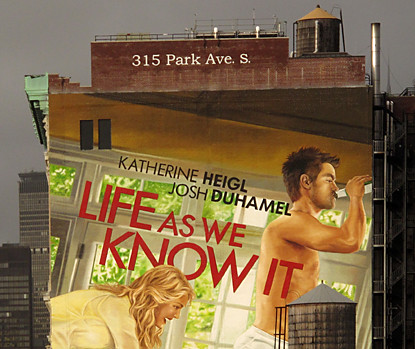
LifeAsWeKnowItCUBlog
"As we know it?" Tim Connor, All rights reserved

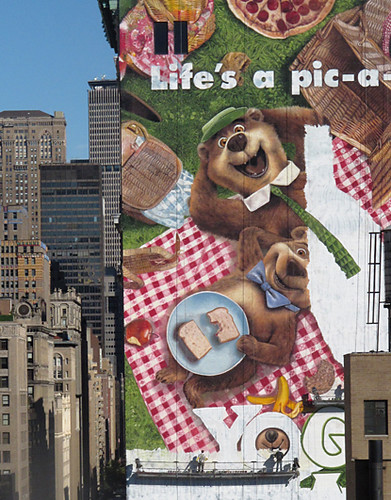
YogiPicnicBlog
"Boo boo," Tim Connor, All rights reserved

Tuesday, February 1, 2011

Saturday, January 29, 2011

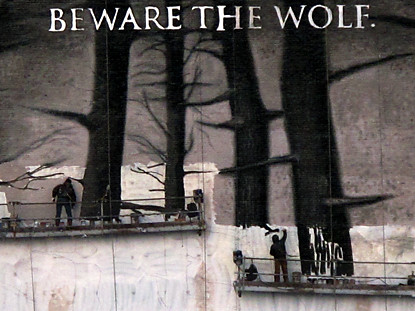
Beware the wolf

PaintrsTreesWithLtrsBlog
"Beware the wolf," Tim Connor, All rights reserved

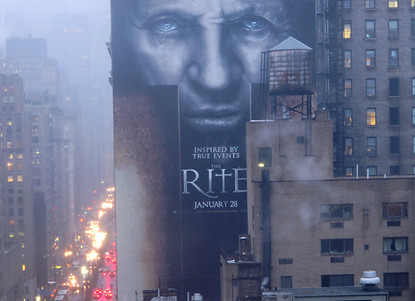
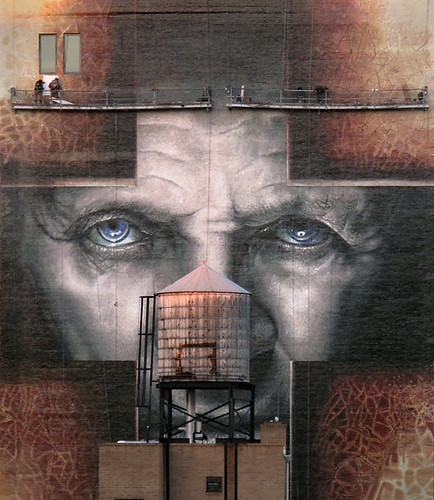
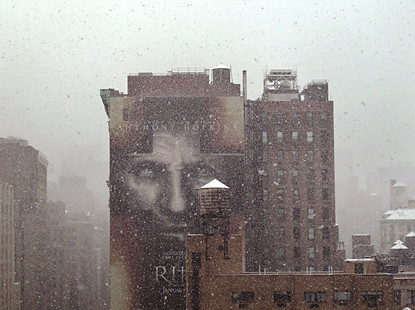
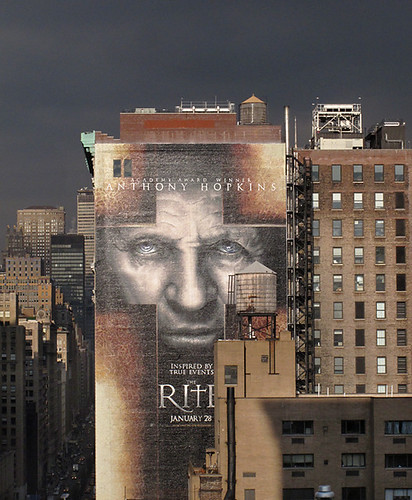
"The Rite"
has had its week. This is the painters working Thursday on the next one, apparently a blood-spattered version of "Red Riding Hood," made by the director who did "Twilight." Watch out for werewolves!

Monday, January 24, 2011

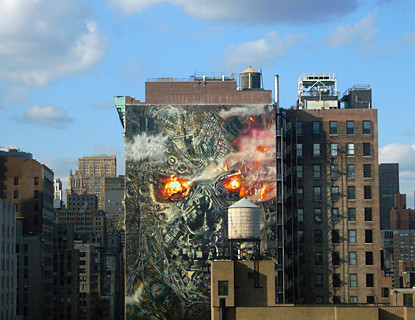
Monster

Against all advertising rules, the name of this movie was so overwhelmed by the image, I don't even remember it. This is my favorite in the "big movie" series.

ExplodingCityHorizBlog

"Big movies," Tim Connor, All rights reserved

Saturday, January 22, 2011

Monday, January 17, 2011

Rent this movie? Down to the Bone

DTTB_irene_bob_floorblog
Still from "Down to the Bone," All rights reserved

"Down to the Bone" is director Debra Granik's 1st feature ( last year's surprise hit, "Winter's Bone," was her 2nd). Made in 2005, "Down to..." stars Vera Famiga as Irene, a mother of two young boys in upstate New York with a dead-end job, a feckless husband & a cocaine habit. Irene checks into a rehab, gets clean &, against advice, returns too soon to her cash-strapped, overburdened life. No one in the small-time rural drug scene she comes from has any idea what she's up against; her creepy husband gets her high because he hopes it will make her want sex. Irene returns to the N.A. meetings at the rehab, where she gets support from Bob (Hugh Dillon), a former heroin addict, now solidly clean & working as a nurse to the other addicts. Irene falls for him. And Bob, who knows better, can't seem to help himself...
Anyone watching this movie can easily spot the foolish choices Irene & Bob make & foresee their tragic results. But Granik never allows us to feel superior. These two don't lack experience or willpower & their determination is real. In the end, the unbreakable grip of their compulsion is simply a fact. And human love, by itself, is not enough to change it.

"Down to the Bone" is as unsparing about the realities of addiction as it refuses to be didactic about recovery. I can't recall a movie that comes closer than this one to the grinding low-grade misery of wanting to get high -- knowing you can't handle it -- &, in a moment of pure insanity, doing it anyway.

After hard-won years staying clean, Bob shoots up at exactly the moment it seems he might have a real-life basis for hope. Irene -- left behind, distraught -- picks up the needle & follows him into the abyss. Bob tells her not to; they both know it's folly. And we're horrified too, but not surprised. We're allowed to see that their crazy act also promises a kind of peace ... as the hippies once used the word. For a short time the heroin gives them peace. Peace. And love? ... They have that too. It's not all you need. But the lovers at least are together.

Granik & the actors don't shy away from the perverse comfort of this. After their inevitable bust, Irene & Bob are arrested & cuffed by NYC cops. Still high, awaiting their fates on a station house bench, they press their bodies together, eyes closed, like babies seeking their mommies.

A passing cop matter-of-factly yanks them apart.

Based on more than three years of documentary research & set in real locations, DP Michael McDonough's stripped-down, mostly handheld video is relentlessly intimate as it follows the small cast's lives through shabby rooms & soggy parking lots edged with piles of dirty snow. Only inside moving cars are the cameras allowed to wander. Peering through grime-specked windows, as wipers push muddy mist aside, the lenses seem to marvel at fields & houses flipping past against wintry gray skies. It's a hyper real style that somehow -- maybe because I've become accustomed to Hollywood's overlit, too-perfect sets -- took on a dreamlike quality.

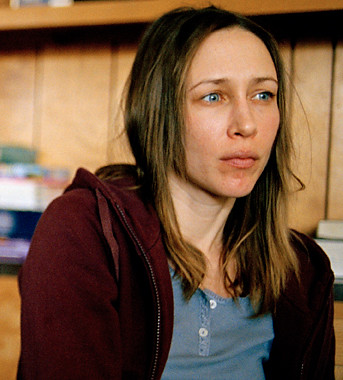
DTTB_VeraF
"Vera Farmiga," "Down to the Bone," All rights reserved.

Finally, a word about Vera Farmiga. I can't get her out of my head. I first saw her in the recent "Up in the Air," where she was glamorous & self-assured, a worthy comic foil to George Clooney's debonair super-traveler. In this film she's a bedraggled, working class country mom, a supermarket check-out girl, her lank hair sloppily pinned-up, her mouth turned down in defensive cynicism.

Playing Irene, Farmiga is no movie star. Her sylphlike beauty seems lost in scene after scene. But you don't forget her eyes. Shaped like almonds, a vivid green-blue, they register her tense, intelligent character's anger & bewilderment. And especially her pain. By the time this movie reached the final ambiguous scene, brilliantly played between Irene & Bob through a closed, slotted-glass backdoor, I wanted to cry.

Monday, January 10, 2011

Big Movies: The Book?

Hannibal, wearing his cask

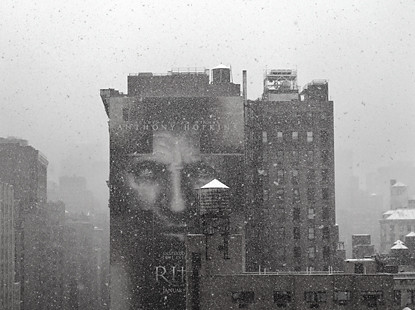
The rite stuff

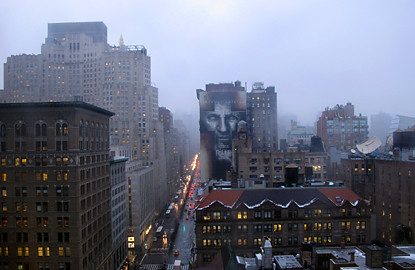
"Hannibal 1 and 2," Tim Connor, All rights reserved


I've been photographing these painted "upcoming movie" ads on the building wall across from my office since 2008. It's been fun, an excuse to take a break from desk work. It's been as easy as shooting fish in a barrel! Now I'm suddenly realizing the series could make a book. See my earlier book here:

I have to go back now & pull together my files. I've shot these pictures carefully but without much purpose. Time to see what I've got...

Sunday, January 9, 2011