Showing posts with label technology. Show all posts

Saturday, January 24, 2015

Thomas Struth: Striving for the big picture

Review by Tim Connor


As a photography student at Kunstakademie Düsseldorf in the 1970s, Thomas Struth learned to create big, highly detailed pictures with his classmates – now photographic luminaries -- Andreas Gursky, Thomas Ruff and Candida Hofer. At the time their teachers, the legendary husband-wife team, Bernd and Hilla Becher, taught a technically rigorous system to “objectively” document disappearing German architecture. According to the Becher system, subjects must be captured serially with a large-format camera using black-and-white film under a cloudless sky. All subjects must be shot from uniform distances and heights, printed with medium contrast at a prescribed size and shown together to facilitate comparison.

In his current show at the Met we see Struth’s homage to this exacting style -- a wall-sized grid of black-and-white prints showing well-known New York City intersections in 1978. Older New Yorkers may treasure or rue these pictures as memories, but the more salient point is that, soon enough, nobody will be alive to remember them. Still, there is much to admire in the way the pictures treat, not only the streets and buildings , but everything -- every parked car, overloaded trash can and  random walking-through-the-shot human -- with exactly the same crisp, non-judgmental clarity.

CrosbyStSoho1978_struth
"Crosby Street, Soho, 1978," Thomas Struth, All rights reserved
This is Struth’s first major project.  Afterward, his career moves on fast. Without abandoning the discipline and technique he has acquired from the Bechers, he begins to take on large ideas and issues. It is his willingness to do so that animates this show.

In the 80s Struth continues to shoot architecture and landscapes.  Like his schoolmate Gursky, he takes up color and begins to use photoshop to assemble from multiple viewpoints single images of large locations and structures. But, unlike Gursky, who over the years steadily creates more and more gigantic prints of larger and larger events, (the Chicago Board of Trade, the Olympics)  Struth’s big pictures seem uninterested in spectacle. Gursky wins worldwide acclaim by moving farther and farther away from what he photographs. Struth moves closer. His pictures, though still large and complex, become more and more about the people present or implied within the frame.  They radiate emotion that can be felt by anyone.

These qualities are best seen in the pictures the Met has collected from Struth’s three ongoing series – roughly titled, “Museum,” “Paradise” and “Technology.”

Struth’s “Museum” series comes from a simple idea. He photographs people looking at art and history in museums all over the world. Strictly realistic, rendered in sumptuous colors, these large, calm compositions at times resemble the Old Master paintings that appear in many of the prints. Yet the unrehearsed modern tourist crowds are always there too. Some museum-goers are reverent. Some are playing with their iphones and thinking about their lunch. They bring a  here-and-now immediacy to pictures meant to last. 

MuseumStruth
"Art Institute of Chicago,1990," Thomas Struth, All rights reserved
struthbigMuseum
"Museo Del Prado 7, 2005," Thomas Struth, All rights reserved

The balance between large ideas – the present and the past, the material and the spiritual, for example – makes me wonder if Struth is aiming for the cusp between them? Or do his museum pictures – like many of the old religion-based paintings depicted within them –incline toward moral lessons? If so, the messages are hard to recognize, extremely subtle. Yet the question continues to rise.

Asked about the Museum series, Struth said “… the ineffable spills into the ordinary and the spiritual aspirations of our ancestors intersect with the needs of the present.” It’s clear that with these works Struth is gesturing toward something beyond their quotidian content. In fact – like every artist -- he is imbuing lifeless materials with human energy. Where does that energy come from?

We get to decide for ourselves.

One thing I think we know.  In the Museum series the goal of this energy is no longer the same as it is in the old paintings. Unlike the paintings, the energy of the photographs is not directed at individual salvation.  We might think of its heaven as salvation for all.

familyofartistsretouchersTStruth
"Art Restorers at San Lorenzo Maggiore, Naples, Italy, 1988," Thomas Struth


I think this becomes clear in Struth’s Paradise series. Photographed at ground level in various rainforests in Japan, Australia and South America, all the images in the series are called “paradise” and numbered.  Only one, “Paradise 13, Yakushima, Japan 1999,” is included in the show.  Yet, from this picture and others I have seen elsewhere, “paradise” seems a very odd title for Struth to have chosen.
“Paradise 13,” for example, is shot deep inside a low, wet, dark forest strewn with fallen trees and moss-covered boulders. It is certainly no Eden. Struth is well-known as an ardent environmentalist, and it’s hard to imagine him resorting to cheap irony. Some of the other forest “interiors” in this series are tangles of dazzling green, flooded with transforming light. They are beautiful to look at and, as we know, vital to the health of our planet.
 But – come to think of it – real rainforests are always unrestrained riots of hungry competitive life. They are always difficult for humans. Struth is making a difficult point. Our human instinct is to transform them to meet our needs. But the Earth too needs salvation.

Paradise17-TStruth
"Paradise 13," Thomas Struth

thomas-struth-growth-09-690x568
 "Paradise 9," Thomas Struth, All rights reserved

With the “Technology” series, Struth asks: Does the human genius for technology threaten our species? Does technology also offer hope? These too are ultimately spiritual questions.

 Struth’s “Hot Rolling Mill, Thysen Krupp Steel, Duisburg, 2010,” takes us into the silent interior of a gigantic industrial machine. By choosing an old German steel mill and associating it with the name Krupp, Struth is deliberately evoking Hitler’s Third Reich and the murderous weapons with which Germany came close to conquering the world. And the picture itself -- a vast brutal wall of machinery in semi-darkness, grime-encrusted, its khaki greens punctuated with the faded, reds and oranges of catwalks and cables -- is indeed terrifying. Even worse, a thick chain is bolted to the steel-plate floor in the only area lit by a window. It took bravery to make this picture. Struth knows exactly what he is alluding to. 
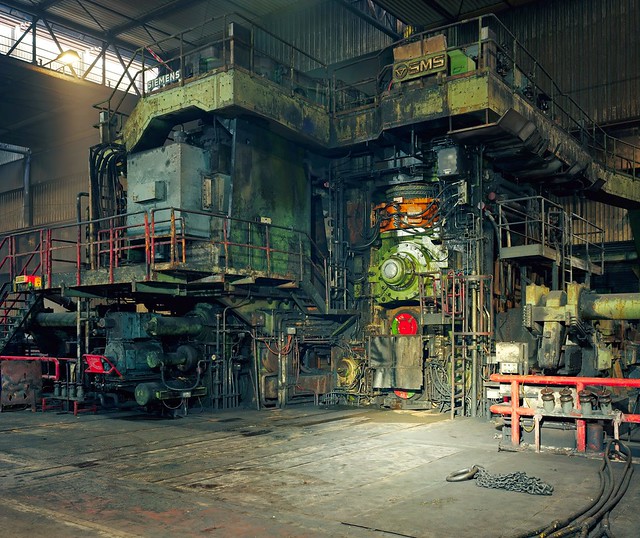
5. Hot Rolling Mill,ThyssenKrupp Steel, Duisburg_Thomas Struth
"Hot Rolling Mill, Thysen Krupp Steel, Duisburg, 2010," Thomas Struth

If “Hot Rolling Mill” balances past and present, the most astonishing picture in the Technology series presents itself literally as a fulcrum between present and future.   Called “Figure 2, Charite, 2013,” the picture shows a woman strapped to a medical gurney suspended in mid air. Looping in from piled machines and monitors are dozens of wires, tubes and cables, all of which attach to her body. At first, we recoil from the image. It seems to be a Frankenstein-like experiment or perhaps some hideous torture. Then we notice that the room is spotless, the light is clear and the woman is young and blonde with beautiful skin.  We are confused. What are we looking at?
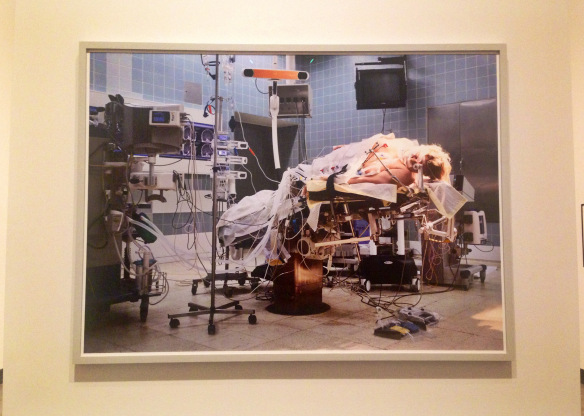
Figure2,Charite, 2013
"Figure 2, Charite, 2013," Thomas Struth, All rights reserved

It’s an operating theater in Berlin, where this anaesthesized young woman is about to undergo surgery to remove a brain tumor. With the woman’s full permission, Struth has photographed the moment before the doctors and nurses enter to begin. We learn in a caption that the woman survived and, two years, later is living comfortably. Still, we wouldn’t know that if we hadn’t been told. Is Struth intentionally frightening us with scary technology that is actually built and used to save lives?

I don’t think so. I think he is making full use of his freedom to challenge us.  Some things that at first seem repellent are beautiful. Struth’s mentors, the Bechers, photographed water towers, silos and blast furnaces they judged beautiful – and safe to photograph – in a defeated, divided Germany after a vicious war.  Now, more than a half century later, Struth again finds beauty in our still dangerous and increasingly complicated – but perhaps freer – world.  He makes big pictures for the world.

This review appears in The New York Photo Review


Friday, May 23, 2014

A photographer looks at Swoon

brooklyn-street-art-swoon-jaime-rojo-10-09-400x533
"Street art by Swoon, Brooklyn, NY," Jaime Rojo
I saw my first street installation by the New York artist, Caledonia Dance Curry, known as Swoon, years ago in the Gowanus section of Brooklyn. Gowanus was then a mix of aging and abandoned low-rise factories, warehouses, loading docks and junk-filled lots. It was a favorite destination for taggers and graffiti artists, who took advantage of its off-hours’ emptiness to paint their rowdy bright-colored works on its many blank walls. For me Gowanus was a quiet place to walk on weekends and take pictures.

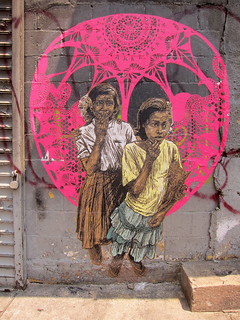
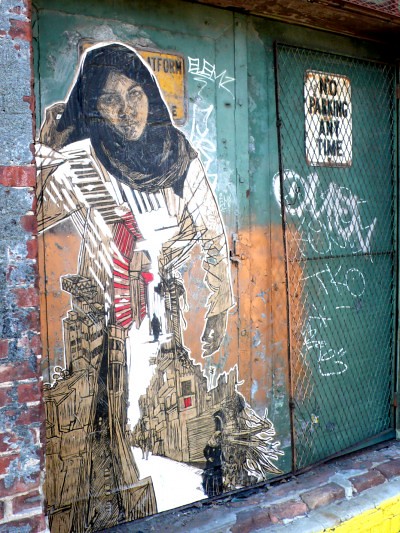
Swoon’s street art in Gowanus and, later, in other parts of the city, always stopped me and made me look. Despite its obvious sophistication, the work has the intensity of a child. Her prints, made from drawings on paper, cut out and carefully wheat-pasted at selected locations, are stylized portraits that often morph from (or into) other creatures and places. They’re over-sized, but not too big — the figures a little larger than human. Sometimes, Swoon cuts out lines and wedges from the portraits or creates lace-like additions and lets the walls shine through the openings. Color is also used on the prints – but sparingly.
swoon
"Two girls, street art by Swoon"
One of the things I always liked about these outdoor installations was that they are suddenly there; they are not signaled or heralded in any way. After mounting, they are left to the elements and the unpredictable mercies of passersby. Swoon makes sure to locate her prints where ordinary people will see them – and maybe not see them as art. Naturally, they are much photographed and subsequently circulated through photo-sharing sites to a potentially unlimited audience online. 

Dramatic and of-the-moment, the best of these repeatedly shared photographs – along with the offhand brilliance of the her art-name, Swoon – have no doubt done a great deal to spread Curry’s reputation and differentiate her from the other talented artists who use similar methods (I’ll mention, for example, Brian Adam Douglas — moniker Elbow Toe – whose work I also saw on Gowanus walls).

I know Swoon’s placement of her work is an expression of her conviction that art needs to move out of the studio and take back public visual space from advertisers and brand masters. It’s a conviction shared by Swoon’s British counterpart, Banksy, and thousands of other less-well-known artists worldwide. But, unlike Banksy, with his stenciled, laugh-out-loud provocations, Swoon’s approach is essentially romantic.

This renders her outdoor prints especially vulnerable. Made of paper, they’re organic and destined to fade, fray and fall away under the constant onslaughts of wind and weather. This is exactly the opposite of the results the art world strives for and, arguably, the most radical aspect of Swoon’s work. It’s also the aspect, I’d argue, that excites street photographers, who approach these prints, not as precious art to be recorded, but as elements of a particular moment’s concatenation of light, shape, color and meaning.
Swoon-Street-Art-London-18
"Street art by Swoon, London"

I was thinking about these ideas as I entered Swoon’s monumental installation, “Submerged Motherlands,” last weekend at the Brooklyn Museum. “Motherlands” fills a large high-ceilinged room, centered on a wonderful 60-foot-high fabricated tree covered with thousands of long strands of dyed fabric. The tree is flanked by a small charmingly decorated structure, called a “nest” or “hive,” where visitors can rest. “The Miss Rockaway Armada” and “The Swimming Cities of Switchback Sea,” two large ramshackle wooden rafts full of junk and tools turn out to be what’s left of Swoon-and-company’s amazing art-flotation adventures, on the Mississippi and the Hudson respectively, in the summers from 2006 to 2008. Swoon’s portraits in different sizes are spread throughout the space.


I didn’t get much from the exhibit notes, which adopt a sort of fantasy tone to suggest the show is about climate change and refer vaguely to Doggerland, a once-populated area between England and the Continent that went under as sea levels rose about 6,000 years ago. But it occurred to me that, even if the waters were rising outside the Museum, we would all feel cozy and well cared for in this exhibit. And, in fact, at that moment a museum guard politely warned me to not get too close to the art.

This show seemed to me a very long way from Swoon’s audacious collective raft projects of a few years ago – she has referred to the raft armadas as enactments of her childhood dreams. Perhaps the show is even farther from another kind of dream – say, a solitary print on a Gowanus wall as the February light is slipping away fast.

To confirm this, I looked more closely at the portraits that populate the show. Crisply reprinted in different sizes, many of them standing on their own, all are recycled. Perhaps this isn’t so strange. I’m aware that Swoon likes to repeat images and spread the notion of a kind of family around the city, but here, in a major museum show, in her hometown I thought she might show something new.

But there they are – Swoon’s mother and friends, portraits from Haiti and Mexico, a beautiful woman breastfeeding her baby, two grizzled toothless men with casts on their arms, laughing. Why do they feel so empty?
SwoonBoyUnionSt2011
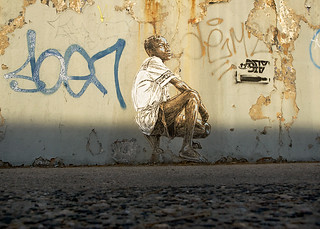
"Boy looking up, by Swoon," Tim Connor
I think the answer is context. Here at the museum I’m part of a swirling, cheerful crowd in a magnificent high-ceilinged, sky-lit room. Everyone is talking. Everyone is taking pictures with tiny point-and-shoots and camera phones. It seems almost like an alternate to looking. As soon as shooters have their picture, they turn away and move on. A new normal?

I recognize a print of a black boy in a decorated tunic and shorts squatting on the ground, glaring upward. It’s an image I photographed on a heavily-tagged wall in Gowanus (on Union Street in 2011, it turns out). I remember crouching way down, almost to street level, to frame the picture. Afterwards, I looked at the boy for a long time. Alone on the street, I felt I understood his tense posture, his angry look. Not here.

Researching this article, I listened to Swoon talk on video about how her big collective projects had been exhausting experiences from which she needed time to recover. She called them “going outside” projects and said that afterwards she needed to “come inside” by accepting gallery or museum help to work on her own art.

That sounded (and sounds) reasonable to me. But, as I left this show, I really just wanted to urge Swoon to “go back outside” soon. 

This article also appears in The New York Photo Review.

Monday, April 28, 2014

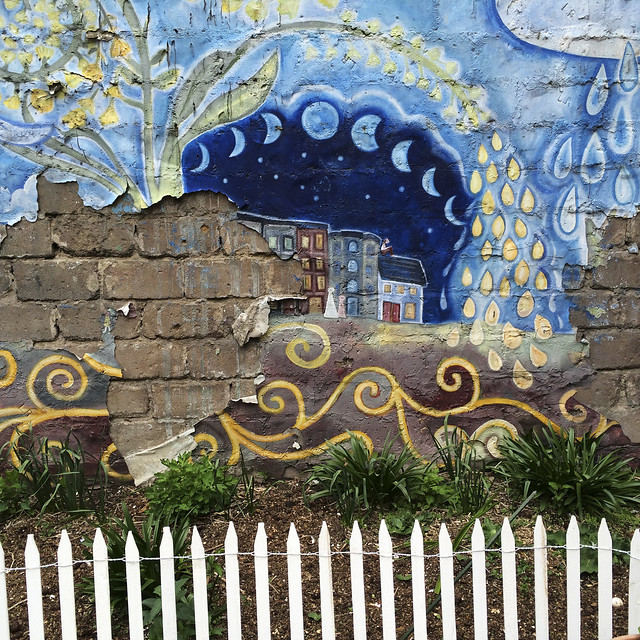
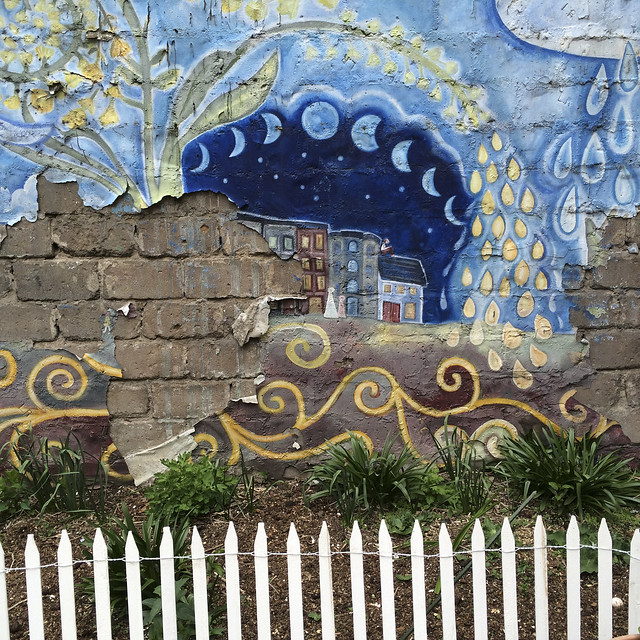
Pocket Park (2 versions)

PocketPark
"Pocket park - Photoshop," Tim Connor, All rights reserved

PocketParkInstagram
"Pocket park - Instagram," Tim Connor, All rights reserved

Volunteers replanted and put up this picket fence, among other improvements, in one of my favorite pocket parks in Brooklyn (5th Ave. & President St). There was nothing they could do about the peeling mural, but I still love it.

As in my last post,  the top picture was processed using Instagram's on-phone tools.  The bottom one was processed in Photoshop.

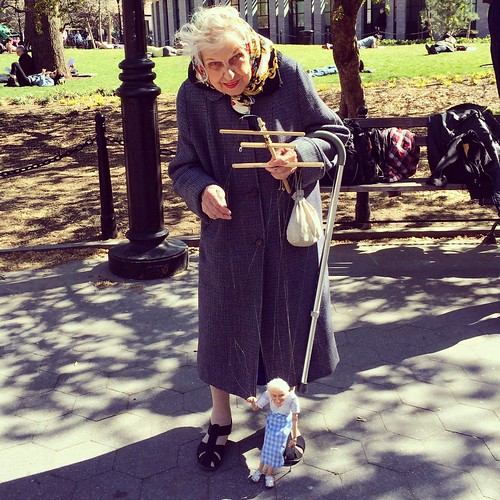
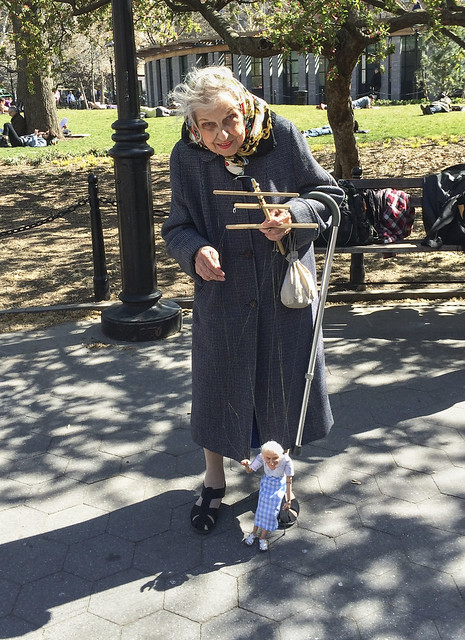
Puppet contest

Posting two recent photos. The first (top) shot was cropped and processed in Instagram. The second was cropped and processed to my aesthetic taste in Photoshop. I'm trying to decide what I think.

Dear Reader: Any opinion?

PuppetLady
"Lady and puppet, Washington Sq.-- Instagram," Tim Connor, All rights reserved
Lady and her puppet
"Lady and puppet, Washington Sq," Tim Connor, All rights reserved

Wednesday, March 26, 2014

Mirrors and windows


"Space cadet," Tim Connor All rights reserved


"Selfie with hole in the head," Tim Connor, All rights reserved

Tuesday, March 25, 2014

Monday, March 3, 2014

Instagram

To make instagram: Shoot picture with phone camera, process through phone app with standardized filter choices, then phone to your network. Share.


"My favorite shawarma shop," Tim Connor, All rights reserved

"Schoolday instructions," Tim Connor, All rights reserved


"Taking a call," Tim Connor, All rights reserved

http://instagram.com/

Monday, January 27, 2014

Fay Weldon -- an excerpt that made me laugh

From an essay in The NY Times Book Review: "Writers of a Certain Age," by British novelist Fay Weldon. Funny, sad and too true.

"Like the gap between rich and poor, the gap between young and old widens. The New Young increasingly resent theNew Old -- those whom medical science keeps in their prime without the will to accept obscurity and fade away gracefully. There are more of us, and we don't look nearly as nice as the New Young. We move slowly, get in their way on the sidewalk, lose our glasses, hold up the line using coins not cards, take forever texting, irritate by asking for help with smartphones, can't manage tablets and take forever in the powder room. Having destroyed the planet, the New Old now encroach upon Facebook and Twitter, invented by the young for the young, to try to sell our own books. For the New Young it must seem intolerable, but for us, what a great boon it is to be judged by our words and ideas, not by our looks."

Wednesday, November 20, 2013

Brandon Stanton's "Humans of New York"

Image3496a
"Humans of New York," Brandon Stanton, All rights reserved

Just a week after its publication, Brandon Stanton’s photo book, Humans of New York, jumped to number one on the Times best-seller list. To make the book, Stanton walked all five boroughs (but mostly Manhattan) with his camera, approached people he found interesting, started up conversations and asked to take their pictures. Not only did the people agree, they opened up for surprisingly unguarded portraits; many also gave Stanton intimate quotes for attribution, as though he was a trusted friend.

Does this sound like a classic New York artist’s fairy tale? Well, it is. And here comes  its modern twist: Stanton was not discovered by a John Szarkowski-style prince of taste but by millions of viewers on the internet. To become the people’s choice Stanton began showing his pictures on photoblogs and social media in 2010.  The last time I visited his “Humans of New York” (HONY) page on Facebook, it had been “liked” by 1,772,196 visitors, and each of the page’s hundreds of pictures had themselves inspired hundreds or thousands of comments.

These are astonishing numbers. What makes the pictures so popular? Certainly, Stanton’s well-made color portraits are uniformly pleasing. Straightforward and unfussy, they fill out a New York City “gorgeous mosaic” of demographic diversity with an eye for individual style and a flair for tripping the shutter at the perfect moment. Perhaps Stanton’s real gift, in fact, is his ability to create that moment – to persuade strangers to feel good about him, his project and ultimately themselves.

In addition, Stanton is a sympathetic interviewer. As he shoots, he asks big questions, such as “What is your biggest struggle?” The answers range from ironic (often very funny) quips to true attempts at self-revelation.  Later, Stanton combines his subjects’ edited answers with their pictures to create funny, swoony or sad little stories.
Image3496b
"Humans of New York," Brandon Stanton, All rights reserved

On a rainy street, for instance, he asks a mysteriously smiling young woman, “What was the happiest moment of your life?” The woman replies: “There are two. The day my baby was born, and last night.” Responding to another question, an elegant old woman in a fur hat  looks proudly at the lens and says, “When my husband was dying, I said, ‘Moe, how am I supposed to live without you?’ He told me, ’Take the love and spread it around.’ “

I’m told this collection moves many viewers to tears.  I’m guessing most of these are what people call ‘happy’ tears. Most viewers – like most of the people photographed -- seem helpless against Stanton’s optimistic charm and genuine affection.  In this book, buoyed up by his eager energy, dancers dance, lovers kiss and old grumps laugh aloud.  For a moment this friendly young man seems able to create an experience of deeply-felt community. 

His style, it seems to me, embodies our cultural moment’s  
ideal template for photographic portraiture. Everything is in the open. No pictures are taken without full permission. Editing and usage rights are theoretically collaborative. Recorded words are reliably accurate and respect the true context in which they were spoken. The final photographs represent a synergy of shooter and subject. Posted to the internet, they become a kind of collective. 

I’m guessing that most of Stanton’s subjects felt they were posing under just such an unwritten moral contract (legal realities may be different). No doubt they felt good about it. Stanton’s wide-open, democratic style is the flip side, after all, of the rampant insecurity and paranoia that curls more and more insistently through our high-tech society – and often surfaces around photography. “That man with the camera,” we fret.  “Is he pointing it at us? Is he the government, a stalker, a pervert? Is he looking at the kids?” Such fears may be extreme, but they’re not contemptible. There’s a reason for them to exist.

Image3496d
"Humans of New York," Brandon Stanton, All rights reserved

Nevertheless, as a critic, I’m concerned about this trend.  If photographers and their intentions are forced to endure such fear-driven vetting, will only feel-good, we-did-this-together projects like Stanton’s be able to thrive? I say this as a sincere fan of  “Humans of New York.” I admire its steady, non-judgmental acceptance of its subjects’ offerings. But I worry about photographers who use very different methods and mine very different veins.

levitt_artistcolor2
"Lower East Side Children," Helen Levitt, All rights reserved

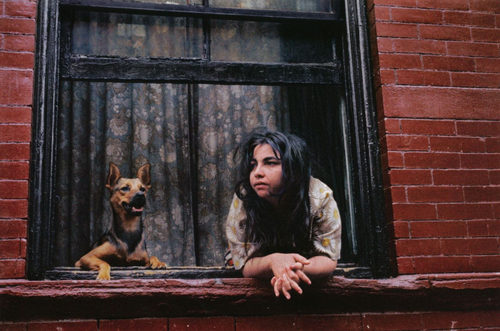
Take Helen Levitt, who died a few years ago. Regularly described as “shy and retiring,” she walked the streets of Harlem and the Lower East Side anonymously for 60 years, photographing and filming people -- most often, children – using cameras fitted with a right angle viewer, called a ‘Winkelsucher,’ that allowed Levitt to stand sideways to her actual subjects. In other words, she snuck shots in pursuit of what legendary author James Agee called “…a fleeting and half-secret world… most abundant in lyrical qualities.” 

tumblr_mvim4rnKDk1qaqnlfo1_500
"Girl at Window," Helen Levitt, All rights reserved

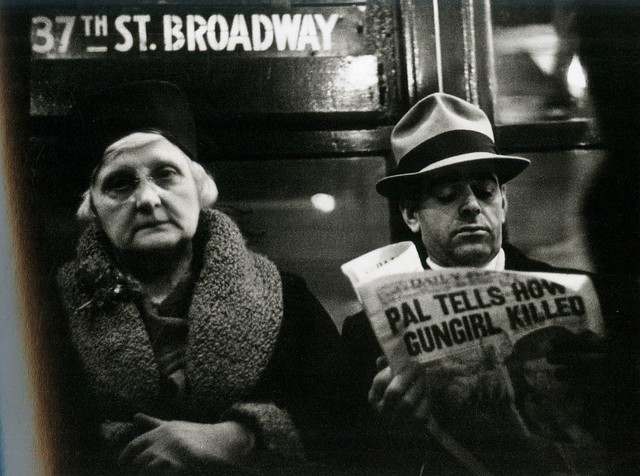
Levitt’s colleague and friend Walker Evans did something similar in his famous subway series, “Many Are Called.” With Levitt often sitting by his side, Evans rode the New York trains for weeks making exposures with a tiny camera through the buttonhole of his overcoat.  Riders among the daily mass migration rarely noticed, but there was nothing dishonest about the pictures. Looked at now, Evan’s pictures, like Levitt’s, are a triumph of humanist affirmation.

WalkerEvans-Subways
"Many Are Called," Walker Evans, All rights reserved

Does “Humans…” give us a truer look at New Yorkers than the street portraits of the past or today's by other photographers?  I’d say it gives us another kind of look – a familiar modern look, balanced on the tightrope between disguise and revelation. Call it a social media look.  My recommendation is: If you can’t afford the book, at least check out the website (humansofnewyork.com). It may be the first big mainstream collection that takes for granted the facebook selves – at once pleading and performative – that we willingly reveal to our linked-up world.

This review also appears in The New York Photo Review
Friday, October 4, 2013

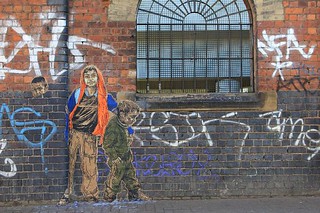
Phone among phones

2 street phones
"Two street phones" by Tim Connor, All rights reserved

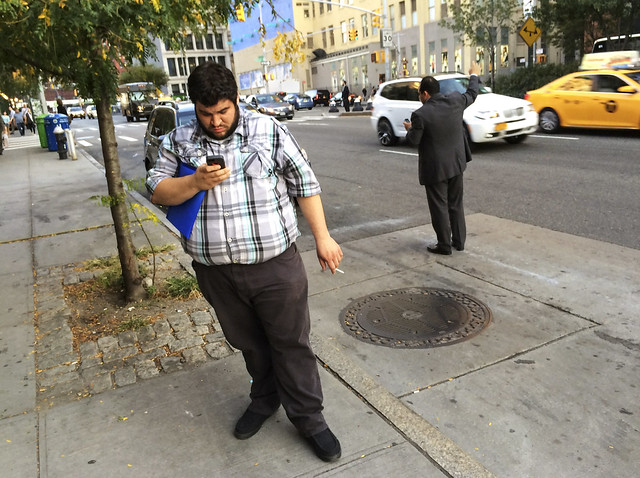
Taken with my new iphone 5S. I didn't buy this phone/camera to shoot Gary Winnogrand-style street snaps, but that's about all I've done so far. The FS camera is well-suited to nervy spontaneous shooting, though it's awkward as hell (I keep shooting pictures of my big pink figures). For one thing the Fs's fully automatic white balance and metering systems  handle mixed NYC color and light brilliantly so far. I'm pleased with the quality.

But, way more important, shooting with a phone seems to excuse my voyeuristic perfidy! I' m just a guy with a phone! No one is worried about a guy with a phone. Look,  everybody is walking around with them-- handling them, playing with them, peering at them, listening and talking to them, tapping and swiping at them. What could be more harmless?

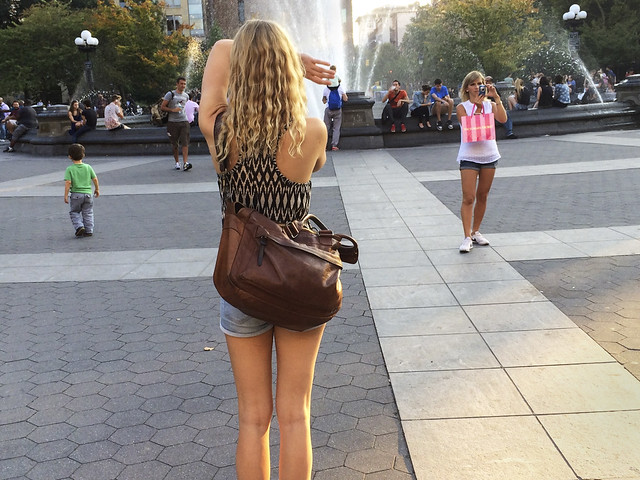
Two girls and a small boy at Washington Square
"Two girls and a small boy, Washington Square" by Tim Connor, All rights reserved


Wednesday, March 6, 2013

Other Landscapes Under the Sun


Michael Benson’s “Planetfall” at Hasted-Kraeutler        Reviewed by Tim Connor


 MBenson_UltraVioletSunBlog
"Ultraviolet Sun," Michael Benson, All rights reserved
 Human imagination has been soaring into the heavens for millions of years, but it wasn’t until 1961 that Russian cosmonaut Yuri Gagarin actually left Earth’s atmosphere.  Between 1969 and 1972 twelve Americans walked on the moon, but that’s as far as human bodies ever got. Increasingly, in recent years, space travel has meant virtual ride-alongs on remotely-piloted robotic spacecraft with engineered senses. It is from these otherworldly robots that writer-photographer Michael Benson mined visual data for his powerful exhibit, “Planetfall,” at Hasted-Kraeutler.
To show the solar system “…through the lens of art,” Benson used raw frames culled from NASA and European Space Station missions from 2000 to 2012 (astonishingly, all spacecraft data is free and stored on the internet.) “It’s all online. I browse from home,” Benson says of his method.  He curated by “…sifting through tens of thousands of raw frames – in effect panning for gold.” Next came image processing, compositing and mosaicking to make the final photographs.

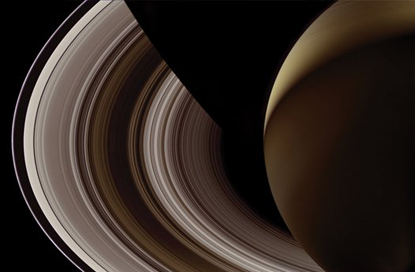
It’s no surprise that “Planetfall’s”  images are technically extraordinary. Some of the pictures of Mars, for instance, were made with NASA’s HIRISE camera, which has a 19.7-inch aperture, allowing it to render images of one foot per pixel. Such cameras create images that astonish, not only because they really exist but also because they seem impossible (or faked). The show’s images of Saturn’s rings, for example, have a rigid, abstract geometric precision that makes them appear to be machines. On the other hand, Io, Jupiter’s highly volcanic fifth moon, looks like a hunk of pocked and mouldy yellow cheese.
MBenton_NightSaturnBlog
"Saturn at Night," Michael Benson, All rights reserved
But science is only the beginning here. Without some emotional content most of the pictures in this show would amount to little more than strongly-lit dead rocks or migrating cauldrons of swirling gas. Benson’s art is to make the distant, inhospitable places in our solar system seem accessible, if not to human travelers, then at least to a viewer’s feelings. One way he does this is to emphasize universal commonalities – shapes, colors, gravitational logic, the behavior of wind, light, fire and so on.  We see how alien it is out there -- but it’s not so alien we can’t feel connected.

Benson explains this approach with a quote from theoretical physicist Werner Heisenberg: “We have to remember that what we see is not nature herself, but nature exposed to our method of questioning.” In “Eclipse of the Sun by the Earth,” for instance, an orangey-red hemisphere of sun emerges from Earth’s shadow literally boiling --in fact, half-exploding -- with heat.    From the writhing gases on the sun’s surface, hellish flowers seem to be blooming, their centers blazing  with incandescent yellows. A viewer is hard-pressed not to back away from this ferocious image. And this is not just a reaction to its imagined heat. This sun appears to be in a violent rage. We can feel its uncontrolled wrath. There is danger in this wrath – and beauty too. We can glimpse why ancient people gave such strong personalities to their god-planets and stars.

MBenson_SunsetMarsBlog
"Sunset on Mars," Michael Benson, All rights reserved
It’s interesting that Benson finds very different metaphors in his pictures of Earth’s nearest sibling, Mars.  The planet’s red rock and sand deserts , barren valleys and far-off low ranges of hills are not so different from views found on our own planet. Thus Benson’s “Sunset on Mars” is weirdly familiar, even with its tiny, distant sun and magenta-tinted atmosphere.

Why, I wondered, is this Martian sunset so much more melancholy than any I’ve seen on Earth?  Perhaps it’s because this and the other Martian photographs in the show seem to bear out a mood detectable in our long-standing, obsessive fantasies about vanished civilizations on the Red Planet.  The NASA photographs are detailed; they show no canals. Yet the Mars in these pictures seems spent, desolated; its time over; its ripeness gone. Something must have happened ...

MBenson_HomewardBoundBlog
"Sun on the Pacific," Michael Benson, All rights reserved

Here I’m in mythical territory, of course. But perhaps I’m not being whimsical. Could the cautionary feel of the Mars pictures reveal an aspect of Benson’s curatorial intentions? Here’s a piece of evidence. My favorite picture in “Planetfall,” titled “Sun on the Pacific,” shows a softly curving Earth horizon pushed up against an inky black crescent of space. When I first gazed at this picture’s large-scale print on the wall, I felt oddly weightless, a speck floating dreamlike above blue and pink clouds that framed a golden gleam of sunlight on a peaceful ocean.  And then I realized my point of view – the point of view Benson had chosen for me -- was a spaceship cruising the last leg of its homeward journey. And the Earth had never looked more beautiful.
More evidence. In a recent interview Michael Benson said the following: “I’ve looked at thousands of images [of Earth] from space over the last few months, and many images show evidence of planetary distress. For instance you can see smoke filling the air of the entire continent of South America due to the burn off of jungles. My view is that an honest look at the early twenty-first century solar system needs to include visual evidence of climate change here on the third planet. “
Also published in New York Photo Review, 03/2012

Friday, June 1, 2012

"Heinrich Kuehn and his American circle:" A review
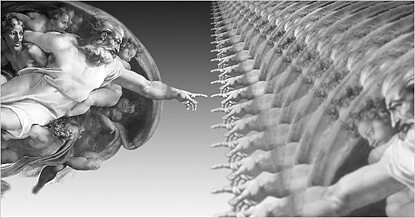

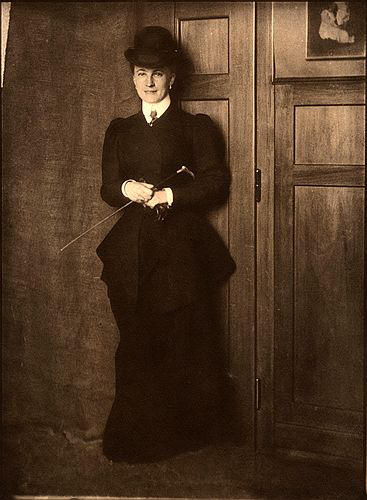
 HKuehnRidingOutfit
"Woman in riding costume," Heinrich Kuehn, All rights reserved

Austrian photographer Heidrich Kuehn was a friend of well-known American shooters Alfred Stieglitz and Edward Steichen around the turn of the last century. The three men visited each other and took pictures together in both the U.S. and Europe; Stieglitz and Kuehns also corresponded vociferously for over 30 years.
This trans-Atlantic artistic friendship is the basis of a new show, “Heidrich Kuehn and His American Circle: Stieglitz and Steichen,” at the Neue Galerie.  No doubt the concept serves as an excuse to pull in American audiences who know Stieglitz and Steichen, but it’s also a fascinating exercise in curatorial sleuthing.  As the show makes clear, ideas did flow freely among the men. We can literally see Kuehn’s bold romantic use of natural symbols like trees and clouds turn up in prints by Stieglitz and Steichen. At the same time the Modernist tendencies of the two New Yorkers start to appear in Kuehn’s painterly landscapes.
But what impresses most about this show is the sheer impact of its century-old prints. 
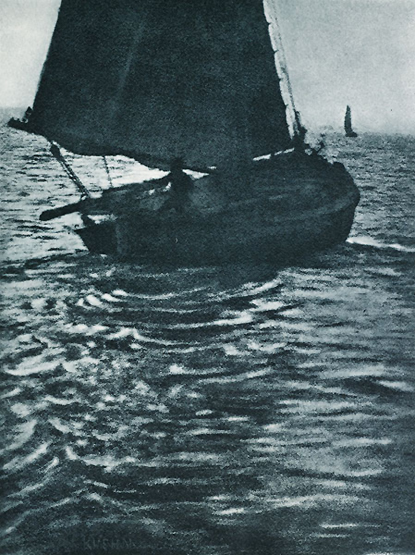
Kuehn_DieKunst_98_20
"Die Kunst," Heinrich Kuench, All rights reserved

In a back room the show’s curator Monika Faber has reconstructed an installation of Kuehn’s large-sized Pictorialist land- and seascapes that appeared in 1906 in Stieglitz’s Gallery 291. The approach is as insistent as any contemporary artist aiming to grab eyeballs. Strongly tinted in cyans, greens, brick reds and carroty oranges, the pictures seem to leap out of their frames. Hardly the faded stuff of ancient photo history, they are  brassy and bright as a new penny.
Later, Kuehn’s Stieglitz-inspired turn toward Modernist clarity also exhibits a freshness one rarely sees in large-format pictures before 1920. Abandoning the large prints, universal themes and impressionist effects of Pictorialism, Kuehn launched into Modernism by making intimate, psychologically–telling portraits of his family.
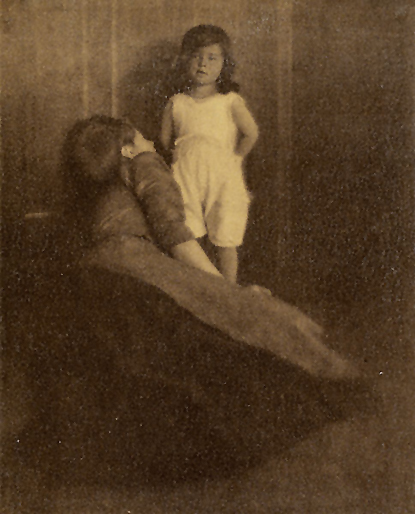
Kuehn_LotteMaryW_33_13
"Lotte and her nurse (Mary Warner)," Heinrich Kuehns, All rights reserved

A recent piece by Karen Rosenberg in the New York Times calls Kuehn “one of the medium’s great control freaks” and describes how, in making the family portraits, “…he selected a site and sketched it in pencil, had his children and their nanny assume specific poses in clothing he had preselected for its photogenic qualities, and waited until every shadow was right where he wanted it to be.”
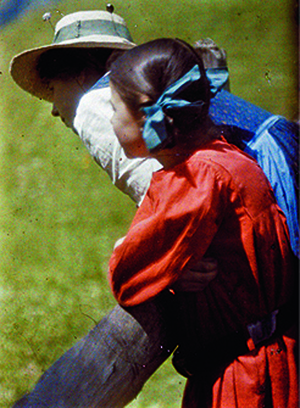
kuehnAutochrome300
"Autochrome," Heinrich Kuehn, All rights reserved

Yet Kuehn’s portraits in this show – even those in color, using the then-new Autochrome process -- seem remarkably unposed, warm and natural.  How could such a punctilious taskmaster produce such relaxed work?  The answer probably lies with the family’s young English nanny, Mary Warner, who had taken charge of Kuehn’s four children after his wife died. Photographed by Kuehn with his children, Warner seems a tender presence. When she reveals her face to the lens she is nothing short of radiant. 
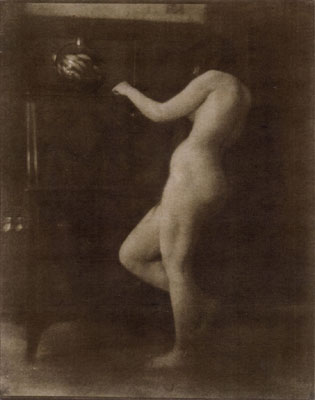
It comes as no surprise that, during this period, master and nanny were lovers. Later, as Kuehn’s companion, Warner posed for an erotically charged series of nudes, some of which are included in the show.
HKuehnNude
"Nude (Mary Warner)," Heinrich Kuehn, All rights reserved

After that, Kuehn’s story goes swiftly down hill. The First World War devastated his traditional world.  He lost his money and stopped reaching out to the great world beyond his Tyrolean hills. In the end – so the story goes – Kuehn became a crank and finally a recluse.
I wonder what happened to Mary Warner?

Tuesday, December 27, 2011

Simen Johan says "Hallo dahling"

"Hello, darling" -- photo by Simen Johan
"Untitled," Simen Johan, All rights reserved

Simen Johan
is a Swedish photographer, born in 1973. I saw his show, "Until the Kingdom Comes," last week at the Yossi Milo gallery in Manhattan. The prints started at $20,000 each.

Unfortunately, the show is now closed, but here's a link to all the pictures.

This is from Yossi Milo's press release:
"Photographs from Simen Johan’s ongoing project, Until the Kingdom Comes, depict an unsettling natural world hovering between reality, fantasy and nightmare. Johan merges traditional photographic and sculptural techniques with digital methods. Having originally photographed a variety of plants and animals in natural preserves, zoos, farms, museum dioramas or his own studio, the artist then resituates them digitally into new environments constructed from images photographed elsewhere."

And this is from an earlier write-up at the Robert Koch Gallery.
"In his most recent images, from the series "Until the Kingdom Comes", Johan depicts animals in scenarios where their actions or demeanor mirror human conventions. The images allude to our inclination to anthropomorphize and domesticate what we see and find around us, and they speak to realms of emotion, our fears and desires, rather than reason."

Monday, April 11, 2011

Visualizing (a tiny part of) the Universe

frLHuBlog
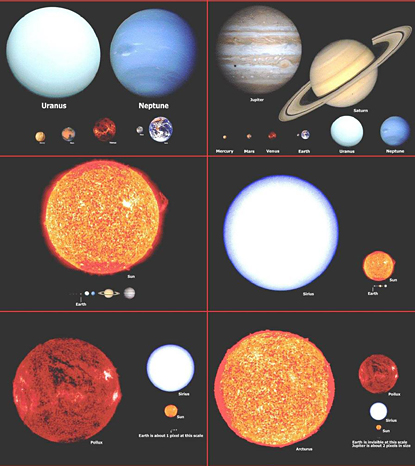
Courtesy "All That Is Interesting" from the PBH Network

Check out this fascinating sequential visualization of our Earth scaled against various objects in the near-universe. The final images in the post are from the Hubble telescope, which focused on an ink black area in the night sky for over 4 months to collect light that had spent 13 billion years reaching its lens.

Wednesday, December 15, 2010

Where is your mind?

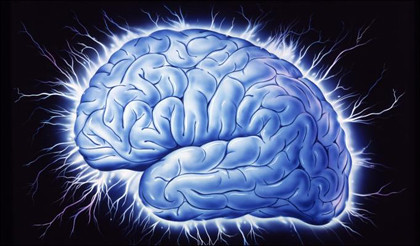
brain_420px

In this article the author asks, "Is it possible that... some of the activity that enables us to be the thinking, knowing, agents that we are occurs outside the brain?" Could, for example, "...iPhones, BlackBerrys, laptops and organizers ... sometimes be best seen as bio-external elements in an extended cognitive process: one that now criss-crosses the conventional boundaries of skin and skull?"

It's a fascinating argument. Read it at "Out of Our Brains" by Andy Clark. There's even a Pixie's video.

Sunday, November 21, 2010

i-Less in Gotham

Zuckerberg
"Mark Zuckerberg, born 1984," photo courtesy The New Yorker

After a recent series of interviews with Mark Zuckerberg, the co-founder of Facebook, Jose Antonio Vargas wrote: "Eventually, the company [Facebook] hopes that users will read articles, visit restaurants, and watch movies based on what their Facebook friends have recommended, not, say, based on a page that Google’s algorithm sends them to. Zuckerberg imagines Facebook as, eventually, a layer underneath almost every electronic device. You’ll turn on your TV, and you’ll see that fourteen of your Facebook friends are watching 'Entourage,' and that your parents taped '60 Minutes' for you. You’ll buy a brand-new phone, and you’ll just enter your credentials. All your friends—and perhaps directions to all the places you and they have visited recently—will be right there." ("Letter from Palo Alto," The New Yorker).


In Manhattan during my work day I watch other humans. Here's what I see. In public most of them seem mesmerized by small screens that they hold in their hands. They stare at these screens with unblinking attentiveness -- in the street, on the subway, in buses, on elevators, in restaurants, waiting on checkout lines, idling in cars, on benches, walking, hunched over in entryways, climbing stairs, peeing in urinals, windowshopping, pushing strollers, talking with friends, eating sandwiches... At every possible moment.

Occasionally my fellow humans move their thumbs. Sometimes they raise their screens to their ears & talk or listen (Aha! It's a phone!). You can tell by the wires going from their screens into their ears that they're listening to music or a podcast. If it's music, they sometimes close their eyes & bop to the beat. I like that. Occasionally, someone stops in mid stride & punches frantically with index & 2nd finger at his or her screen, then -- without looking up -- walks on.

A stranger to our culture would certainly conclude that something very important is happening here. I don't necessarily disagree. But why, if I'm witnessing something significant, does no one else even seem to notice? And why -- poor, sad isolato that I am -- do I not feel inclined to join in? Why do I not desire my own magic screen to keep me company all the way home?

Friday, October 15, 2010

Brooklyn Space Program shows how it's done

SpaceFlight

A giant step for all kind! Using an orange foam takeout container and a weather balloon, a Brooklyn group of grownups & kids sent an HD video camera 19 miles into the upper stratosphere. When the weather balloon burst, the camera (recording footage the whole time) plummeted back to earth at over 150 mph, landing only 30 miles from where it was launched.

See the video (6 min.) here.

More about the Brooklyn Space Program.

Sunday, September 12, 2010

Homo plasticus

Paris
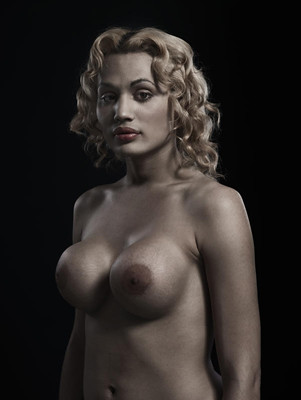
"Paris," Phillip Toledano, All rights reserved

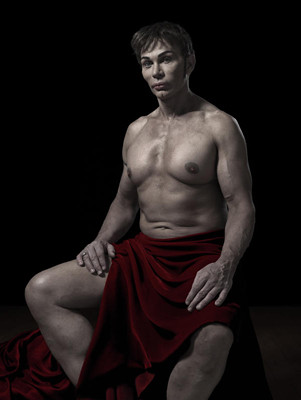
Though we might sometimes wish otherwise, most people go to photography shows for the subject matter. Thus, it's probably a safe bet that "A New Kind of Beauty" -- Phillip Toledano's nude and semi-nude portraits of men and women who have opted for extensive plastic surgery -- will draw big crowds at Brooklyn's Klompching Gallery. What's questionable is whether the gawkers will get what they came for.

Toledano works against his material's unmistakable tabloid tow, staging his subjects coolly in classical large-format studio-style & then toning them a homogenous golden brown against deep black. Still, the subjects' personal surgery choices -- for larger breasts, impervious to gravity; smooth, wide-cheek-boned faces; bigger, softer lips, & enlarged, sometimes slanted eyes -- seem designed mainly to enhance sexual animality. I'm guessing the subjects are sex workers (an earlier book by Toledano pictured phonesex workers). Would a wider cross-section of people who have volunteered for plastic-surgery reveal a different aesthetic?

Steve
"Steve," Phillip Toledano, All rights reserved

It's probably an answerable question. According to Wikipedia,"Nearly 12 million cosmetic procedures were performed [in the U.S.] in 2007, with the five most common surgeries being breast augmentation, liposuction, nasal surgery, eyelid surgery and abdominoplasty. The increased use of cosmetic procedures crosses racial and ethnic lines in the U.S., with increases seen among African-Americans and Hispanic Americans as well as Caucasian Americans. In Europe, the second largest market for cosmetic procedures, cosmetic surgery is a $2.2 billion business. Cosmetic surgery is now very common in countries such as the United Kingdom, France, and Germany. In Asia, cosmetic surgery has become an accepted practice; currently most widely prevalent and normal in South Korean society... "

Quoted in one of the press clips on Klompching's site, Toledano imagines the trend going much further : "We're looking at a new stage of human evolution," he says. "Twenty years ago, getting your tongue pierced or having a full arm tattoo was considered outrageous, but now they're commonplace, and perhaps the same thing will happen with plastic surgery ... Perhaps we could even say a new species of human is evolving, the Homo Plasticus. "

Tuesday, August 31, 2010

Goddesses with tennis rackets

29fs-tennis-filmstrip
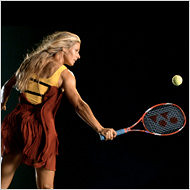
"Elena Dementieva," Dewey Hicks, NY Times Magazine, All rights reserved

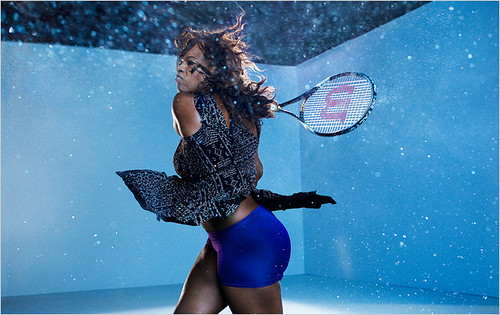
For the article, "How Power Has Transformed Women's Tennis, " in Sunday's NY Times Magazine, a special camera that makes over a thousand exposures a second was used to shoot top female tennis stars in action. The resulting animated videos are shockingly beautiful. I feel I am watching focused inexorable acts of will, performed by young women whose beauty is inseparable from the power they summon. This is hard to explain. Before I say any more, see the video for yourself:

These women seem to me goddesses the way the ancient Greeks conceived them. They are physically & emotionally conjoined to human women; formed from the same template -- but from finer, more perfect materials. Stronger, more beautiful, they are naturally above the mortal plane -- but not separate from it. As immortal goddesses they are somehow more intensely, vividly mortal than their human sisters.

Like their sisters, too, the goddesses have a touching vanity. Their long, beautiful hair is not tied back; it swirls around their faces. Their costumes are each a little different; the styles & colors are carefully chosen. They are jealous, competitive. It is perhaps an important source of their power. And they understand passion -- & vengeance. Look at their faces. Like Hera, the Queen of the Goddesses, they are not above turning a rival's long hair into snakes, or turning their husband's mistress into a cow, then driving her mad with biting flies.

29tennis-span-articleLargeSerenaWilliams
"Serena Williams," Dewey Nicks, NY Times Magazine, All rights reserved

Monday, August 9, 2010

We love our machines, so we tell stories about them

09oped-art-articleNYTimes
NY Times op-ed illustration by Ji Lee

We're all familiar with the well-worn science fiction trope: Humans build a vast network of powerful machines; the machines become sentient & take over the world. Software designer Jaron Lanier doesn't necessarily believe this story, but he thinks it's important. In a recent NY Times op-ed, "The First Church of Robotics," Lanier argues that this machine-mind creation myth is fast gaining currency in our culture as a real -- not sci fi -- near-future event. At the well-heeled & well-connected Singularity University, for example, many of Silicon Valley's technological elite expect that "one day... the Internet will suddenly coalesce into a super-intelligent A.I. (Artificial Intelligence), infinitely smarter than any of us individually and all of us combined." In fact "...these are guiding principles, not just amusements, for many of the most influential technologists," Lanier reports.

Crazy? Who knows. Meanwhile, let's talk about the present. For good or ill, A.I. is seen right now as a new kind of god. I think the idea thrills us. Even if our new god turns out to be cruel (witness the recent explosion of literary & cinematic dystopias), we are ready. Perhaps we welcome AI because we can't help loving our own intelligence. Encoded within the AI, our small isolated stores of knowledge -- our data -- may become part of something much greater. The AI needs us. Thus, the master machines share our humanity & give us immortality.

"What we are seeing is a new religion , expressed through an engineering culture," says Lanier.

What's interesting is that Lanier makes this provocative point as an unreconstructed engineer & Silicon Valley insider. When he says that IBM -- which recently unveiled a question-answering computer designed to play the TV game show 'Jeopardy' -- could have "...dispensed with the theatrics [and] declared it had done Google one better and come up with a new phrase-based search engine," he clearly knows what he's talking about.

Not that we don't all understand why IBM listened to its ad people. Just a search engine? How boring. Why not a talking machine, a smart robot, something like a ... person? Think R2D2. Think WALL-E. Let's face it, there's something irresistible about those little mannikins. Even their old neurotic granddad, HAL, felt like part of the family. What's not to like?

Lanier warns that our identification with our technology is "allowing artificial intelligence to reshape our concept of personhood... we think of people more & more as computers, just as we think of computers as people...The very idea of A.I. gives us the cover to avoid accountability by pretending that machines can take on more and more human responsibility," Lanier says.

What a bummer this guy is! He's no fun at all. But, hold on, his suggestions of what to do about the fatal attraction of man & machine aren't really radical. For example, listen to his comment about the recommendation software on Netflix or Pandora: "Seeing movies or listening to music suggested to us by algorithims is relatively harmless, I suppose. But I hope that once in a while the users of those services resist the recommendations; our exposure to art shouldn't be hemmed in by an algorithim that we merely want to believe predicts our tastes accurately. These algorithims do not represent emotion or meaning, only statistics & correlations."

Spoken like an engineer. Factual. Unembellished. This is the way Lanier thinks we should look at our technology. What he's warning against is the way artists (& clergy) -- who typically know next to nothing technically -- look at it. They make up stories, invent metaphors, assign meanings. It's not very likely, after all, that a true scientist will fall in love with his iPhone. He may find it useful; he may admire it. But he is not likely to adore a mere tool. It's the artist who is smitten, who praises his iPhone every day, who thanks it for its loyalty & brilliance, who regards it as his secretary, amanuensis, his dear little friend.

"Technology is essentially a form of service," Lanier counters. "We work to make the world better. Our inventions can ease burdens, reduce poverty & suffering, and sometimes even bring new forms of beauty into the world. We can give people more options to act morally because people with medicine, housing and agriculture can more easily afford to be kind than those who are cold, sick and starving... But civility, human improvement, these are still choices. That's why scientists & engineers should present technology in ways that don't confound those choices."

And finally: "When we think of computers as inert, passive tools instead of people, we are rewarded with a clearer, less ideological view of what is going on -- with the machines and with ourselves."