As a photography student at Kunstakademie Düsseldorf in the 1970s, Thomas Struth learned to create
big, highly detailed pictures with his classmates – now photographic luminaries
-- Andreas Gursky, Thomas Ruff and Candida Hofer. At the time their teachers, the
legendary husband-wife team, Bernd
and Hilla Becher, taught a
technically rigorous system to “objectively” document disappearing German architecture.
According
to the Becher system, subjects must be captured serially with a large-format camera using black-and-white
film under a cloudless sky. All subjects must be shot from uniform distances
and heights, printed with medium contrast at a prescribed size and shown
together to facilitate comparison.
In his current show at the Met we see Struth’s homage to
this exacting style -- a wall-sized grid of black-and-white prints showing
well-known New York City intersections in 1978. Older New Yorkers may treasure or
rue these pictures as memories, but the more salient point is that, soon enough,
nobody will be alive to remember them. Still, there is much to admire in the
way the pictures treat, not only the streets and buildings , but everything -- every
parked car, overloaded trash can and
random walking-through-the-shot human -- with exactly the same crisp, non-judgmental
clarity.

"Crosby Street, Soho, 1978," Thomas Struth, All rights reserved
This is Struth’s first major project. Afterward, his career moves on fast. Without abandoning the discipline and technique he has acquired from the Bechers, he begins to take on large ideas and issues. It is his willingness to do so that animates this show.


"Crosby Street, Soho, 1978," Thomas Struth, All rights reserved
This is Struth’s first major project. Afterward, his career moves on fast. Without abandoning the discipline and technique he has acquired from the Bechers, he begins to take on large ideas and issues. It is his willingness to do so that animates this show.
In the 80s Struth continues to shoot architecture and
landscapes. Like his schoolmate Gursky, he takes up
color and begins to use photoshop to assemble from multiple viewpoints single
images of large locations and structures. But, unlike Gursky, who over the years
steadily creates more and more gigantic prints of larger and larger events,
(the Chicago Board of Trade, the Olympics) Struth’s big pictures seem uninterested in spectacle. Gursky
wins worldwide acclaim by moving farther and farther away from what he
photographs. Struth moves closer. His pictures, though still large and complex,
become more and more about the people present or implied within the frame. They radiate emotion that can be felt
by anyone.
These qualities
are best seen in the pictures the Met has collected from Struth’s three ongoing
series – roughly titled, “Museum,” “Paradise” and “Technology.”
Struth’s “Museum”
series comes from a simple idea. He photographs people looking at art and
history in museums all over the world. Strictly realistic, rendered in
sumptuous colors, these large, calm compositions at times resemble the Old
Master paintings that appear in many of the prints. Yet the unrehearsed modern tourist
crowds are always there too. Some museum-goers are reverent. Some are playing
with their iphones and thinking about their lunch. They bring a here-and-now immediacy to pictures meant
to last.
"Art Institute of Chicago,1990," Thomas Struth, All rights reserved
"Museo Del Prado 7, 2005," Thomas Struth, All rights reserved
The balance
between large ideas – the present and the past, the material and the spiritual,
for example – makes me wonder if Struth is aiming for the cusp between them? Or
do his museum pictures – like many of the old religion-based paintings depicted
within them –incline toward moral lessons? If so, the messages are hard to
recognize, extremely subtle. Yet the question continues to rise.
Asked about the
Museum series, Struth said “… the ineffable spills into the ordinary and the
spiritual aspirations of our ancestors intersect with the needs of the
present.” It’s clear that with these works Struth is gesturing toward something
beyond their quotidian content. In fact – like every artist -- he is imbuing
lifeless materials with human energy. Where does that energy come from?
We get to decide
for ourselves.
One thing I think
we know. In the Museum series the
goal of this energy is no longer the same as it is in the old paintings. Unlike
the paintings, the energy of the photographs is not directed at individual salvation.
We might think of its heaven as
salvation for all.
"Art Restorers at San Lorenzo Maggiore, Naples, Italy, 1988," Thomas Struth

"Paradise 13," Thomas Struth
I think this
becomes clear in Struth’s Paradise series. Photographed at ground level in
various rainforests in Japan, Australia and South America, all the images in
the series are called “paradise” and numbered. Only one, “Paradise 13, Yakushima, Japan 1999,” is included
in the show. Yet, from this
picture and others I have seen elsewhere, “paradise” seems a very odd title for
Struth to have chosen.
“Paradise 13,” for example, is shot deep inside a low, wet, dark forest strewn with fallen trees and moss-covered boulders. It is certainly no Eden. Struth is well-known as an ardent environmentalist, and it’s hard to imagine him resorting to cheap irony. Some of the other forest “interiors” in this series are tangles of dazzling green, flooded with transforming light. They are beautiful to look at and, as we know, vital to the health of our planet. But – come to think of it – real rainforests are always unrestrained riots of hungry competitive life. They are always difficult for humans. Struth is making a difficult point. Our human instinct is to transform them to meet our needs. But the Earth too needs salvation.
“Paradise 13,” for example, is shot deep inside a low, wet, dark forest strewn with fallen trees and moss-covered boulders. It is certainly no Eden. Struth is well-known as an ardent environmentalist, and it’s hard to imagine him resorting to cheap irony. Some of the other forest “interiors” in this series are tangles of dazzling green, flooded with transforming light. They are beautiful to look at and, as we know, vital to the health of our planet. But – come to think of it – real rainforests are always unrestrained riots of hungry competitive life. They are always difficult for humans. Struth is making a difficult point. Our human instinct is to transform them to meet our needs. But the Earth too needs salvation.
"Paradise 13," Thomas Struth
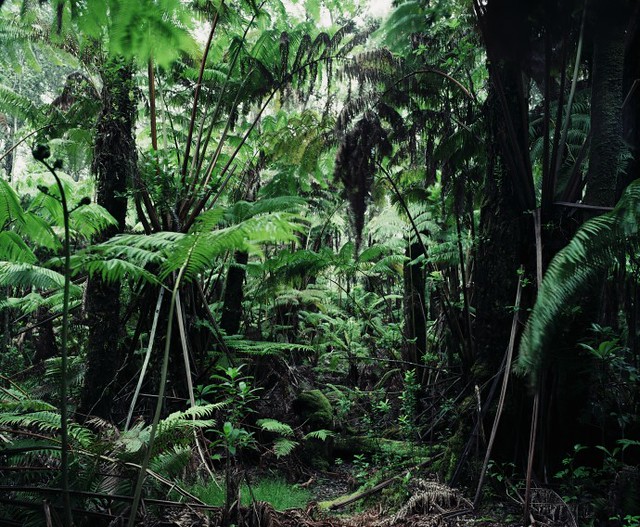
"Paradise 9," Thomas Struth, All rights reserved
With the
“Technology” series, Struth asks: Does the human genius for technology threaten
our species? Does technology also offer hope? These too are ultimately
spiritual questions.
Struth’s “Hot Rolling Mill, Thysen Krupp
Steel, Duisburg, 2010,” takes us into the silent interior of a gigantic
industrial machine. By choosing an old German steel mill and associating it
with the name Krupp, Struth is deliberately evoking Hitler’s Third Reich and the
murderous weapons with which Germany came close to conquering the world. And the
picture itself -- a vast brutal wall of machinery in semi-darkness,
grime-encrusted, its khaki greens punctuated with the faded, reds and oranges of
catwalks and cables -- is indeed terrifying. Even worse, a thick chain is
bolted to the steel-plate floor in the only area lit by a window. It took bravery to make this picture. Struth
knows exactly what he is alluding to.
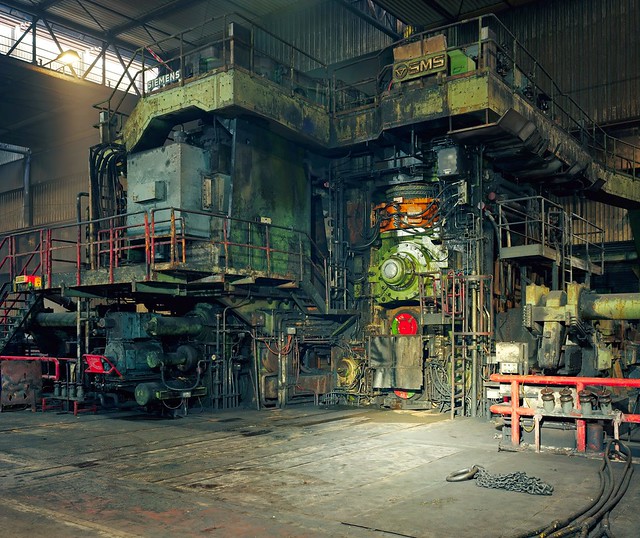
"Hot Rolling Mill, Thysen Krupp Steel, Duisburg, 2010," Thomas Struth
If “Hot Rolling
Mill” balances past and present, the most astonishing picture in the Technology
series presents itself literally as a fulcrum between present and future. Called “Figure 2, Charite, 2013,”
the picture shows a woman strapped to a medical gurney suspended in mid air. Looping
in from piled machines and monitors are dozens of wires, tubes and cables, all
of which attach to her body. At first, we recoil from the image. It seems to be
a Frankenstein-like experiment or perhaps some hideous torture. Then we notice
that the room is spotless, the light is clear and the woman is young and blonde
with beautiful skin. We are
confused. What are we looking at?
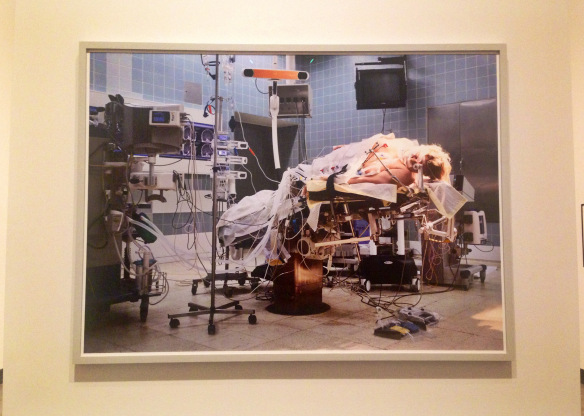
"Figure 2, Charite, 2013," Thomas Struth, All rights reserved
"Figure 2, Charite, 2013," Thomas Struth, All rights reserved
It’s an operating
theater in Berlin, where this anaesthesized young woman is about to undergo surgery
to remove a brain tumor. With the woman’s full permission, Struth has
photographed the moment before the doctors and nurses enter to begin. We learn
in a caption that the woman survived and, two years, later is living
comfortably. Still, we wouldn’t know that if we hadn’t been told. Is Struth
intentionally frightening us with scary technology that is actually built and
used to save lives?
I don’t think so.
I think he is making full use of his freedom to challenge us. Some things that at first seem
repellent are beautiful. Struth’s mentors, the Bechers, photographed water
towers, silos and blast furnaces they judged beautiful – and safe to photograph
– in a defeated, divided Germany after a vicious war. Now, more than a half century later, Struth again finds
beauty in our still dangerous and increasingly complicated – but perhaps freer – world.
He makes big pictures for the world.
This review appears in The New York Photo Review